India defends right to buy Russian arms on US trip
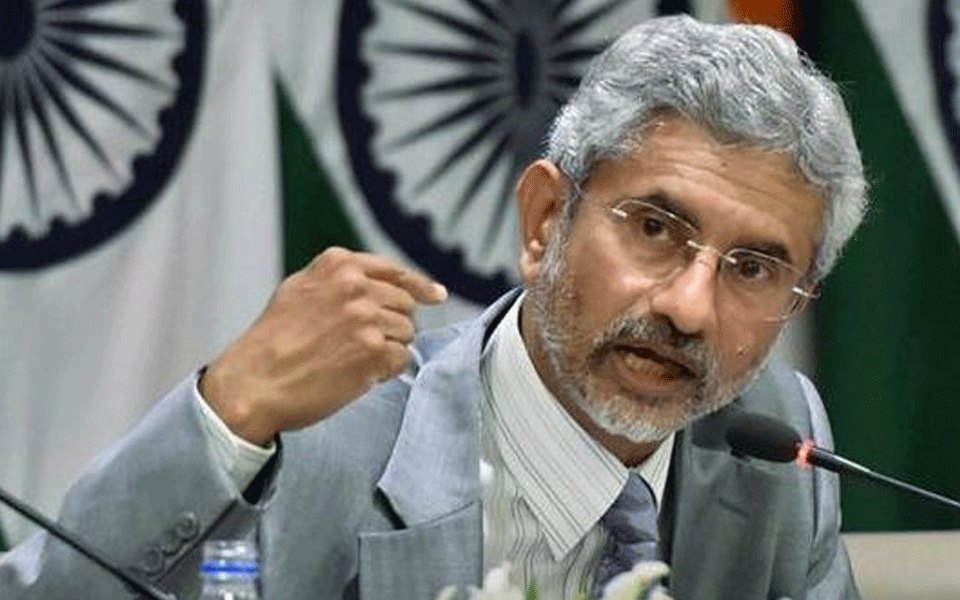
Washington: India's foreign minister on Monday defended his country's right to buy a missile defense system from Russia despite the threat of sanctions from the United States.
On a visit to Washington, Foreign Minister S. Jaishankar said India was discussing the US concerns but declined to forecast the ultimate decision on the fate of the S-400 purchase from Russia.
"We have always maintained that what we buy -- the sourcing of military equipment -- is very much a sovereign right," he told reporters ahead of a meeting with Secretary of State Mike Pompeo.
"We would not like any state to tell us what to buy or not to buy from Russia any more than we would like any state to tell us to buy or not buy from America," he said.
"That freedom of choice is ours and we think it's in everybody's interest to recognize that," he said.
India, a Cold War ally of the Soviet Union, last year agreed to buy five S-400 systems for 5.2 billion, and Russia has said that delivery is on track.
Under a 2017 law, the United States imposes sanctions against countries over "major" arms purchases from Russia due to Moscow's military involvement in Ukraine and Syria and alleged meddling in US elections.
Turkey, a NATO ally, in June angered the United States by also going ahead with an S-400 purchase.
President Donald Trump responded by ending Turkey's involvement in the F-35 fighter jet program but has yet to announce other sanctions.
Jaishankar hailed warm relations overall with the United States but underlined India's differences with Trump's hawkish stance on Iran.
The United States has threatened sanctions to force all countries to stop buying oil from Iran as it seeks to curb the clerical regime's influence in the Middle East.
In May, the Trump administration ended waivers for countries including India, formerly a leading customer for Iranian oil "We view Iran from the east, and from the east Iran has been a very stable, status quo power," Jaishankar said.
For India, "we've been repeatedly assured that the affordable and predictable access to energy will not change," he said, declining to comment further on discussions on Iran.
India has been teaming up to expand Iran's Chabahar port, a way to ensure a supply route to Afghanistan that bypasses Pakistan, New Delhi's rival and historic ally of the Taliban.
Let the Truth be known. If you read VB and like VB, please be a VB Supporter and Help us deliver the Truth to one and all.
Karnataka launches state-led Centre of Excellence for Space Technology in Bengaluru
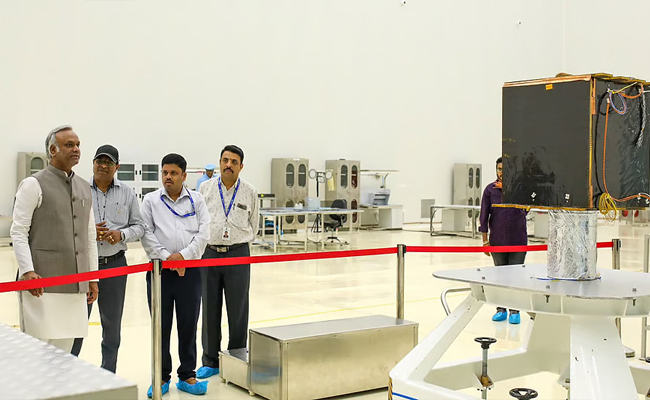
Bengaluru (PTI): In a significant boost to India’s rapidly expanding space economy, the Karnataka government on Friday launched the country’s first state-led Centre of Excellence for Space Technology here, officials said.
The initiative is aimed at strengthening India’s capabilities to translate space innovation into scalable commercial outcomes, they said.
The Centre, established by the Government of Karnataka through the Karnataka Innovation and Technology Society in collaboration with SIA (Satcom Industry Association India) -India, was inaugurated by Minister for Electronics, IT/BT, and Rural Development and Panchayat Raj, Priyank Kharge, in the presence of senior officials and industry leaders, officials said.
Speaking at the launch, Minister Kharge said that Karnataka has consistently been at the forefront of India's technology and innovation journey. With the launch of this Centre of Excellence for Space Technology, we are extending that leadership into one of the most strategic sectors of the future.
"Our focus is not just on advancing research, but on creating an ecosystem where innovation can translate into real-world applications, economic growth, and high-quality jobs. This Centre will play a critical role in positioning Karnataka as a key driver of India's space economy," he said.
According to an official statement, the CoE SpaceTech Foundation has been established under a Memorandum of Agreement between KITS and SIA-India to drive research and innovation in space technologies, industry-aligned training, startup incubation and cross-sector applications, it said.
The Centre has also formalised strategic MoUs with multiple industry and academic partners to support research in space biotech and microgravity, enable collaboration, build talent pipelines, and provide startups with training and market access, it added.