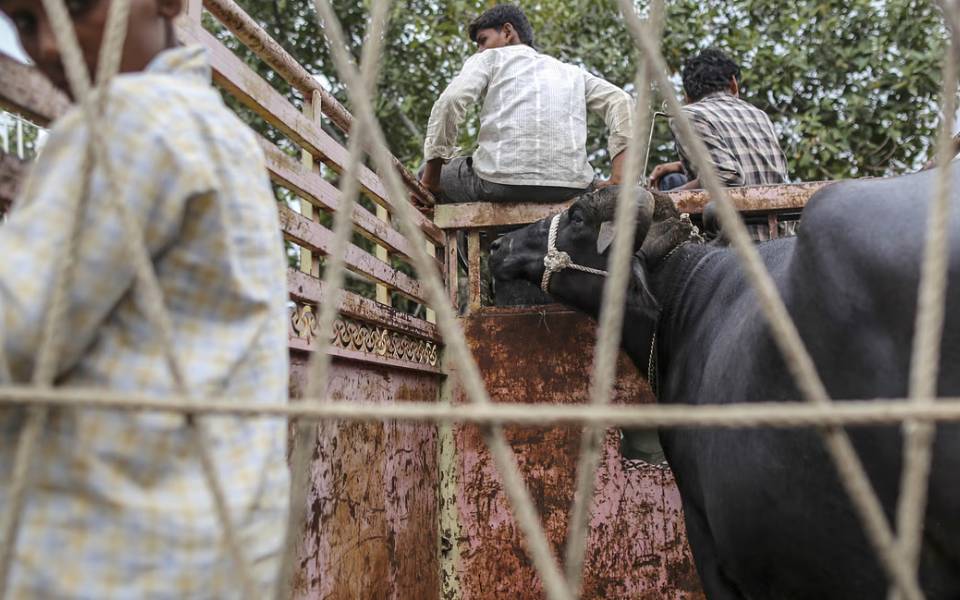
India emerges as second largest beef exporter in the world
New Delhi: An investigation conducted by the environmental and human rights group Global Witness, and first reported by the BBC, has implicated three of the world's leading meat producers—JBS, Minerva, and Marfrig—in illegal deforestation in Brazil's Cerrado plains. The companies, however, deny any wrongdoing. The inquiry, which focused on the state of Mato Grosso within the expansive Cerrado region, revealed that much of the deforested land for ranching owned by the three entities lacked the necessary permits, suggesting illegal activities.
This revelation comes amid the approaching deadline for companies to comply with the European Union's (EU) new regulation, the EU Deforestation Regulation (EUDR). The law, effective December 30, 2024 (June 30, 2025, for micro or small businesses), requires companies selling goods to the EU to prove that their produce was not grown on land deforested after 2020, under the threat of substantial fines. Critics argue that this legislation may disproportionately impact smallholder farmers who lack the resources to provide the required data, potentially disrupting crucial revenue streams.
Products such as beef, coffee, palm oil, and soy will be among those affected by the EUDR. However, campaigners from Global Witness contend that the law falls short as it does not fully encompass the Cerrado plains, unlike the Amazon.
As of 2023, Brazil holds the position of the largest beef exporter globally, according to data from the US Department of Agriculture. Predictions from April 2023 anticipated Brazil's beef exports to surpass 3 million tons that year. Other significant players in beef exports in 2023 included India (water buffalo meat), the United States, and Australia. However, when considering countries with the highest beef production, the order differs, with the US leading due to a substantial portion of its beef being consumed domestically.

Let the Truth be known. If you read VB and like VB, please be a VB Supporter and Help us deliver the Truth to one and all.
Web designer selling Diljit Dosanjh's concert tickets on fake Zomato website arrested

Gurugram (PTI): Gurugram police have arrested a web designer, accused of selling tickets for Punjabi singer Diljit Dosanjh's concert on a fake Zomato website in a 2024 case, police said on Wednesday.
Police said they arrested the two accused in the case, Nitin and Vishnu, earlier and have since been searching for the designer who was on the run.
According to police, Zomato filed a complaint on September 17, 2024, with the Cyber Police Station South, alleging that fraudsters created a fake website and Instagram page resembling Zomato's and were illegally selling tickets to Diljit's concert.
Zomato was the official ticketing partner for the concert.
The company said the fraud resulted in losses for both the company and fans.
Police arrested the third accused on Tuesday, identified as Priyanshu Kushwah (22), a resident of Udham Singh Nagar, Uttarakhand. He completed his BCA from Ghaziabad in 2024 and was currently working as a freelance website designer in Dehradun, police said.
"During interrogation, the accused confessed that he created the fake website at the behest of his friend Nitin, for which he received only Rs 5,000. We are questioning the accused," said the Gurugram police spokesperson. COR