India-EU announce mega FTA; PM Modi calls it New Delhi's biggest trade deal ever
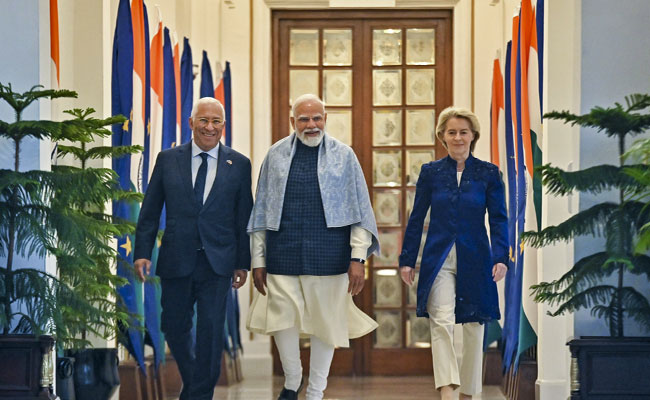
New Delhi (PTI): India and Europe on Tuesday announced sealing of an ambitious free trade agreement -- billed as "mother of all deals" -- that came against the backdrop of a fractious global environment and trade disruptions largely caused by Washington's policy on tariff.
Today, India has concluded the biggest free trade agreement (FTA) in its history with the European Union, Prime Minister Narendra Modi said after holding summit talks with the 27-nation bloc's top leaders Ursula von der Leyen and Antonio Costa.
"This is not just a trade agreement. This is a new blueprint for shared prosperity," Modi said in his media statement.
The two sides also inked a strategic defence partnership pact and a mobility agreement.
The prime minister said India-EU partnership will help the world.
European Council President Costa said India and the EU began a "new chapter" in their relations in sectors such trade, security, and on people-to-people ties.
"Trade agreements reinforce a rules-based economic order and promote shared prosperity. That's why today's free trade agreement is of historic importance. It is one of the most ambitious agreements ever concluded," he said.
"We delivered the mother of all deals," Von der Leyen said.
The long-awaited FTA is set to significantly expand the overall trajectory of two-way engagement as it will open up new opportunity for cooperation in diverse areas.
The EU and India had first launched negotiations for the FTA in 2007, before the talks were suspended in 2013 due to a gap in ambition. The negotiations were relaunched in June 2022.
The EU, as a bloc, is India's largest trading partner in goods.
For the financial year 2024-25, India's total trade in goods with the EU was worth about USD 136 billion, with exports around USD 76 billion and imports at USD 60 billion.
The broad focus of the summit was on trade, defence and security, climate change, critical technologies and strengthening the rules-based global order.
India and the European Union have been strategic partners since 2004.
The proposed Security and Defence Partnership (SDP) will facilitate deeper defence and security cooperation between the two sides.
Let the Truth be known. If you read VB and like VB, please be a VB Supporter and Help us deliver the Truth to one and all.
Navy ensures security of Indian commercial ships, oil tankers: Defence Minister Rajnath Singh
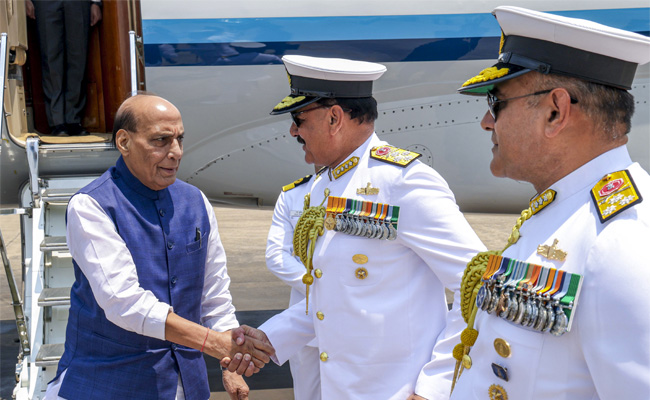
Visakhapatnam (PTI): Pointing out that 95 per cent of the country’s trade, including energy supplies, is conducted through sea, Defence Minister Rajnath Singh on Friday noted the Indian Navy's indispensable role in securing commercial shipping lanes and oil tankers against emerging maritime threats.
Speaking at the commissioning ceremony of INS Taragiri here, the Defence Minister said the Indian Navy continuously maintains its presence in the Indian Ocean--whether it is the Persian Gulf or the Malacca Strait.
Singh’s comments assume significance following the disruption of oil supplies and blockage of oil tankers in view of the prevailing situation in West Asia.
According to him, a strong and capable navy is not an option for the country, but a necessity.
“There are many sensitive points in the sea where our Navy has continuously made its active presence to ensure the smooth supply of goods. Whenever there is a situation of tension there, the Indian Navy has ensured the security of our commercial ships and oil tankers,” he said.
The Indian Navy has proven that it is not only capable of protecting the interests of the country, but if necessary, can also take every step to ensure the safety of its citizens and trade routes around the world, he added.
Citing history, he said without strengthening the naval power, no country can be considered powerful in the right sense and therefore, when Prime Minister Narendra Modi talks about Viksit Bharat by 2047, the basis of marine power becomes very important.