India for permanently removing Jammu and Kashmir issue under 'outdated agenda item' from UNSC
United Nations: India at the UN has called for permanently removing the issue of Jammu and Kashmir under the outdated agenda item of the India-Pakistan question' from the Security Council's agenda, saying such "irrational exuberance" has no takers in a dignified world.
In a veiled attack on Pakistan, India said that there is a delegation that repeatedly attempts to rebrand itself as contributing to international peace but unfortunately fails to recognise that it is globally known for being the fountainhead of international terror and the hub for terror syndicates.
During a virtual informal meeting of the plenary on the annual report of the Security Council, Pakistan's UN envoy Munir Akram had raked up the issue of Jammu and Kashmir and said that the Security Council has also been found lacking in implementing its own resolutions and decisions on the situation in Jammu and Kashmir.
He added that the Council has met thrice during the last one year to consider the situation in Jammu and Kashmir.
India, without naming Pakistan, said in a statement on Monday that there is a delegation that repeatedly attempts to rebrand itself as contributing to international peace, but unfortunately fails to recognise that it is globally known for being the fountainhead of international terror and the hub for terror syndicates.
This delegation keeps pushing for discussions on an outdated agenda item in the Council, which for all matter needs to be removed from the Council's agenda permanently. Such irrational exuberance has no takers in a dignified world, India said on the Report of the Security Council for 2019'.
An August 3, 2020 summary statement by the Secretary-General of "matters of which the Security Council is seized listed The India-Pakistan question' among those items that have not been considered by the Council at a formal meeting during the period from January 1, 2017 to August 1, 2020.
The agenda item India-Pakistan question' was first taken up by the Council at a formal meeting on January 6, 1948 and was last considered on November 5, 1965.
Pakistan, backed by its all-weather ally' China, has been repeatedly seeking to have a discussion on the issue of Jammu and Kashmir in the Security Council.
The Council had held closed consultations on the issue of Jammu and Kashmir on August 16 last year after China asked for the "closed consultations" to discuss the matter. That meeting had ended without any outcome.
In January this year, China, on behalf of Pakistan, had again made an attempt to raise the Kashmir issue under "other matters" during closed consultations in the Security Council Consultations Room. Then too, China stood alone in the Pakistani corner to get the Security Council to focus on the Kashmir issue.
Last month, as India marked the first anniversary of ending the special status to Jammu and Kashmir and its bifurcation into two union territories -- Jammu and Kashmir and Ladakh, Beijing again called for a discussion on the issue of Jammu and Kashmir in the Security Council under 'Any Other Business'.
All these meetings ended without any outcome, as many other members of the Security Council have underlined that Jammu and Kashmir is a bilateral matter between India and Pakistan.
India's Permanent Representative to the UN Ambassador T S Tirumurti had told PTI that contrary to what Pakistan may claim, Islamabad has not been successful in trying to put Jammu and Kashmir on the UN agenda.
Frankly, the attempt by Pakistan to try and internationalise, what is a bilateral issue, is nothing new, he had said.
Tirumurti had pointed out that contrary to what the Foreign Minister of Pakistan Shah Mehmood Qureshi asserted, there has been no formal meeting of the Security Council on the India-Pakistan issue even once for the past 55 years, let alone three times!
Pakistan, backed by China, has only been able to bring up the issue of Jammu and Kashmir informally and in closed door meetings under what is called Any Other Business', a category where literally any item can be brought for discussion by anyone. These meetings have no records and there is no outcome.
Tirumurti had pointed out that even UN Secretary-General Antonio Guterres, in his statement last August, clearly referred to the 1972 bilateral Simla Agreement.
Consequently, Pakistan has been singularly unsuccessful in making any inroads into the UN on Jammu and Kashmir. That is the reality, Tirumurti had said.
Let the Truth be known. If you read VB and like VB, please be a VB Supporter and Help us deliver the Truth to one and all.
Bhojshala complex registered as 'mosque' in old revenue records: Muslim side to MP HC
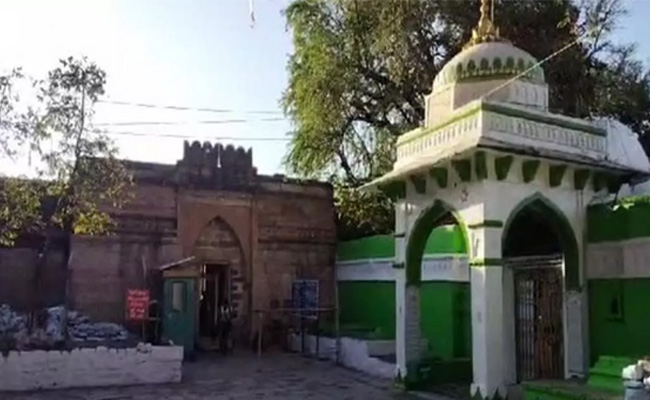
Indore (PTI): The disputed Bhojshala Temple-Kamal Maula Mosque complex has historically been registered as a 'mosque' in revenue records and available sources don't clearly mention any Saraswati temple established by then-king Raja Bhoj, the Muslim side has told the Madhya Pradesh High Court.
The Hindu community considers Bhojshala a temple dedicated to Goddess Saraswati, while the Muslim side calls the 11th-century monument Kamal Maula Mosque. The disputed complex located in Dhar district is protected by the Archaeological Survey of India (ASI).
During the hearing before the HC's Indore bench of Justices Vijay Kumar Shukla and Justice Alok Awasthi on Wednesday, Qazi Moinuddin questioned two PILs filed as intervenors in the Bhojshala case by an organisation named Hindu Front for Justice, one Kuldeep Tiwari and another individual.
Moinuddin claims to be a descendant of Sufi saint Maulana Kamaluddin Chishti and the 'Sajjadanashin' (spiritual head, guru, or successor of a Sufi shrine, khanqah, or religious site).
The PILs state that Bhojshala is actually a Saraswati temple and only Hindus should be granted the right to worship at the disputed complex.
Moinuddin's lawyer, Noor Ahmed Sheikh, claimed in the court that his client's ancestors, who are descendants of Maulana Kamaluddin Chishti, have historically held titles to the complex, and the site was also recorded as a "mosque" in government revenue records.
He contended that those associated with the management of the Kamal Maula Mosque, located within the complex, have been in "continuous and peaceful occupation" of the site for a long time.
Citing Muslim law, Sheikh argued that in the case of religious property, particularly a mosque or its related properties, officials such as the Sajjadanashin and Mutawalli (person entrusted with management, maintenance, and administration of a Waqf), and their descendants, not only have the right to intervene, but also have the right to manage and use such a structure.
Citing provisions of the Ancient Monuments Preservation Act 1904, the Muslim side's lawyer said the term "in-charge of the property" is used in this law, which makes it clear that the person or party who has been in charge of a property for a long time has rights over it.
During the hearing, Touseef Warsi, the lawyer representing the Maulana Kamaluddin Welfare Society of Dhar, claimed that Hindu parties in both PILs had made "misleading representations" regarding historical facts before the high court.
He further claimed that available historical sources do not clearly mention the existence of a Saraswati temple established by Raja Bhoj, the legendary king of the Parmar dynasty who ruled Dhar from 1010 to 1055.
The ASI, a central government agency, has adopted three different positions in the lawsuits filed regarding the Bhojshala dispute, changing its answers from time to time, and this situation raises serious questions about judicial scrutiny of the complex, Warsi submitted.
He raised objections regarding the ASI's process of scientific survey of the Bhojshala complex, carried out on the HC order in 2024, and the method of videography and requested the court to examine these objections.
The hearing in the Bhojshala case will continue on Thursday.
The HC has been regularly hearing four petitions and one writ appeal since April 6, contesting the religious nature of the monument.