India has always been Hindu Rashtra, no need to establish one: RSS leader Hosabale
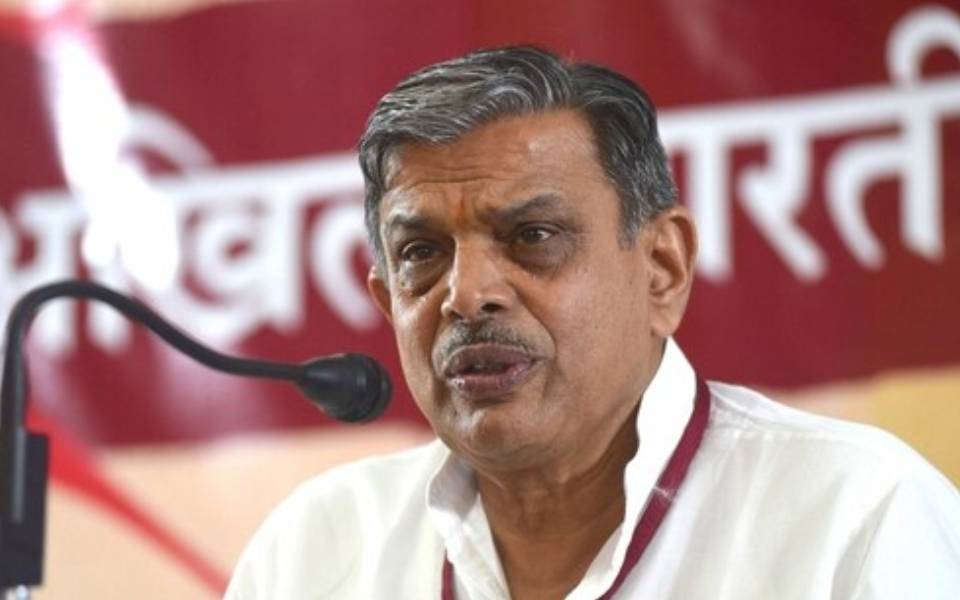
Bhuj, Nov 7: Rashtriya Swayamsevak Sangh (RSS) general secretary Dattatreya Hosabale on Tuesday said the organisation believes that there is no need to turn India into a `Hindu Rashtra' or Hindu nation because the country has always been one.
The senior RSS leader was speaking to the media at Bhuj in Gujarat's Kutch district on the last day of the Sangh's three-day All India Executive Board meeting.
"India is already a Hindu Rashtra and it will remain so in the future too. Dr Hedgewar (founder of RSS) had once said that as long as there is a Hindu in this country, this country is a Hindu nation. The Constitution talks about a state system, which is different. As a nation, India was, India is and India will remain a Hindu Rashtra," Hosabale said.
He was replying to the question "when will India become a Hindu nation."
Caring about the country's unity and spending some time for the betterment of society is `Hindutva', Hosabale said.
"The RSS does the work of making the people realize that India is a Hindu Rashtra. Thus, there is no need to establish a Hindu Rashtra because India is already one. That is what the RSS believes," he said.
One of the main challenges before the country is a conspiracy to divide it on the `north versus south' lines, the RSS general secretary claimed.
"Some people are now saying that south India is different from north India. A conspiracy is being hatched at the political and intellectual level to cut the south (from the rest of India), claiming that they are Dravidians and their language is also different. This is a tactic to weaken the country. People must come forward to oppose it and make sure that such people do not succeed," he said.
Further, "cultural marxism and wokeism", as mentioned by RSS chief Mohan Bhagwat in his Vijayadashami speech last month, was another challenge before the country, Hosabale said.
Ahead of the inauguration of the Ram temple at Ayodhya on January 22, RSS workers will embark on a nation-wide door-to-door campaign between January 1 to 15 to extend invitation to the country's people for the grand opening of the temple, he said.
Another issue discussed at the RSS meeting here was the migration of Hindus from border villages, including villages in the Kutch district which shares a border with Pakistan, he said.
"We discussed the development and security of border villages. People are migrating elsewhere due to lack of facilities from these villages. Religious conversions are also taking place there. We are addressing these issues. Presence of patriotic citizens near the border is crucial for the safety and security of the country," he said.
On `love Jihad', the RSS leader said the issue had two aspects -- making people aware of it and fighting legal cases. The RSS is also working on rehabilitation of the women who freed themselves from such relationships but were not accepted by their families, he said.
Right-wing Hindu organisations use the term `love Jihad' to claim that there is a conspiracy to convert Hindu women to Islam through inter-faith marriages.
During the RSS meeting, invited members reviewed the progress of the outfit's expansion plans, as the Sangh has set itself a target of opening 'shakhas' (branches) in all 59,060 'mandals' of the country ahead of its centenary celebrations in 2025. At present, the RSS has more than 95,000 shakhas in nearly 38,000 mandals, Hosabale said.
Bhagwat and other senior leaders of the Sangh were present when the meeting began on November 5. According to Hosabale, 357 RSS leaders from across the country took part in the meeting.
Let the Truth be known. If you read VB and like VB, please be a VB Supporter and Help us deliver the Truth to one and all.
Online fraud: Hotel chef from Udupi cheated of over Rs 1 lakh by WhatsApp contact

Udupi: Udupi City Police have registered a case of online fraud after a 62-year-old hotel chef was allegedly cheated of Rs 1.13 lakh by a woman who befriended him on WhatsApp, claiming to be based in London.
The victim, identified as Pandu Kariappa Poojary, a resident of Kuthpadi in Udupi, was working at a hotel in Mangaluru.
He reportedly came into contact with a woman identifying herself as Emilda William on WhatsApp. During their interactions, she told Poojary that she planned to start a cosmetics and hotel business in India and would meet him during a visit to Mangaluru.
On April 7, Emilda sent Poojary a flight ticket from London to Delhi via WhatsApp. The following day, Poojary received a phone call from a woman who informed him that Emilda had arrived at Delhi airport carrying a demand draft worth Rs 5 crore along with other items. The caller allegedly asked him to pay Rs 70,000.
Subsequently, Poojary also received a call from Emilda, who was reportedly crying and spoke about the situation. Believing the claims, he transferred a total of Rs 1,13,300 in phases using a scanner. He later realised that he had been cheated.