Vikram-S marks "The Beginning" of private venture in Indian space programme with maiden success
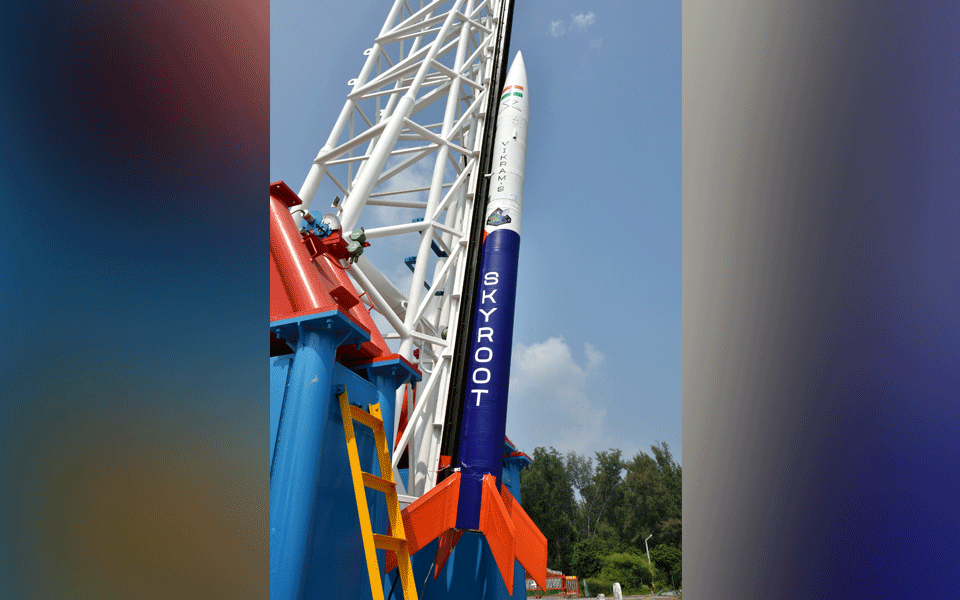
Sriharikota (AP) (PTI): India on Friday successfully placed three satellites into an orbit on a rocket completely developed by a four-year-old startup, marking the entry of the private sector into space activities, currently dominated by the state-run behemoth ISRO.
Skyroot Aerospace-designed Vikram-S, named in a befitting tribute to the father of the country's space programme Vikram Sarabhai, tasted success in its maiden mission. Skyroot Aerospace become the first privately held company in India after the space sector was opened for the private players by the Centre in 2020.
"I am happy to announce the successful completion of Mission Prarambh, The Beginning, by Skyroot aerospace," a smiling Pawan Goenka, Chairman of the country's space regulator, Indian National Space Promotion and Authorisation Centre (INSPACe), said from ISRO's Mission Control Center here.
The rocket achieved an altitude of 89.5 km and a range of 121.2 km, "exactly what was planned by Skyroot Aerospace," he said.
The rocket "worked as planned" and Skyroot Aerospace has demonstrated various capability of sub-systems that will go into the orbital launch vehicle, he added.
The rocket integrated into the launcher soared after lifting off at the prefixed 11.30 am from the sounding rocket complex at the Indian Space Research Organisation's Satish Dhawan Space Centre, here, about 115 km from Chennai.
The Mission unveiled by ISRO Chairman S Somanath has three payloads with two belonging to domestic customers and one from a foreign client.
The 6-metre tall launch vehicle is one of the world's first few all-composite rockets that has 3-D printed solid thrusters for spin stability of the launch vehicle.
"This is a new beginning for the Indian private sector entering aerospace and a historic moment for all of us," Goenka said.
The three payloads riding piggyback on the rocket are from Chennai-based start-up SpaceKidz, Andhra Pradesh-based N-SpaceTech and Armenian BazoomQ Space Research Lab.
Vikram-S launched the payloads in about 500 km low inclination orbit.
In a departure from the routine, Friday's mission was launched from the complex where sounding rockets were used by ISRO.
The Satish Dhawan Space Centre (SDSC) in Sriharikota has two launch complexes, each capable of providing complete support for vehicle assembly, check out and launch operations for any kind of missions -- Low Earth Orbit, Geosynchronous Transfer Orbit. PSLVs and GSLVs are launched from here.
Friday's mission is considered to be a significant milestone for Skyroot Aerospace as it would help test and validate majority of the technologies in the Vikram series of orbital class space launch vehicles, including many sub-systems and technologies that would be tested before lift-off and post lift off phases of the launch.
'Fun-Sat', a 2.5 kgs payload belonging to Chennai-based aerospace startup Spacekidz, has been developed by students from India, the United States, Singapore and Indonesia.
The 545 kg Vikram launch vehicle consists of the Vikram II and Vikram III series.
The technology architecture of the launch vehicle offers unique capabilities like multi-orbit insertion and interplanetary missions, while providing customised, dedicated and ride share options covering a wide spectrum of small satellite customer needs, Skyroot Aerospace said.
The company added the rockets can be assembled and launched within 24 hours from any launch site.
Mission Prarambh is successfully accomplished.
— ISRO (@isro) November 18, 2022
Congratulations @SkyrootA
Congratulations India! @INSPACeIND pic.twitter.com/PhRF9n5Mh4
Let the Truth be known. If you read VB and like VB, please be a VB Supporter and Help us deliver the Truth to one and all.
Vartha Bharati–Sankalp predictions align closely with Karnataka bypoll results
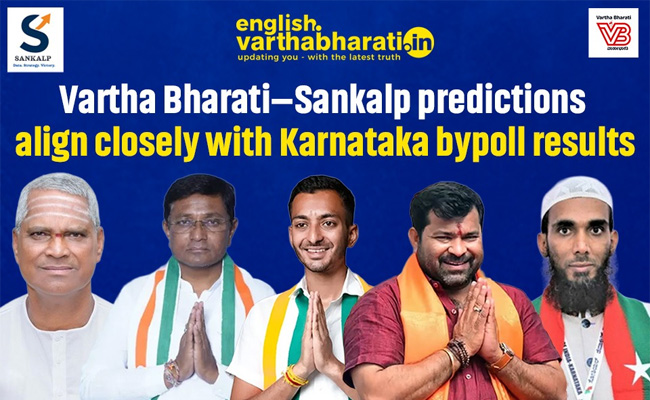
Bengaluru: The Vartha Bharati–Sankalp election analysis has shown a high level of accuracy in predicting the outcome of the recent Karnataka Assembly by-elections held in May 2026, correctly calling winners in both constituencies and closely estimating vote share trends.
The by-elections were held in Bagalkot and Davanagere South, drawing significant political attention as both seats were seen as key tests for the ruling Congress and opposition BJP.
According to the analysis, Vartha Bharati–Sankalp had made three major projections ahead of the results the winning party, vote share percentages, and margin of victory.
In both constituencies, the platform accurately predicted that the Congress would emerge victorious. The outcome matched the projections, with Congress candidates winning in Bagalkot and Davanagere South.
In terms of vote share, the predictions were largely in line with the final results. In Bagalkot, the BJP’s vote share was forecast in the range of 40 to 46 per cent, while the actual figure stood at 42.9 per cent. The Congress vote share, however, exceeded expectations, with the party securing 55.4 per cent against a projected range of 43 to 48 per cent.
The margin of victory in Bagalkot turned out to be significantly higher than anticipated. While the projection had placed the margin between 2,000 and 3,500 votes, the final margin was around 22,332 votes.
In Davanagere South, the predictions also remained largely accurate. The Congress vote share was projected between 43 and 51 per cent, and the final figure stood at 43.9 per cent. The BJP was expected to secure between 42 and 50 per cent but ended with 40.3 per cent.
The analysis had also identified the role of SDPI as a potential spoiler in the constituency. While its vote share was estimated around 6 per cent, the party eventually secured around 12 per cent of the vote.
The margin of victory in Davanagere South was predicted to be between 1,500 and 2,600 votes. The actual margin was higher at around 5,708 votes, though the contest remained relatively close as anticipated.
Overall, the performance of Vartha Bharati–Sankalp stood out for correctly identifying the winning parties in both seats and maintaining close accuracy in vote share estimates, with only limited deviations in specific cases.