India identifies 40 nations to ease textile sector stress amid US tariff blow: Report
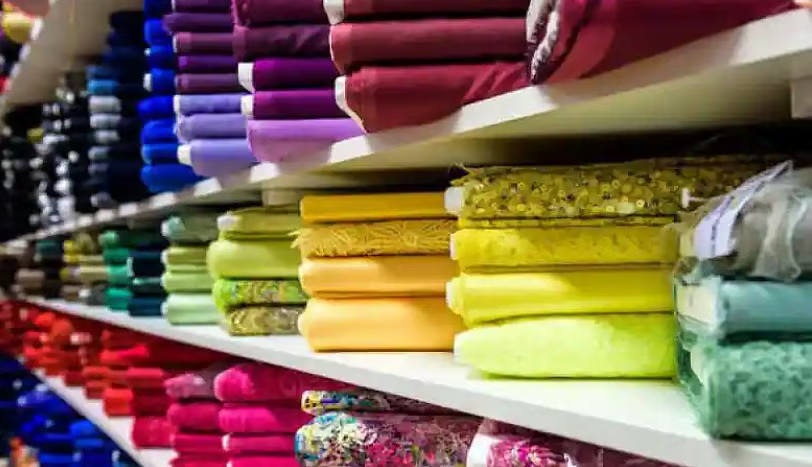
New Delhi: With the textile sector emerging as the hardest hit under the United States' reciprocal tariff regime, the Indian government is reportedly moving in "war mode" to cushion the impact on an industry that employs over 45 million people.
“40 key importing countries have been identified as part of efforts to diversify India’s textile exports,” The New Indian Express quoted government sources as saying on Thursday. These markets span North America, Europe, Asia, Africa, Latin America, and Oceania and together represent nearly three-fourths of global demand for textiles and apparel.
Government officials say targeted outreach programmes are being developed to expand India's modest 5–6% market share in these regions, with a focus on apparel, home textiles, technical textiles, and handicrafts. The effort reportedly began several months ago, and early signs show a positive trend in export figures.
According to the Directorate General of Commercial Intelligence & Statistics (DGCIS), India’s textile exports rose to $3.10 billion in July 2025, a 5.37% increase year-on-year. From April to July 2025, total exports stood at $12.18 billion, up 3.87% compared to the same period last year.
Special focus is being placed on Free Trade Agreements (FTAs) with partner nations, including the recently signed India–UK Comprehensive Economic and Trade Agreement (CETA). Officials quoted in the report mentioned that Export Promotion Councils, in coordination with Indian missions abroad, will lead targeted promotion drives to position India as a reliable source of quality, sustainable, and innovative textiles while reducing overdependence on a handful of traditional markets.
The urgency stems from a sharp blow dealt by the US, which last year accounted for $10.8 billion or 35% of India’s textile exports. With apparel exports now facing a 63.9% duty, Indian exporters find themselves at a 30–35% price disadvantage compared to competitors such as Bangladesh, Vietnam, Mexico, and Central American nations.
Industry insiders have warned that continued tariff pressure could lead to 15–20 lakh job losses in the apparel segment alone.
To address the crisis, the government has formed four industry-led committees tasked with recommending time-bound measures covering fiscal, banking and credit support, structural reforms in the value chain, and cost competitiveness through innovation, added the report.
Commenting on the trade strain, US Treasury Secretary Scott Bessent hinted that India’s delays in trade deal negotiations may have contributed to the steep tariffs, rather than just its Russian oil purchases. He, however, said: “I think at the end of the day, we’ll come together.”
Let the Truth be known. If you read VB and like VB, please be a VB Supporter and Help us deliver the Truth to one and all.
2nd phase of Bengal poll: Over 61 pc voting till 1 pm amid sporadic violence
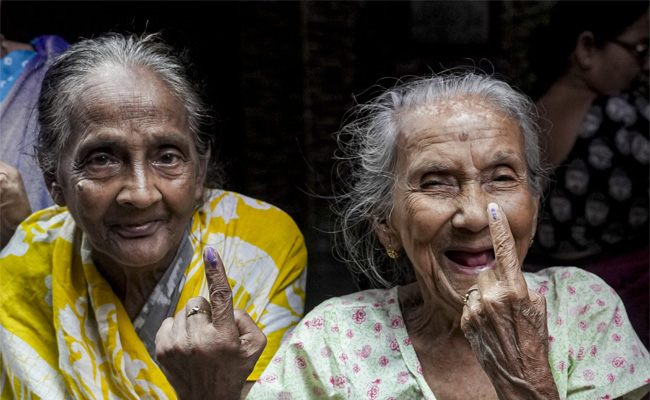
Kolkata (PTI): Over 61 per cent of the 3.21 crore electors exercised their franchise till 1 pm of the second and final phase of polling in West Bengal amid attacks on a few candidates, while tension gripped the Bhabanipur seat briefly as Chief Minister Mamata Banerjee and BJP's Suvendu Adhikari took swipes at one another in the same booth area.
Voters queued up from 7 am outside booths in Kolkata, Howrah, Hooghly, Nadia, North and South 24 Parganas and Purba Bardhaman districts, which form Bengal's electoral and political core.
Of the total electorate eligible to vote in this phase, 1.57 crore are women, and 792 are third-gender.
Till 1 pm, West Bengal recorded 61.11 per cent polling with Purba Bardhaman registering the highest turnout at 66.8 per cent, followed by Hooghly at 64.57 per cent and Nadia at 61.41 per cent.
Howrah registered 60.68 per cent polling, while North 24 Parganas recorded 60.18 per cent.
ALSO READ: PM must resign when TMC wins Bengal: Derek O'Brien
Kolkata North and Kolkata South recorded 60.18 per cent and 57.73 per cent turnout, respectively.
South 24 Parganas, a politically crucial district witnessing several high-profile contests, registered 58.58 per cent voting.
The first phase of polls in 152 assembly seats of West Bengal on April 23 also recorded more than 62.18 per cent polling till 1 pm.
"Polling is underway peacefully, barring some minor incidents in certain areas. We have sought reports from the officials concerned," a poll panel official said.
The early-morning convergence of Banerjee and Adhikari in the same booth area in Chakraberia turned Bhabanipur -- the chief minister's electoral bastion -- into the centrepiece of the day, reinforcing the symbolic weight of their prestige battle seen as a rematch of Nandigram, where the BJP leader had defeated her in 2021.
Banerjee was seated outside the booth after receiving complaints of alleged intimidation of local TMC leaders when Adhikari arrived there, amid heavy deployment of central forces.
Stepping out of his car, Adhikari said, "I will not allow any hooliganism", while Banerjee accused the BJP of trying to "rig" the election using central forces, police observers and election officials.
"The BJP wants to rig this election. Polls in Bengal are usually peaceful. Is there 'goonda raj' (hooliganism) here?" Banerjee told reporters, alleging CRPF personnel had visited the homes of TMC leaders late Tuesday night and unleashed terror in the area.
She alleged that election observers were acting at the BJP's behest and claimed TMC workers were being selectively targeted across districts.
Adhikari dismissed the charges as signs of "frustration", claiming Banerjee had realised that "not a single vote" was coming her way.
Banerjee, who usually steps out of her Kalighat residence late in the day to cast her vote at Mitra Institution School, broke convention and hit the ground before 8 am, moving through Chetla, Padmapukur and Chakraberia, underlining the stakes attached to Bhabanipur and the wider battle for south Bengal.
Later in the day, tension flared up in the Kalighat area when Adhikari visited a polling booth and was greeted with slogans by TMC workers, prompting police intervention and a complaint by the opposition leader to the EC seeking deployment of additional central forces.
Security forces had to resort to a lathi-charge to disperse the crowd. Adhikari chased the sloganeering crowds, whom he alleged were "outsiders trying to influence the polls".
As soon as he reached the area, TMC workers and supporters raised slogans of 'Jai Bangla' and 'chor, chor' against him, while BJP activists responded with chants of 'Jai Shri Ram'.
Reports of violence, vandalism and tension surfaced from several districts.
In Nadia district's Chapra, a BJP polling agent was allegedly assaulted inside a booth during a mock poll. The BJP accused TMC supporters of attacking its agent, while the ruling party denied the charge. In Shantipur, a BJP camp office was found vandalised.
The ISF alleged that its polling agents were prevented from entering booths in South 24 Pargana's Bhangar.
Howrah's Bally constituency saw tension at a booth in Liluah after an EVM malfunction delayed voting, prompting central forces to lathi-charge agitated voters. Two people were arrested in the matter.
Police and RAF personnel were also seen chasing away crowds near a booth in Amdanga following complaints of unlawful gathering by bike-borne supporters.
In Panihati, BJP candidate Ratna Debnath, the mother of the RG Kar victim, faced protests and her car was allegedly stopped by TMC workers, while in Jagaddal, the recovery of a firearm near a polling booth triggered tension before police and central forces restored order.
BJP candidate from Basanti assembly constituency in South 24 Parganas, Bikash Sardar, on Wednesday, alleged that "200-250 TMC goons" attacked his car and assaulted his driver when he was visiting polling booths in the constituency.
The TMC did not immediately respond to the allegations.
Unlike the first phase, where the BJP sought to defend its north Bengal gains, the final round has shifted the battle squarely to the TMC's strongest belt.
In 2021, the ruling party had won 123 of these 142 seats, leaving just 18 for the BJP and one for the ISF. For the BJP, breaching this southern fortress remains critical if it hopes to mount a serious challenge for power in the state.