
India in growth recession; extreme centralisation of power in PMO not good: Raghuram Rajan
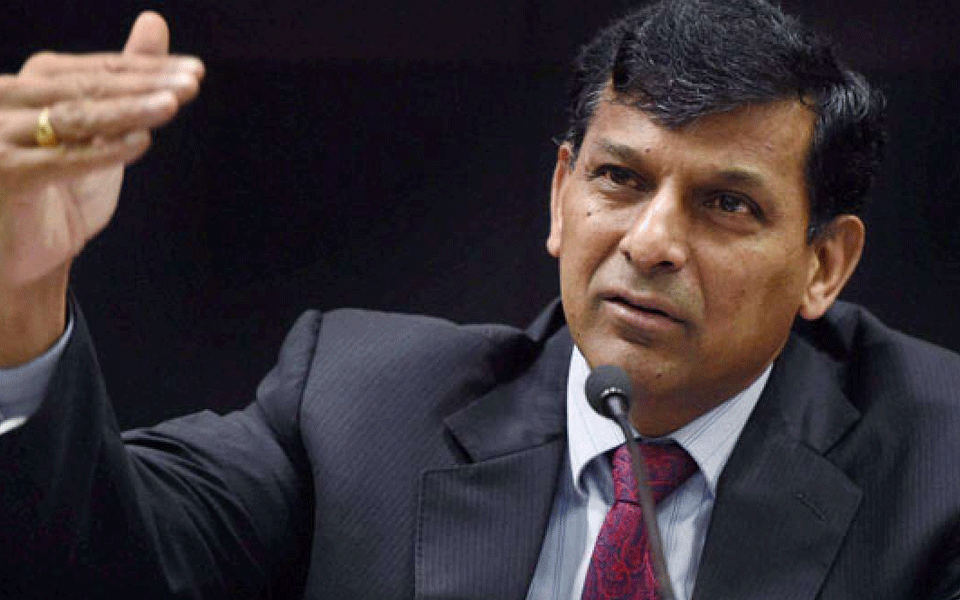
New Delhi: Former Reserve Bank of India (RBI) governor Raghuram Rajan said India is in the midst of a "growth recession" with signs of deep malaise in the Indian economy that is being run through extreme centralisation of power in Prime Minister's Office and powerless ministers.
Penning down his recommendations to help the ailing Indian economy out of the ongoing slowdown in the India Today magazine, he called for reforms to liberalise capital, land and labour markets, and spur investment as well as growth.
He also urged India to join free trade agreements judiciously in order to boost competition and improve domestic efficiency.
"To understand what has gone wrong, we need to start first with the centralised nature of the current government. Not just decision-making but also ideas and plans emanate from a small set of personalities around the Prime Minister and in the Prime Minister's Office (PMO).
"That works well for the party's political and social agenda, which is well laid out, and where all these individuals have domain expertise. It works less well for economic reforms, where there is less of a coherent articulated agenda at the top, and less domain knowledge of how the economy works at the national rather than state level," Rajan wrote.
Stating that previous governments may have been untidy coalitions but they consistently took path of further economic liberalisation, he said, "extreme centralisation, coupled with the absence of empowered ministers and the lack of a coherent guiding vision, ensures that reform efforts pick up steam only when the PMO focuses on them, and lose impetus when its attention switches to other pressing issues".
"The Modi government came to power emphasising 'minimum government, maximum governance'. This slogan is often misunderstood. What was meant was that government would do things more efficiently, not that people and the private sector would be freed to do more. While the government continues the creditable drive to automation -- direct benefit transfer to recipients is an important achievement -- the role of the government in many spheres has expanded, not shrunk," he said.
Rajan said the starting point to address the economic slowdown will be for the Modi government to acknowledge the problem.
"The starting point has to be to recognise the magnitude of the problem, to not brand every internal or external critic as politically-motivated, and to stop believing that the problem is temporary and that suppressing bad news and inconvenient surveys will make it go away," he said. "India is in the midst of a growth recession, with significant distress in rural areas."
India's economic growth slowed to a 6-year low of 4.5 per cent in the July-September quarter. With inflation rising, fears of stagflation -- a fall in aggregate demand accompanied by rising inflation -- have resurfaced.
He said construction, real estate and infrastructure sectors are in "deep trouble" and so are lenders to it like the non-bank finance companies. The crisis among shadow lenders and a build-up of bad loans at banks have curbed lending in the economy.
Seeking asset quality review of the non-bank finance companies, he said corporate and household debt is rising, and there is deep distress in parts of the financial sector.
Unemployment, especially amongst youth, seems to be growing, as is the accompanying risk of youth unrest. "Domestic businesses have not been investing either, and the stagnation in investment is the strongest sign that something is deeply wrong," he said.
Rajan called for reforms in land acquisition, labour laws, stable tax and regulatory regime, fast track bankruptcy resolution of developers in default, proper pricing of electricity, preserving competition in telecom sector and giving farmers access to inputs and finance.
Calling for not selling already dominant family enterprises to avoid concentration of power, he also wanted decentralisation of power by empowering ministers and engaging states, beginning with amending the terms of reference of the 15th Finance Commission by not curtailing states' share of tax revenue.
Rajan said the government should desist from cutting personal income tax rates for the middle-class for now and should use its scarce fiscal resources to support the rural poor through schemes such as the MGNREGA.
The repeated government allusions to a USD 5-trillion-economy by 2024, which would necessitate steady real growth of at least 8-9 per cent per year starting now, seem increasingly unrealistic, he added.
"Furthermore, even if some of the problems are legacies, the government, after five-and-a-half years in power, needs to resolve them. A massive new reform thrust is needed, accompanied by a change in how the administration governs," he said.
Rajan said the Modi government has shown "surprising timidity" when it comes to unfinished reforms on the business environment, land acquisition, labour and the role of the public sector.
Let the Truth be known. If you read VB and like VB, please be a VB Supporter and Help us deliver the Truth to one and all.
Karnataka issues nutrition advisory for govt events; recommends millets, healthier options
_vb_61.jpeg)
Bengaluru (PTI): The Karnataka government on Monday issued a nutrition advisory recommending healthier food and beverage options at meetings, functions, and other official gatherings held in the state.
The advisory has been issued by the Department of Karnataka Health and Family Welfare Services to promote healthy dietary and nutritional habits among officials and staff, noting that food, refreshments and beverages served in government offices and official programmes are "often not aligned with nutrition standards."
The advisory recommends serving snacks such as millet-based, low-fat and low-sugar foods, fresh fruits, vegetable salads, sprouts, roasted nuts and seeds during in-house office meetings and breaks.
Beverages such as green tea, low-fat buttermilk, and locally filtered or boiled water served in glass bottles or steel flasks have also been suggested.
According to the advisory, for larger government events, conferences and exhibitions, departments have been advised to include at least one millet-based item during snacks and a minimum of two millet dishes in meals, along with local cuisine and at least one regional recipe.
It also recommends the use of brown rice instead of white rice, freshly prepared vegetable salads, and fresh fruits or low-sugar fruit juices.
If non-vegetarian food is served, it should consist of well-cooked lean or white meat, the advisory stated.
In eateries operating within government office campuses, the department has recommended millet-based foods, fresh vegetable salads, boiled pulses such as horse gram or chickpeas, and low-fat beverages.
It suggests serving food using reusable metal plates and glasses.
The advisory also recommends avoiding microwave-heated food, industrially processed food, fried snacks, high-fat or heavily spiced dishes, carbonated drinks, high-sugar fruit juices, and alcoholic beverages.
It further discourages serving milk-based tea or coffee and plastic-bottled water during official events.
“Overall, hygiene and cleanliness should be maintained while serving food and water. Local cottage industries, self-help groups, prison kitchens, nutri-gardens and others should be preferred for placing food and beverage orders,” the advisory added.
_vb_54.jpeg)
_vb_07.jpeg)
_vb_34.jpeg)