India looking at raising 'rocket-cum-missile' force: Army chief
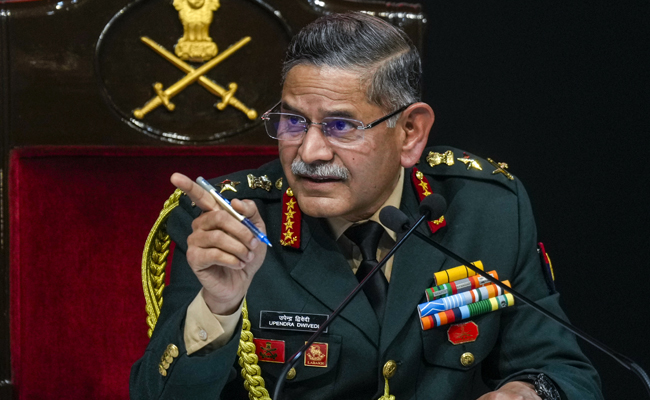
New Delhi (PTI): India is looking at raising a "rocket-cum-missile" force in view of the evolving regional security situation as both China and Pakistan have similar units, Army Chief Gen Upendra Dwivedi said on Tuesday.
It is the need of the hour that "we also have such a force", he said addressing a press conference ahead of the Army Day.
Drawing lessons from Operation Sindoor, the India Army has been extensively focusing on enhancing its combat prowess including inducting large numbers of drones, missiles and air defence weapons.
At present, the missiles and rockets in Army's inventory are handled by the Corps of Army Air Defence (AAD) and the Artillery regiments.
"We are looking towards a rocket-missile force. Pakistan has established a rocket force, and China has also created one," he said.
The China's PLA (People's Liberation Army) Rocket Force (PLARF) is considered to be a very potent wing of the country's military. China has been constantly enhancing the combat might of the PLARF since 2016.
In his remarks, Gen Dwivedi also noted that the Indian military has boosted its long-range strike capabilities and cited induction of BrahMos, Pralay, Pinaka and other similar missiles to augment its combat prowess.
"Rockets and missiles have become interdependent to each other in today's time. If we want a major impact, then we need both rockets as well as missiles," he said.
Gen Dwivedi said it will have to decide whether the "rocket-cum-missile" force will be part of the Army or it will be operated directly at a higher level.
"We have to decide whether it will be (operated) at the Army level or it will be directly under the Ministry of Defence or at the level of CDS (Chief of Defence Staff). This is the question which we need to decide," he said.
The Army chief said initially, it will be under the Army's artillery regiments.
"It may see a different look in terms of the size, scope and the command and control in future," he said.
He also said that the Indian Army on Tuesday strongly raised with Pakistan's Director General of Military Operations (DGMO) about sightings of Pakistani drones along the border areas in Jammu Sector in the last three days.
Gen Dwivedi said major reform measures are underway in the Army that included restructuring of the force which is focused on reviewing the organisational structures to enhance multi-domain combat potency and achieve an optimal "teeth-to-tail" balance.
"We have adopted a spiral development approach centred on organisation rather than equipment alone," he said.
"We have re-oriented and created several new structures: Rudra Brigades for high-tempo multi-domain operations and Bhairav Battalions for agility and disruptive effect," he said.
"Similarly Shaktibaan regiments and Divyastra batteries of artillery will use Unmanned Aerial Systems (UAS) and counter-UAS for extended reach and real-time targeting," he said.
The Army chief said Ashni platoons and other units on the design board will enhance precision, surveillance and strike options at the tactical level.
Gen Dwivedi, highlighting the Army's focus on enhancing its combat prowess, said the focus now is to steadily progress towards a "different Indian Army -- capable of thinking smart, seeing all, striking deep, moving fast, connecting domains, standing resilient and most importantly, winning together".
"We are progressing towards integrated structures in the form of theatre commands -- a deliberate, consultative and well-synchronised process to which the Indian Army is fully committed," he said.
Gen Dwivedi said the Army is continuing to refine organisational mechanisms to adopt best practices, improve efficiency, enhance outcomes and gradually reorient manpower.
"Warfighting doctrines are being updated to fine-tune multi-domain operations -- ability to succeed in all four quadrants," he said.
Let the Truth be known. If you read VB and like VB, please be a VB Supporter and Help us deliver the Truth to one and all.
4 workers die after being buried under coal slurry in Jharkhand's Dhanbad
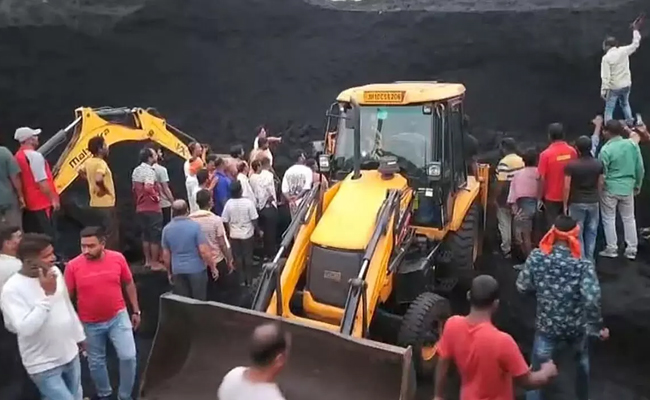
Dhanbad (Jharkhand) (PTI): At least four workers died after being buried under coal slurry in Jharkhand's Dhanbad district on Saturday, a police official said.
The incident took place at Moonidih coal washery in the command area of Bharat Coking Coal Limited (BCCL).
"Bodies of all four workers were dug out of debris during a rescue operation," Putki police station in-charge Waqar Hussain told PTI.
The incident took place when coal slurry was being loaded into trucks by workers, during which a large chunk of slurry fell and trapped several workers underneath, officials said.
The deceased have been identified as Manik Bauri, Dinesh Bauri, Deepak Bauri, and Hemlal Gope.
Meanwhile, the family members of the deceased and local villagers placed the bodies in front of the washery gate and began a protest.
They demanded compensation, jobs for dependents and action against those responsible for the incident.
Police and administration officials are trying to pacify the protesters, an official said.