India loses “fastest growing economy” tag to china
GDP growth slows to 5-year low
New Delhi: India has lost its coveted title of the world's fastest growing economy to China, as low agriculture and mining output along with subdued consumer demand, slowed the country's economic growth rate to 5.8 per cent during the fourth quarter of 2018-19, official data showed on Friday.
China's economy had grown by over 6 per cent in the fourth quarter.
On a sequential basis, India's economy had grown at 6.6 per cent in the third quarter ending December.
According to the Central Statistics Office (CSO), on a year-on-year (YoY) basis, the GDP growth of 5.8 per cent in the fourth quarter ended March was way lower than the 8.1 per cent expansion witnessed during the same quarter of the previous year.
"GDP (gross domestic product) at constant (2011-12) prices in Q4 of 2018-19 is estimated at Rs 37.20 lakh crore, as against Rs 35.15 lakh crore in Q4 of 2017-18, showing a growth rate of 5.8 per cent," according to the GDP estimates released by the CSO.
Similarly, the full fiscal 2018-19 was no better for the economy with the country recording a GDP growth of 6.8 per cent - the lowest in five years. In the fiscal 2017-18, the country had clocked a GDP growth rate of 7.2 per cent.
The gross value added (GVA) growth rate during 2018-19 on a YoY basis fell to 6.6 per cent, from 6.9 per cent during the previous fiscal.
"Real GVA, (GVA at basic constant) (2011-12) prices for the year 2018-19 is now estimated at Rs 129.07 lakh crore, showing a growth rate of 6.6 per cent over 'First Revised Estimates of GVA' for the year 2017-18 of Rs 121.04 lakh crore released on January 31, 2019," the CSO said.
The GVA includes taxes, but excludes subsidies.
As per the data, the economic activities which registered growth of over 7 per cent on a YoY basis in 2018-19 were 'public administration, defence and other services', 'construction', 'financial, real estate and professional services', 'electricity, gas, water supply and other utility services'.
"The growth in the 'agriculture, forestry and fishing', 'mining and quarrying', 'manufacturing' and 'trade, hotels, transport, communication and services related to broadcasting' is estimated to be 2.9 per cent, 1.3 per cent, 6.9 per cent and 6.9 per cent, respectively," the CSO said.
Sector-wise, GVA for 2018-19 from "agriculture, forestry and fishing" sector showed a growth of 2.9 per cent, from 5 per cent in 2017-18.
The GVA in 2018-19 from the manufacturing sector grew at 6.9 per cent, as compared to 5.9 per cent in the previous fiscal.
The mining and quarrying sector grew by 1.3 per cent against the previous year's growth rate of 5.1 per cent.
Let the Truth be known. If you read VB and like VB, please be a VB Supporter and Help us deliver the Truth to one and all.
Trump says EU has until July 4 to approve last year's trade deal or it will face higher tariffs
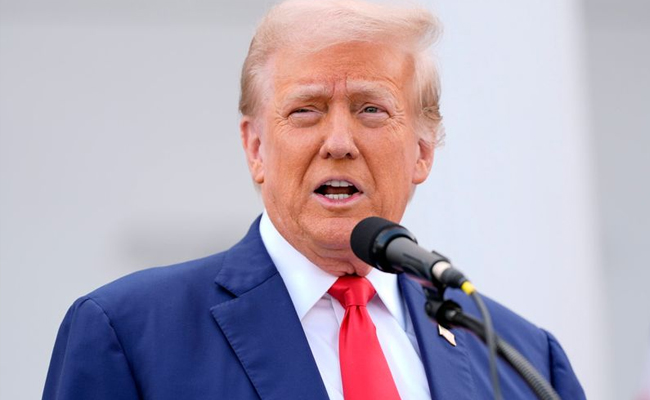
Washington (AP): President Donald Trump has said in a social media post that goods from the European Union would face higher tariff rates if the 27-member bloc fails to approve last year's trade framework by July 4.
The announcement on Thursday appeared to be a deadline extension after the president said last Friday that EU autos would face a higher 25 per cent tariff starting this week. Trump made the updated announcement after what he described as a "great call" with European Commission President Ursula von der Leyen.
Still, the US president was displeased that the European Parliament had yet to finalize the trade arrangement reached last year, which was further complicated in February by the US Supreme Court ruling that Trump lacked the legal authority to declare an economic emergency to impose the initial tariffs used to pressure the EU into talks.
"A promise was made that the EU would deliver their side of the Deal and, as per Agreement, cut their Tariffs to ZERO!" Trump posted. "I agreed to give her until our Country's 250th Birthday or, unfortunately, their Tariffs would immediately jump to much higher levels."
It was unclear from the post whether Trump was implying that the tariff rates would jump on all EU goods or the increase would only apply to autos.
His latest statement indicates he might be backing away from his earlier threat on EU autos by giving the European Parliament several more weeks to approve the agreement.
Under the original terms of the framework, the US would charge a 15 per cent tax on most goods imported from the EU.
But since the Supreme Court ruling, the administration has levied a 10 per cent tariff while investigating trade imbalances and national security issues, aiming to put in new tariffs to make up for lost revenues.