India need not fear oil shortage: UAE envoy

New Delhi, July 18 : Even as the US-imposed sanctions on Iran has put India's energy security in jeopardy, UAE Ambassador to India Ahmed Albanna has allayed fears of an oil shortage, saying his country as well as Saudi Arabia can fill in if supply from Iran is disrupted.
"In the international market, the law of demand and supply controls the prices," Albanna told IANS here in an exclusive interview when asked about rising fuel prices in India.
"Production is the important element there... to ensure that the production is enough for the world consumption of oil," he said.
He said that consumer countries have been faced with most of the problems because of challenges faced by some Organisation of Petroleum Exporting Countries (OPEC) countries as also non-OPEC countries.
However, at the same time, he said that India need not fear shortage of oil with the new US sanctions on Iran set to take effect in November this year. Iran is the second-largest supplier of crude oil to India, supplying more than 425,000 barrels of oil per day, and India is one of the biggest foreign investors in Iran's oil and gas industry.
"There was some disruption during the embargo against Iran years ago," Albanna said.
"Saudi Arabia was able to rectify the matter and supply India in the face of the shortage that took place because of the embargo," he said.
"The same thing will happen this time I guess in November, when the embargo takes place."
The Ambassador said that because India enjoys a "great relationship" with the United Arab Emirates (UAE), Saudi Arabia and Iraq, "the alternatives are there all the time".
Regarding energy giants Abu Dhabi National Oil Company (Adnoc) and Saudi Aramco jointly investing in the development of the $44-billion Ratnagiri refinery and petrochemicals complex in Maharashtra, Albanna said that it is a "strategic project" with a trilateral arrangement.
"Due to the close and strategic relationship between the UAE and Saudi Arabia and between India and both UAE and Saudi Arabia, we have been able to reach such an agreement," he said. "It will be beneficial to all parties."
Earlier this year, the first consignment of two million barrels of crude oil from the UAE for India's strategic petroleum reserve in Karnataka's Mangaluru landed on the west coast. This consignment fills one of the two strategic reserve caverns at Mangaluru under an agreement between Adnoc and the Indian Strategic Petroleum Reserves Ltd (ISPRL).
Albanna also highlighted the close ties between India and the UAE which were elevated to that of a Comprehensive and Strategic Partnership during Prime Minister Narendra Modi's visit to the Gulf nation in August 2015, the first prime ministerial visit from India to that country in 34 years.
This was followed by the visit of Abu Dhabi Crown Prince and Deputy Commander of the UAE Armed Forces to India Sheikh Mohamed bin Zayed Al Nahyan in 2016 and then again in 2017 as the chief guest for India's Republic Day celebrations. Modi again visited the UAE last year where he delivered the keynote address at the World Government Summit in Dubai.
Stating that India is one of the first countries with which the UAE has signed a strategic agreement, he said there are collaborations at many different levels.
"Whether we talk about traditional sectors like oil and gas and the normal trade and also the new sectors such as cooperation in airspace, cooperation in IT, IT manufacturing, cooperation in security and security exchange, security information exchange, and also in solar energy," he said.
"If we look at the bilateral trade between the UAE and India, India is trading partner number one (for the UAE) with a total value of $57 billion," Albanna said.
"If we look at the Indian side, the UAE is the third-largest trading partner after China and the US."
Stating that all these show the importance of the India-UAE relationship, the Ambassador said that it "reflects the vision of our leadership to look at this bilateral trade and to make it further grow".
He also referred to UAE Foreign Minister Sheikh Abdullah bin Zayed Al Nahyan's week-long visit to India last month and said that there are many outcomes of the visit "which we are now at the stage of following up and look at the best way of implementation".
The UAE is home to a nearly three million-strong expatriate Indian population.
Let the Truth be known. If you read VB and like VB, please be a VB Supporter and Help us deliver the Truth to one and all.
MP boat tragedy: Death toll rises to 10 with recovery of one more body; 3 tourists still missing
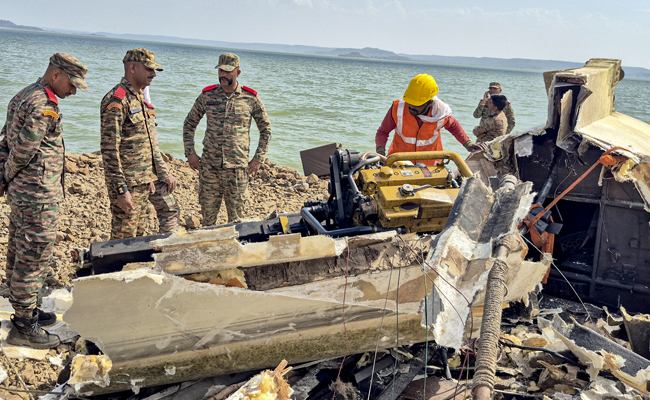
Jabalpur (PTI): The body of a child was retrieved on Saturday evening from Bargi Dam in Jabalpur district of Madhya Pradesh, raising the death toll in the cruise boat tragedy that took place two days ago to ten, while search continued for three missing tourists.
The boat, operated by the state tourism department, capsized during a storm on Thursday evening with some of the survivors alleging negligence and safety lapses such as life jackets not being distributed in time.
The body recovered on Saturday evening was possibly that of six-year-old Viraj Soni, said Sub-Divisional Officer of Police (SDOP) Anjul Ayank Mishra.
"The identity will be confirmed after family members identify the body," he told PTI.
Kamraj, an employee of the Ordnance Factory at Khamaria, his five-year-old son Tamil, and another child Mayuram (5) who had come from southern India were still missing.
Authorities have arranged equipment to search deep waters of the dam and are getting a generator to facilitate diving operations, Mishra added.
Divers and disaster response teams have expanded the search radius to five km, he said.
Of the 41 identified passengers on board the ill-fated vessel, 28 were rescued, police said.
More than 200 rescuers, including around 20 Army divers airlifted from Agra, joined the search operation that resumed at 5 on Saturday morning. The operation, involving the National Disaster Response Force, State Disaster Response Force and local divers, was briefly affected at around 9 am due to strong winds, officials said.
Post-mortem examinations of nine deceased persons have been completed, Mishra said.
"Our priority is to search for the missing persons. We will also register a First Information Report in the case soon," he said.
Police said CCTV footage near the boarding point showed 43 people heading towards the boat while the identities of 41 passengers have been confirmed so far.
The state government on Friday ordered a probe into the tragedy and dismissed three crew members. It also banned operation of similar vessels in the state.