India needs 2,500 universities to accommodate 50 pc students: NITI Aayog CEO
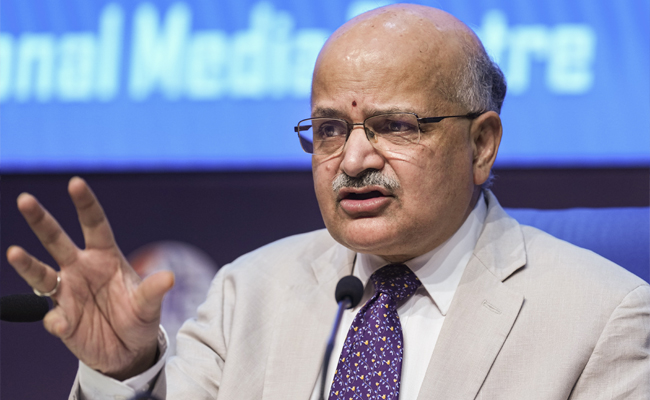
Hyderabad (PTI): In order to have 50 per cent students in universities, India needs to double the varsities’ strength to 2,500, NITI Aayog CEO BVR Subrahmanyam has said.
Delivering a keynote address at the Indian School of Business (ISB) here on Friday, he said though one university and two colleges were opened every week in the past ten years, only 29 per cent of the age cohort enroll in the varsities.
Subrahmanyam also said that with a huge digital infrastructure, India has become the biggest laboratory in the digital world where one can experiment at a scale.
"Today we have 1,200 universities and slightly more than four crore students, but that’s only 29 per cent of the cohort age enroll in the university system. Actually, at least 50 per cent of the students should be in colleges.
"We need to double the colleges and universities in the country. The country needs 2,500 universities. It may look like a lot of universities are not up to the mark or whatever, but the fact is, you need those numbers. Maybe we need to deliver education differently," he said.
The CEO said India has created a huge architecture called digital public infrastructure by going the public route rather than the private.
The official further said Estonia was the first country with a population of two million which went for digital identity. However, India did at the scale of 140 crore people and everybody has a digital identity and 120 crore people have bank accounts.
"India has become the biggest laboratory in the digital world. A laboratory where you can experiment at a scale which is impossible and inconceivable anywhere else, probably except the United States. Maybe we even leapfrog them for a variety of reasons," he said.
India has become a place which is digitally and financially connected with an identity, which has led to innovations one after another, he said, adding that UPI is an innovation and 48 to 50 per cent of all global financial transactions happen in India.
As many as 10 billion transactions a month are happening, which may be lower in terms of value and very high in terms of volume, the NITI CEO said.
He said 'Viksit Bharat' is not necessarily just being a prosperous country, but also an inclusive nation which will have a "rising tide which lifts all the boats."
He said the country is expected to become a USD 30 trillion economy by 2047, surpassing the present size of the US and Chinese economies.
Research and innovation are crucial for becoming a modern developed economy, he said.
With the vast base that has been created in the last 10 years, India has probably become a huge hub for fintech innovation, Subrahmanyam said.
Talking about the transformation in the country during the last decade, he said there will be a drinking water supply in every village by the end of next year.
"Every house is connected with electricity supply. There is a road to every village. We have housing which is being built at a rapid pace," he said.
In the last 10 years, 25 crore people have escaped "acute poverty", he said, also highlighting the transformation in highways, railways (including Vande Bharat trains) and others in the country.
He also said India can be a leader in climate change as the technologies to address the issue have not yet been invented fully.
Observing that most countries in the west have developed stable economies which have to be "rewired and re-engineered" for a green future.
He said such re-engineering is not required in a large part of India and climate-friendly mobility and power systems can be developed.
The government's missions, such as those related to AI and semiconductor are aimed at keeping the country ahead in the concerned areas, he said.
India is going to be a powerful nation in terms of its innovative capabilities, he said.
He also said NITI Aayog is preparing visions for the country, preparing economic plans for cities and trying to transform agriculture into new areas like horticulture and aquaculture.
"The second area which NITI works in is how we capture the technological trends to benefit the country…" he said.
India should be a global leader in frontier technologies, he added.
Since the technologies don’t exist, everybody is starting afresh and India should be setting the benchmarks, the standards, the certification methods for technologies, he said.
"I think NITI would lead that drive," he said.
Let the Truth be known. If you read VB and like VB, please be a VB Supporter and Help us deliver the Truth to one and all.
Marxism will remain relevant despite Left electoral's losses, says general secretary M A Baby
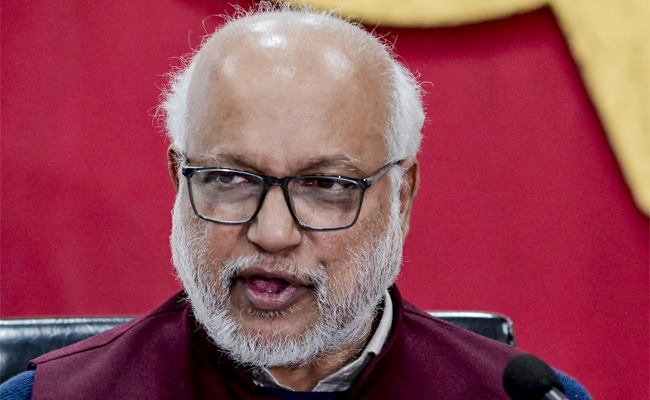
New Delhi (PTI): CPI(M) General Secretary M A Baby on Thursday asserted that the Left movement would remain relevant despite not being in power in any state, saying the ideology would continue to endure as long as social and economic inequalities persist.
Hitting back at BJP leader Rajeev Chandrasekhar over his reported remarks that Marxism had become irrelevant, Baby, in an interview with PTI Videos, said, "So long as there is division in society, so long as there is exploitation of the majority of workers, peasants and ordinary masses by a handful of billionaires, Marxism will remain relevant."
"That perhaps Mr Rajeev Chandrasekhar may not be able to understand, but this is the fact of the matter," he said.
Baby acknowledged that the CPI(M)-led Left was currently without an elected government in any state, but maintained that electoral setbacks would not diminish the movement's role.
"We may not have an elected government in any state. There were occasions when we didn't have a government. But the red flag and the commitment to organise and struggle for the rights of the dispossessed, marginalised and exploited will always be upheld by CPI(M) and the Left movement," he said.
He said the Left continued to enjoy support among workers, peasants, agricultural labourers, youth, students and women, and argued that the movement remained necessary because "oppression and assault" continued in society.
"So long as such problems exist in society, the red flag and the working class movement will continue to work among the masses," the Left leader said.
Exuding confidence on the Left's revival, Baby said the party would reflect on the reasons behind its electoral loss.
"We may be rejected in one election, but we will stage our comeback by understanding what went wrong with us," he said, adding, "We will listen to people and we will come back with higher strength."
Baby also criticised the Congress over reported factional tensions in Kerala after the Congress-led United Democratic Front's victory in the state.
"The way they are behaving is being watched by the people of Kerala," he said, referring to infighting within the Congress.
"Those who have given a massive majority to Congress and UDF would be watching all this," he added, while urging party leaders to "settle the problem in an amicable, democratic manner".
Referring to West Bengal, Baby alleged that violence had escalated following the BJP's victory in the state assembly polls.
"It is quite unfortunate that the moment BJP snatched a massive victory in West Bengal, violence has also started on a big scale," he said.
He also accused the Trinamool Congress of being "notorious for violent activities" and alleged that the "RSS-controlled BJP" had "unleashed violence in many places" after the election results.
"This is not good for Bengal, not good for the country. We wish and hope that normalcy would be restored as soon as possible," he said.
Baby said the CPI(M) and the Left in West Bengal would continue efforts to "pacify people" and avoid violence and confrontation.
Asked about former Kerala chief minister Pinarayi Vijayan not reacting publicly to the election results, Baby said Vijayan would respond "at an appropriate time".