India questions WHO's methodology to estimate COVID-19 mortalities
New Delhi, Apr 16 (PTI) India on Saturday questioned the World Health Organisation's methodology to estimate COVID-19 mortalities in the country, saying using such a mathematical modelling cannot be applied to estimate the death figures for such a vast nation of geographical size and population.
The Union health ministry issued a statement in response to a New York Times article titled India Is Stalling WHO's Efforts to Make Global Covid Death Toll Public dated April 16, saying the country has on several occasions shared its concerns with the global health body over the methodology used.
India has been in regular and in-depth technical exchange with the World Health Organisation (WHO) on the issue. The analysis, which uses mortality figures directly obtained from Tier I set of countries, uses a mathematical modelling process for Tier II countries (which includes India), the ministry said.
"India's basic objection has not been with the result (whatever they might have been), but rather the methodology adopted for the same.
"The model gives two highly different sets of excess mortality estimates of when using the data from Tier I countries and when using unverified data from 18 Indian states. Such a wide variation in estimates raises concerns about validity and accuracy of such a modelling exercise," the ministry said in the statement.
According to the health ministry, India has shared its concerns with the methodology along with other member states through a series of formal communications, including six letters issued to WHO (on November 17, December 20, 2021; December 28, 2021; January 11, 2022; February 12, 2022; and March 2, 2022) and virtual meetings held on December 16, 2021, December 28, 2021, January 6, 2022, February 25, 2022 and the SEARO Regional Webinar held on February 10, 2022.
During these exchanges, specific queries have been raised by India along with other member states -- China, Iran, Bangladesh, Syria, Ethiopia and Egypt -- regarding the methodology, and use of unofficial sets of data.
The concern specifically includes on how the statistical model projects estimates for a country of geographical size and population of India and also fits in with other countries which have smaller population, the statement said.
Such one size fit all approach and models which are true for smaller countries like Tunisia may not be applicable to India with a population of 1.3 billion.
"WHO is yet to share the confidence interval for the present statistical model across various countries," the statement said.
"India has asserted that if the model is accurate and reliable, it should be authenticated by running it for all Tier I countries and if the result of such exercise may be shared with all member states," it said.
The model assumes an inverse relationship between monthly temperature and monthly average deaths, which does not have any scientific backing to establish such peculiar empirical relationship.
India is a country of continental proportions, climatic and seasonal conditions vary vastly across different states and even within a state and therefore, all states have widely varied seasonal patterns.
"Thus, estimating national level mortality based on these 18 states data is statistically unproven," the statement stated.
The Global Health Estimates (GHE) 2019 on which the modelling for Tier II countries is based, is itself an estimate. The present modelling exercise seems to be providing its own set of estimates based on another set of historic estimates, while disregarding the data available with the country, the statement said.
"It is not clear as to why GHE 2019 has been used for estimating expected death figures for India, whereas for the Tier 1 countries, their own historical datasets were used when it has been repeatedly highlighted that India has a robust system of data collection and management," it stated.
In order to calculate the age-sex death distribution for India, WHO determined standard patterns for age and sex for the countries with reported data (61 countries) and then generalised them to the other countries (incl. India) who had no such distribution in their mortality data.
Based on this approach, India's age-sex distribution of predicted deaths was extrapolated based on the age-sex distribution of deaths reported by four countries (Costa Rica, Israel, Paraguay and Tunisia), the ministry said in the statement.
Of the covariates used for analysis, a binary measure for income has been used instead of a more realistic graded variable. Using a binary variable for such an important measure may lend itself to amplifying the magnitude of the variable.
WHO has conveyed that a combination of these variables was found to be most accurate for predicting excess mortality for a sample of 90 countries and 18 months (January 2020-June 2021). The detailed justification of how the combination of these variables is found to be most accurate is yet to be provided by WHO, the statement noted.
"The test positivity rate for Covid in India was never uniform throughout the country at any point of time. But, this variation in Covid positivity rate within India was not considered for modelling purposes.
"Further, India has undertaken COVID-19 testing at a much faster rate than what WHO has advised. India has maintained molecular testing as preferred testing methods and used Rapid Antigen as screening purpose only. Whether these factors have been used in the model for India is still unanswered," the statement stated.
Containment involves a lot of subjective approach (such as school closing, workplace closing, cancelling of public events) to quantify itself. But, it is actually impossible to quantify various measures of containment in such a manner for a country like India, as the strictness of such measures have varied widely even among the states and districts of India. Therefore, the approach followed in this process is very much questionable.
"In addition, subjective approach to quantify such measures will always involve a lot of biasness which will surely not present the real situation. WHO has also agreed about the subjective approach of this measure. However, it is still used," the statement said.
According to the statement, during interactions with WHO, it has also been highlighted that some fluctuations in official reporting of COVID-19 data from some of the Tier I countries, including the USA, Germany, France, defied knowledge of disease epidemiology.
Further inclusion of a country like Iraq which is undergoing an extended complex emergency under Tier I countries raises doubts on WHO's assessment in categorisation of countries as Tier I/II and its assertion on quality of mortality reporting from these countries.
"While India has remained open to collaborate with WHO as data sets like these will be helpful from the policy making point of view, India believes that in-depth clarity on methodology and clear proof of its validity are crucial for policy makers to feel confident about any use of such data.," the statement said.
"It is very surprising that while New York Times purportedly could obtain the alleged figures of excess COVID-19 mortality in respect to India, it was unable to learn the estimates for other countries!," the statement added.
Let the Truth be known. If you read VB and like VB, please be a VB Supporter and Help us deliver the Truth to one and all.
Fadnavis rides motorcycle to Vidhan Bhavan, says PM Modi asked only for 'small sacrifices'
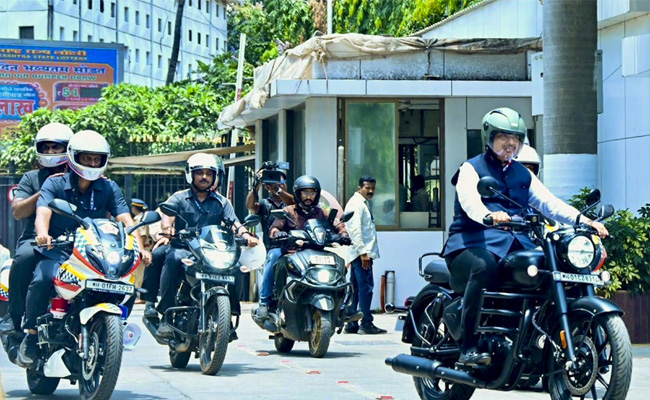
Mumbai (PTI): Maharashtra Chief Minister Devendra Fadnavis on Thursday rode a motorcycle to the Vidhan Bhavan here and later defended the Centre's austerity measures, saying Prime Minister Narendra Modi has only "asked people to make small sacrifices".
He also criticised the Opposition for creating "unnecessary controversy" over the matter, adding that questioning the PM's foreign visits - aimed at strategic alliances and economic benefits - was "sheer foolishness".
Fadnavis arrived at the Vidhan Bhavan in South Mumbai on a motorbike from his residence 'Varsha', with BJP leader and minister Ashish Shelar accompanying him, to attend the swearing-in of new members of the legislative council.
The move comes as part of the measures after PM Modi's appeal to conserve fuel and foreign exchange in view of the ongoing conflict in West Asia, which has disrupted global energy supplies. India relies heavily on West Asia for crude oil and gas imports.
On Wednesday, CM Fadnavis announced a series of austerity measures, including halving the number of vehicles in the convoys of his cabinet colleagues, and cancelling foreign tours of ministers and officials.
Addressing reporters here on Thursday, Fadnavis said the state government had curtailed convoys, cancelled avoidable foreign tours and decided against holding large government events for the next six months.
Targeting the Opposition, the CM said similar austerity measures had been adopted by previous governments, including during the tenures of former prime ministers Indira Gandhi and P V Narasimha Rao, as well as by former finance minister P Chidambaram in 2012.
"The Opposition needs to show some maturity. Countries across the world have taken even tougher decisions. The prime minister has only asked people to make small sacrifices while himself taking very tough decisions. Creating unnecessary controversy over this is not appropriate," he said.
Fadnavis said he travelled by motorcycle to send a message on fuel conservation, adding that symbolic actions by political leaders help spread awareness among people.
"When leaders act symbolically in this manner, the message reaches the people. That is why I came here on a motorcycle," he stressed.
The chief minister said all unnecessary foreign visits by officials and ministers had been stopped, and efforts were underway to reduce fuel consumption and save foreign exchange.
"We have reduced our convoys. Wherever petrol and diesel can be saved, wherever foreign exchange can be conserved, we are making every possible effort," he said.
Fadnavis said a major government event scheduled in Satara on Friday would, however, go ahead as it was planned in advance and expenditure had already been incurred.
He said around 25 lakh families would receive benefits valued at Rs 10,000 crore under the Centre's Pradhan Mantri Awas Yojana during the programme.
"After this event, however, no large government programmes will be organised over the next six months," he added.
The CM also dismissed criticism on social media over PM Modi's foreign visits, saying overseas trips aimed at strategic alliances and economic gains for the country should not be equated with avoidable travel.
"The appeal is only against unnecessary foreign travel. It does not mean businessmen should cancel important overseas deals. Criticising the prime minister's foreign visits is sheer foolishness," he said.