
India re-elected to International Maritime Organisation Council with highest vote
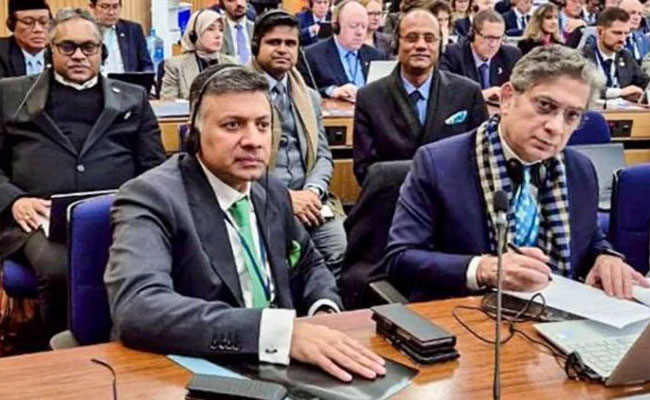
London (PTI): India has been re-elected to the International Maritime Organisation (IMO) Council with the highest vote in its category at elections held at its Assembly in London for the 2025-26 biennium.
India's election in Category B on Friday falls under the collection of 10 states with “the largest interest in international seaborne trade,” alongside Australia, Brazil, Canada, France, Germany, the Netherlands, Spain, Sweden and the United Arab Emirates (UAE).
The newly elected Council will meet for its 136th session on December 4 and will elect its Chair and Vice-Chair for the next biennium, the IMO said.
“India re-elected to the IMO Council securing the highest vote in Category B with 154 votes,” the Indian High Commission in London announced following the vote.
“We thank our partners for putting their trust in India, and pledge to continue to work for the global maritime sector,” the mission stated.
The IMO is the premier body that oversees the world's maritime sector, which in turn underpins international trade, transport and all maritime activities.
The Council is the executive organ of IMO and is responsible, under the Assembly, for supervising the work of the organisation.
In July, the Secretary at the Ministry of Ports, Shipping and Waterways had launched India’s candidature for re-election as he revealed the ministry’s plans to invest USD 1 trillion in the sector over the next 25 years.
T K Ramachandran invited representatives from around the world to “partner with India in this quest for us to become one of the leading maritime nations in the world.”
“India embraces the philosophy of 'One Earth, One Family, One Future,' and we bring this vision to life through fostering robust and collaborative maritime efforts,” said Ramachandran at the time.
“Under our Vision 2047, we see maritime growth as a corner of global progress, and we deeply value a growing engagement with the IMO and its member states… we have several pillars, including shipbuilding, ship recycling, ship financing, ship ownership and ship flagging, the entire ecosystem,” he said.
The IMO Assembly normally meets once every two years in a regular session. It is responsible for approving the work programme, voting the budget and determining the financial arrangements of the organisation.
It also elects the organisation's 40-Member Council at these meetings for the next two-year period.
Let the Truth be known. If you read VB and like VB, please be a VB Supporter and Help us deliver the Truth to one and all.
Will not tolerate bias of Congress anymore: Muslim organisations of Karnataka slam party
Bengaluru: Representatives of leading Muslim organisations, associations and unions from across Karnataka have issued a strong and sharply worded joint statement, declaring that the Muslim community “will no longer tolerate” what they described as the biased attitude of the Congress party towards the community and its leaders.
The statement was issued by a wide group of leaders and organisations, including Maulana Syed Tanveer Hashmi, President, Muslim Muttahida Mahaz, Vijayapura; Abdul Khadeer Saheb, President, Shaheen Group of Educational Institutions, Bidar; Maulana Shabbir Ahmed Nadvi, President, Welfare of Humanity Foundation, Bengaluru; K. S. Mohammed Masood, President, The Muslim Central Committee, Dakshina Kannada and Udupi District and former President of the State Minorities Commission; Haji Mohammed Hanif, General Secretary, The Muslim Central Committee, Dakshina Kannada and Udupi District; Muhammad Maula, President, Udupi District Muslim Okkuta; Yaseen Malpe, Immediate Past President, Udupi District Muslim Okkuta; Maulana Abdul Raqeeb MJ Nadvi, General Secretary, Majlis E Islah Wa Tanzeem, Bhatkal; Ashraf Ali Basheer, Convenor, Muslim Voice of Karnataka, Hubballi; Dr Abdul Kareem, former President, Karnataka State Minorities Commission, Hubballi; K. Ashraf, President, Dakshina Kannada District Muslim Okkuta; Muhammad Hanif, Secretary, Dakshina Kannada District Muslim Okkuta; Maulana Abdul Azeez Darimi, Leader, Sunni Yuvajana Sangha Karnataka; Haji Abubakar Nejar, District President, Sunni Samyukta Jamaath, Udupi District; Mohammad Rafiq, District President, Karnataka Muslim Jamaath, Udupi District; Rafiuddin Kudroli, President, Uniwef Mangaluru; Kasim Shuaiburrahman Qureshi, President, All India Jamiatul Qureshi, Karnataka; Afzal Mahmood, Secretary, Karnataka Muslim Political Forum, Gulbarga; Jabbar Kalaburagi, President, Karnataka Muslim Unity, Bagalkote; Nisar Ahmed, State Coordinator, Eddelu Karnataka, Mangaluru; Naqwa Yahya Malpe, President, Namma Naada Okkoota, Udupi District; Afsar, President, Karnataka Souharda Okkoota, Mandya; Advocate Abdul Jabbar Gola, Vice President, Joint Action Committee, Gulbarga; Advocate Anshad Palya, State Committee Member, All India Lawyers Association, Karnataka and Leader, Hassan District Muslim Organisations Federation; Haji Suleiman Saheb, President, Thirthahalli Taluk Joint Muslim Federation; and Mujahid Pasha of Al Jamaatul Quraish Trust, Basavakalyan.
The organisations said the united support extended by Muslims in the state was the main reason for the Congress party coming to power. However, they alleged that the party and its government are not treating Muslims with dignity, and that there is growing anguish within the community over being repeatedly insulted by denial of proper representation in political appointments and key positions in the bureaucracy.
Referring to the Davangere by-election and recent developments, the statement said the Congress party appears to have sent a clear message to Muslims: “You are merely a vote bank for us. Your job is only to vote for the Congress party. Positions, status, representation and opportunities in the party are alms that we give. If you question your rights or the injustice done to you, disciplinary action will be taken.”
The organisations said this approach is unacceptable and warned that the community will no longer remain silent. They questioned the party’s disciplinary actions against certain Muslim leaders, asking what action had been taken in similar situations in the past involving others. “Otherwise, a serious question arises as to whether the party’s disciplinary rules are applicable only to one community,” the statement said.
Calling the issue one of dignity, the organisations said it is not just about a few individuals but concerns the entire Muslim community. They criticised the Congress for taking unilateral decisions without consulting religious and social leaders and said such actions cannot be justified as mere political decisions.
The statement also accused the party of portraying Muslims as being wrong for asking for fair representation. It said it is not fair to expect the community to campaign for the party without giving them tickets that should have been given fairly, and then initiate disciplinary action on what were described as trivial grounds. The organisations termed the attitude of “you should have simply obeyed what we said” as highly condemnable.
They also expressed concern over what they described as attempts by the party leadership to pit leaders of the Muslim community against each other. At the same time, the statement criticised certain leaders within the community for choosing to pursue personal interests instead of standing firmly against what it called discriminatory policies.
Drawing a comparison, the organisations said that when leaders from some communities commit even serious mistakes or make direct statements against the party, no action is taken and they are instead rewarded. “But if leaders from a particular community deviate even slightly from the party’s diktat, they are subjected to severe punishment this is not fair, this is not acceptable,” the statement said.
Warning of political consequences, the organisations said such discriminatory behaviour will harm the Congress party in the coming days and could lead to a serious setback. They said Muslims had supported the party to ensure a secular government based on constitutional values and to prevent divisive forces from gaining power. However, treating this support as a weakness and assuming that the community has no alternative would prove “politically very costly” for the party.
The organisations strongly condemned what they termed as mistreatment of the community in the name of political calculation and demanded that such unilateral decisions be stopped. They also called for the present decision to be reconsidered.
_vb_05.jpeg)
_vb_92.jpeg)