India regrets Kashmir issue being raised at UNHRC

United Nations, Sep 12 : India has expressed regret that the Kashmir issue is being raised at the UN Human Rights Council (HRC) after mentions of it by Michelle Bachelet, the new UN Human Rights High Commissioner, and by Pakistan at its current session.
"Terrorism is the biggest scourge and greatest violator of human rights and we hope that you will address it more emphatically in the coming years," Rajiv K. Chander, India's Permanent Representative to the UN in Geneva, told Bachelet on Tuesday at the HRC meeting in Geneva.
He told the HRC, "We regret that reference has been made to the Indian state of Jammu and Kashmir. Our views on the matter have been made abundantly clear in the Council."
It is important that "human rights issues are handled constructively" and with regard to national sovereignty and territorial integrity in a transparent and credible manner, he added.
In an apparent reference to the Supreme Court striking down the British colonial law criminalising same-sex relations as an example of the capability of Indian legal bodies to deal with human rights issues, Chander said, "From recent developments it is evident our institutions are responsive and capable of meeting the aspirations and needs of the vast and thriving milieu of people."
On Monday, in her first address to the HRC, Bachelet had said the recent human rights report on Kashmir had not been followed up and emphasised that her office would continue monitoring and reporting on the situation there.
The strongly-worded report released by her predecessor, Zeid Ra'ad Al Hussein in June, outlined what it said were human rights abuses on both sides of the line of control and called for an international commission to investigate the human rights situation.
He had also repeatedly asked India to allow human rights monitors to visit Kashmir, which New Delhi has refused asserting that happenings in Kashmir were its internal affairs and there could be no external intervention.
Bachelet said that there has not been "even open and serious discussions on how the grave issues raised (in the report) could be addressed" and added that her office would continue to request permission to visit both sides of the line of control.
"The people of Kashmir have exactly the same rights to justice and dignity as people all over the world, and we urge the authorities to respect them," she said.
She balanced the criticism of India by hailing last week's Supreme Court decision to decriminalise same-sex relations and declared, "I very much hope other countries around the world will look to India's example in this respect."
On Tuesday, Farukh Amil, Pakistan's Permanent Representative to the UN in Geneva, told the HRC in his national capacity that Pakistan shares Bachelet's "anguish" over Kashmir and endorsed her call for implementing the report's recommendations.
Since the report was released, "the plight of Kashmiris has only worsened with 60 civilians killed," he asserted.
Islamabad was willing to allow a Human Rights Commissioner's team to visit the area of Kashmir under its control only if New Delhi would also give a similar access, Amil said.
He also brought up the 70-year-old resolutions of the Security Council and said that a plebiscite should be held under them, even though Islamabad had not kept its agreement to withdraw from the occupied areas to facilitate it.
He had another opportunity to speak to the HRC on behalf of the 53-member Organisation of Islamic Cooperation when he made a passing reference to Kashmir, lumping it with the Palestine and the Rohingya issues.
When the floor was opened to NGOs, the Karachi-based World Muslim Congress representative Sardar Amjad Yousf chimed in, expressing support for Bachelet's references to Kashmir and calling for human rights defenders in Kashmir and those who worked with the human rights report to be declared internationally protected persons.
Let the Truth be known. If you read VB and like VB, please be a VB Supporter and Help us deliver the Truth to one and all.
CM Siddaramaiah alleges ‘criminal conspiracy’ in Sringeri recount, vows legal action
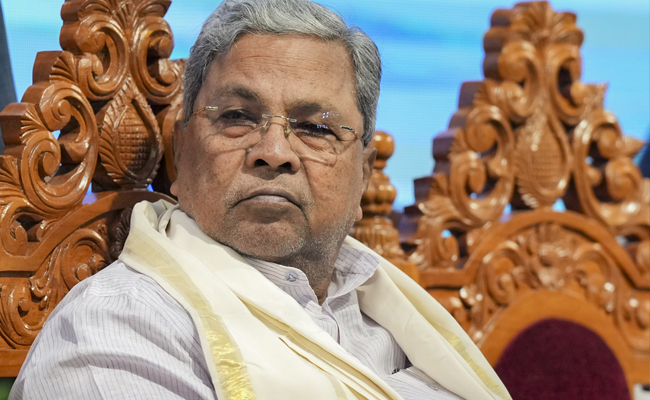
Bengaluru (PTI): Alleging a “criminal conspiracy” by BJP candidate D N Jeevaraj in the Sringeri Assembly poll recounting, Karnataka CM Siddaramaiah on Tuesday said the outcome was manipulated after valid postal ballot votes in favour of Congress leader T D Raje Gowda were tampered with during the recounting process.
Following a Karnataka High Court order on an election petition filed by Jeevaraj, challenging Raje Gowda’s election, the reverification and recounting were conducted on Saturday.
After the reverification and recount of postal ballots for the Sringeri Assembly constituency, votes polled in favour of Raje Gowda were reduced by 255, the returning officer said.
A report on the matter has been submitted to the Election Commission of India for further action, the officer added.
Congress leader Raje Gowda had won the 2023 Assembly polls from Sringeri by 201 votes, defeating his nearest rival Jeevaraj.
Addressing a press conference in Bengaluru, Siddaramaiah said the High Court had directed the recounting of postal ballots and that irregularities were noticed during the exercise conducted on May 2.
“This is a clear case of criminal conspiracy,” Siddaramaiah said, alleging that valid votes cast in favour of Raje Gowda were altered after being accepted by counting agents of all parties, including Congress, BJP, and JD(S).
He claimed that during the recounting of postal ballots, 255 votes were initially accepted as valid by all agents but were later tampered with by subordinate officials.
“There is a second mark on the votes polled in favour of Raje Gowda. They had accepted these as valid votes. Subsequently, another mark was made by officials. This is a clear case of criminal conspiracy,” he said.
When asked who was behind the alleged conspiracy, the CM replied, “It was hatched by Jeevaraj and others. It is planned.”
Siddaramaiah further alleged that the returning officer acted improperly by declaring the result despite the presence of an Election Commission observer during the recounting.
“Immediately after the counting, the returning officer announced the result. He should not have done so; this is against the law,” he said.
He pointed out that Raje Gowda had originally won by 201 votes, but after the recounting, the BJP candidate was declared the winner by 52 votes.
“The BJP has committed a criminal act of conspiracy. This is not vote chori but vote dacoity,” he alleged.
The CM said a police complaint had already been filed by Raje Gowda’s election agent, Sudhir Kumar, and emphasised the need for electoral integrity.
“We want transparency and free and fair elections. That is what our Constitution mandates,” he added.
Stating that the government would pursue legal remedies, Siddaramaiah said, “We are preparing an appeal challenging the returning officer’s announcement in a court of law.”
Responding to a separate query on elections in other states, the CM said there appeared to be an anti-incumbency factor in West Bengal, while results in Tamil Nadu were “surprising,” adding that Vijay’s party was emerging as the largest there.
Following the victory of party candidates in Bagalkote and Davanagere South, Siddaramaiah expressed confidence about future electoral prospects in Karnataka.
“Even in 2028, we will win the Assembly elections. We will come back,” the CM said.
Siddaramaiah added that he would order a forensic examination into the alleged tampering of postal ballots.