India remains committed to best interests of people of Bangladesh: MEA on Hasina verdict
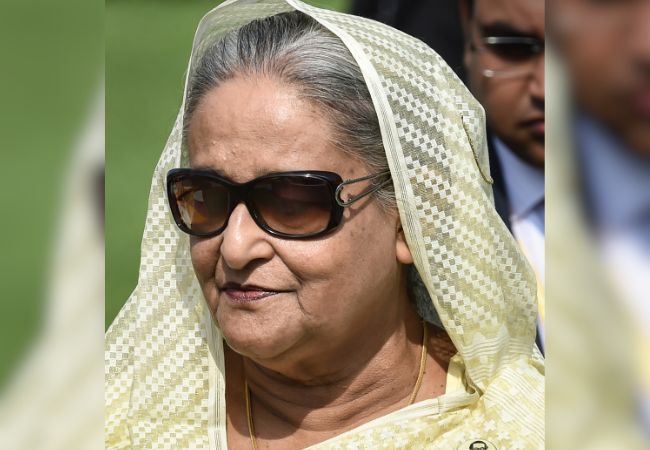
New Delhi (PTI): Hours after a special tribunal in Bangladesh sentenced ousted prime minister Sheikh Hasina to death, India on Monday said it noted the verdict and that it will engage constructively with all stakeholders considering peace, democracy and stability in the neighbouring country.
The Ministry of External Affairs (MEA) said India remains committed to the best interests of people of Bangladesh.
Hasina was found guilty of crimes against humanity by the country's International Crimes Tribunal (ICT) and it sentenced her to death. Hasina's aide and former home minister Asaduzzaman Khan Kamal was also given a death sentence on similar charges.
Hasina, the Awami League leader, has been living in India since she fled Bangladesh on August 5 last year in the face of the massive protests.
"India has noted the verdict announced by the 'International Crimes Tribunal of Bangladesh' concerning former prime minister Sheikh Hasina," the MEA said.
"As a close neighbour, India remains committed to the best interests of the people of Bangladesh, including in peace, democracy, inclusion and stability in that country," it said.
"We will always engage constructively with all stakeholders to that end," the MEA added.
However, it did not comment on Dhaka's call to extradite Hasina.
Following the verdict, Bangladesh's foreign ministry demanded that Hasina be immediately handed over under an extradition treaty in view of her sentencing.
"This is also a duty for India, as per the extradition treaty existing between the two countries," it said.
In her reaction, Hasina said the judgement has been made by a "rigged tribunal established and presided over by an unelected government with no democratic mandate".
"They are biased and politically motivated. In their distasteful call for the death penalty, they reveal the brazen and murderous intent of extremist figures within the interim government to remove Bangladesh's last elected prime minister, and to nullify the Awami League as a political force," she said in a statement.
Hasina said she was not afraid to face her "accusers" in a proper tribunal where the evidence can be weighed and tested fairly. "That is why I have repeatedly challenged the interim government to bring these charges before the International Criminal Court (ICC) in the Hague."
The verdict comes months before parliamentary elections in Bangladesh.
Hasina's Awami League party has been barred from contesting the elections scheduled to be held in February.
Let the Truth be known. If you read VB and like VB, please be a VB Supporter and Help us deliver the Truth to one and all.
BJP, Opposition in war of words after Constitution Amendment Bill defeat
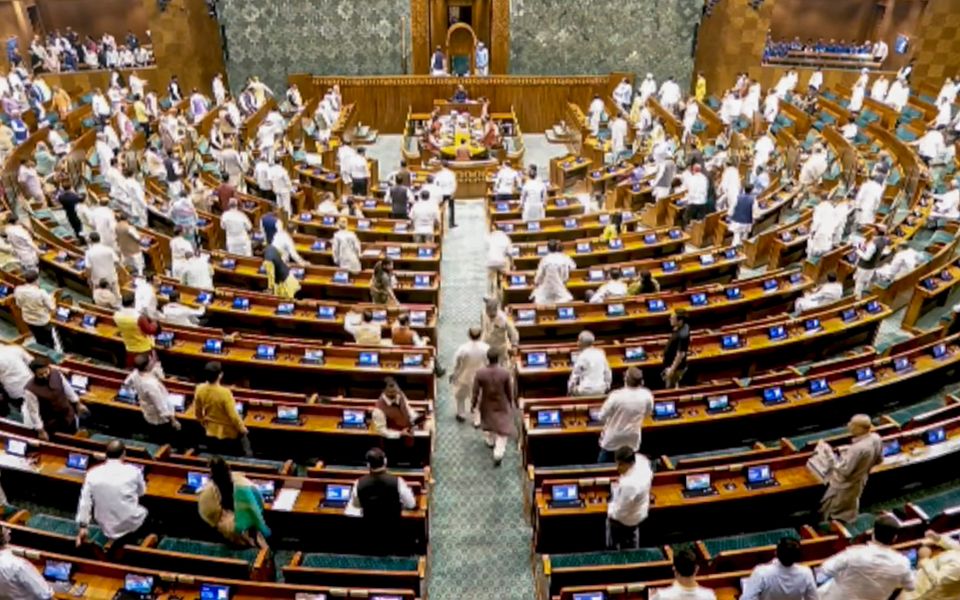
New Delhi (PTI): The BJP and the Opposition on Saturday engaged in a war of words over the issue of the implementation of women's reservation in legislatures, with Union minister Kiren Rijiju saying the parties which stalled the Constitution Amendment Bill will face the wrath of women.
The Opposition accused the government of delaying implementation by linking it with delimitation and using it to serve its political interests.
While the BJP termed the development a “black day” and accused the Congress and other opposition parties of betraying women, the Congress and its allies asserted that the quota law, passed in 2023, should be implemented immediately and accused the government of playing politics over it.
Parliamentary Affairs Minsiter Kiren Rijiju accused the Congress of being anti-women, and said it will have to face their wrath across the country.
“They will have to face the anger of the women of the country. This is a black stain on the Congress and its allies, one that they will never be able to erase. This Bill was about giving historic representation to women—what objection could there have been?” he told reporters in the Parliament House complex.
"The opposition is celebrating after depriving women of their rights; women of the country will teach them a good lesson," he added.
Union minister Shobha Karandlaje targeted Leader of Opposition Rahul Gandhi, alleging that the Opposition’s actions had undermined both women’s empowerment and regional representation.
“They have harmed south India as well, where seats could have increased by over 50 per cent. Women were supposed to get reservation, but they have been denied that opportunity. This has been done under the leadership of Rahul Gandhi,” she alleged.
BJP MP Bansuri Swaraj accused the Congress and the INDIA bloc of deceiving women and backtracking on their earlier stand. “They have betrayed the trust of women, and we will take this story of your deception to every citizen,” she said.
Swapna Verma, general Secretary, BJP (Madhya Pradesh) Mahila Morcha, said, “Congress and its INDI alliance have once again exposed their anti-women mindset. Despite the sincere appeal of Prime Minister Shri Narendra Modi ji for collective, and non-partisan support, those driven by political obstinacy chose to defeat not just a Bill, but the aspirations of an entire nation.”
Opposition leaders accused the government of delaying implementation and using the issue for political gain in Assembly elections in West Bengal and Tamil Nadu.
Congress MP Shashi Tharoor said the opposition is not against women’s reservation, but has objected to its linkage with delimitation. “We are fully in support of women’s reservation and would have happily passed the Bill on Friday itself. Our objection was not to reservation, but to linking it with delimitation,” he said.
Tharoor said delimitation raises “fundamental questions” about the country’s future and cannot be rushed.
“This is a very important issue for India’s unity and democracy. It requires serious, wide-ranging discussion -- not something to be decided in a two-day session.
Alleging political motives, he added, “This was a political game, not about women. Women were being used to serve short-term political interests. If the government brings a new Bill in the Monsoon Session without linking it to delimitation, we will pass it.”
"There must be a serious discussion involving all parties and states, especially in light of future Census data and the framework for a new delimitation exercise.”
Congress MP K C Venugopal said there is no disagreement on women’s reservation and demanded its immediate implementation.
“Their agenda was to link delimitation with women’s reservation, which has failed. They wanted delimitation according to their convenience, like in Assam and Jammu and Kashmir, by redrawing constituencies. That has failed.
“We demand that, without any delay, the 2023 women’s reservation law be implemented,” he said.
CPI(M) leader John Brittas alleged that the government’s strategy had been exposed in Parliament.
“The dubious and diabolical game plan of the government has fallen flat. They were using women as a shield to mislead the nation. If they have even an iota of sincerity, let them implement one-third reservation based on the present strength of legislatures,” he said.
“The opposition will jointly defeat any ulterior motives and designs of this government,” he added.
Samajwadi Party leader Ram Gopal Yadav questioned the legislative process and alleged political motives. “This historic Bill was already passed in 2023. Why was there a need to bring amendments again? Even after that, the earlier law was notified. So what was the need for discussion and voting?” he asked.
“The whole country knows this was done with elections in West Bengal in mind. When you knew you did not have a two-thirds majority, what was the point of bringing it? This shows there was a political angle, not genuine intent,” he said.
The Constitution Amendment Bill, which sought to operationalise women’s reservation and increase the strength of the Lok Sabha, was defeated in the Lower House on Friday as it failed to secure the required two-thirds majority.
While 298 members voted in favour of the Bill, 230 voted against it. Out of 528 members who voted, the Bill required 352 votes for passage.
According to the Bill, Lok Sabha seats were to be increased to a maximum of 850 from the current 543 to operationalise the women’s reservation law before the 2029 parliamentary polls, following a delimitation exercise based on the 2011 Census. Seats were also to be increased in state and Union Territory assemblies to accommodate 33 per cent reservation for women.