India showcases 'Sindoor' valour and cultural hues at 77th R-Day celebrations
New Delhi (PTI): India ushered in its 77th Republic Day on Monday with a grand display of its cultural diversity, economic growth, and military prowess that included missiles, warplanes, newly-raised units and lethal weapon systems used during Operation Sindoor.
President of the European Council, Antonio Costa, and President of the European Commission, Ursula von der Leyen, graced the celebrations as chief guests, marking a significant diplomatic moment alongside the military display.
Although the overarching theme of the event was 150 years of 'Vande Mataram', the Indian military's Operation Sindoor too found prominence at the parade on the Kartavya Path, the centrepiece boulevard of the national capital.
The parade commenced with the President Droupadi Murmu taking the salute shortly after she, Costa and von der Leyen, flanked by the Indian president's bodyguards, arrived at the Kartavya Path in a traditional buggy.
Prime Minister Narendra Modi, Defence Minister Rajnath Singh, several other Union ministers, the country's top military brass, foreign diplomats, and senior officials were among the spectators.
The major weapon systems displayed included BrahMos and Akash weapon systems, rocket launcher 'Suryastra', Main Battle Tank Arjun and an array of indigenously-built military platforms and hardware.
Around 100 artistes heralded the parade, on the theme 'Vividata Mein Ekta (Unity in Diversity) that featured a grand presentation of musical instruments, demonstrating the nation's unity and rich cultural diversity.
The parade then began with President Murmu taking the salute. The parade was led by Parade Commander Lt General Bhavnish Kumar, General Officer Commanding, Delhi Area, a second-generation officer.
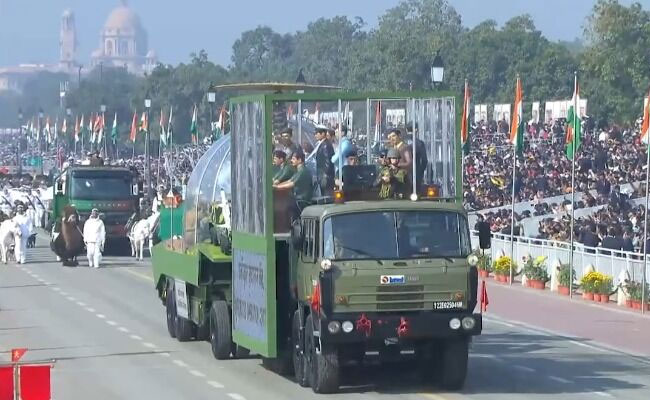
A tri-services tableau showcasing replicas of major weapon systems deployed by the Indian military during Operation Sindoor in early May was a major attraction.
A glass-cased integrated operational centre, depicting the conduct of Operation Sindoor with the use of weapons systems such as BrahMos and S-400 missiles rolled down Kartavya Path.
For the first time, the parade showcased a phased 'Battle Array Format' of the Indian Army, including its aerial component. The recce element consisted of the 61 Cavalry in active combat uniform.
It was followed by a high mobility reconnaissance vehicle. Providing aerial support was the indigenous Dhruv Advanced Light Helicopter and its armed version, Rudra, in Prahar formation, demonstrating battlefield shaping.
The combat elements then followed with T-90 Bhisma and Main Battle Tank Arjun rolling past the saluting dais with aerial support from Apache AH-64E and Prachand light combat helicopters.
Other mechanised columns included BMP-II Infantry Combat Vehicle, along with Nag missile system (Tracked) Mk-2.
A military contingent from the EU, carrying the military staff flag and flags of Operations Atalanta and Aspides, the naval operations of the grouping, also featured at the parade. It was the EU's first participation in such an event outside of Europe.
Among the major weapon systems showcased at the parade were Suryastra Universal Rocket Launcher System (URLS), Brahmos Supersonic cruise missiles and Akash missile systems.
The Indian Navy contingent comprised 144 young personnel, led by Lt Karan Nagyal as contingent commander, and Lt Pawan Kumar Gandi, Lt Priti Kumari and Lt Varun Dreveriya as platoon commanders.
It was followed by the Naval tableau that presented a vivid depiction of the theme 'Strong Navy for a Strong Nation'. It depicted a stitched ship from the fifth century CE, now christened INSV Kaundinya, Gurab-class ships of the Maratha Navy, and frontline indigenous platforms, including the aircraft carrier INS Vikrant and INS Udayagiri.
The tableau featured a depiction of the circumnavigation route followed by INSV Tarini as part of the Navika Sagar Parikrama-II expedition.
In addition to naval personnel, young cadets from the Sea Cadets Corps, a non-governmental organisation that imparts basic nautical skills to youth in Mumbai, marched alongside the tableau.
The Indian Air Force contingent comprised four officers and 144 airmen. The contingent commander was Squadron Leader Jagdesh Kumar with Squadron Leader Nikita Choudhery, Flt Lt Prakhar Chandrakar and Flt Lt Dinesh as supernumerary officers.
Syncing with the marching contingent was a thrilling fly-past by two Rafale jets, two MiG-29s, two Su-30s and one Jaguar aircraft in 'Spearhead' formation, symbolising the "Sindoor Formation".
The Defence Research and Development Organisation (DRDO) showcased its hypersonic glide missile LR-AShM. It is capable of engaging static and moving targets and is designed to carry various payloads.
The missile has a first-of-its-kind indigenous avionics system and high-accuracy sensor packages.
A total of 30 tableaux -- 17 of states and Union Territories and 13 of various ministries and departments rolled down the Kartavya Path. The tableaux showcased a unique mix of 150 years of the national song Vande Mataram and the nation's rapid progress.
A joint 'DareDevils' team of motorcycle riders drawn from the Central Reserve Police Force and the Sashastra Seema Bal enthralled the audience with their manoeuvres.
The aerial fly-past, one of the most eagerly-awaited events of the parade, witnessed the participation of a total of 29 aircraft, including 16 fighter jets, four transport aircraft and nine helicopters.
These include Rafale, Su-30 MKI, MiG-29 and Jaguar aircraft, complemented by strategic assets - C-130 and C-295, as well as the Indian Navy's P-8i aircraft. The formations include Arjan, Vajraang, Varuna and Vijay.
Let the Truth be known. If you read VB and like VB, please be a VB Supporter and Help us deliver the Truth to one and all.
Mamata blames AIMIM, ISF for gherao of judicial officers; accuses Congress, BJP of instigation
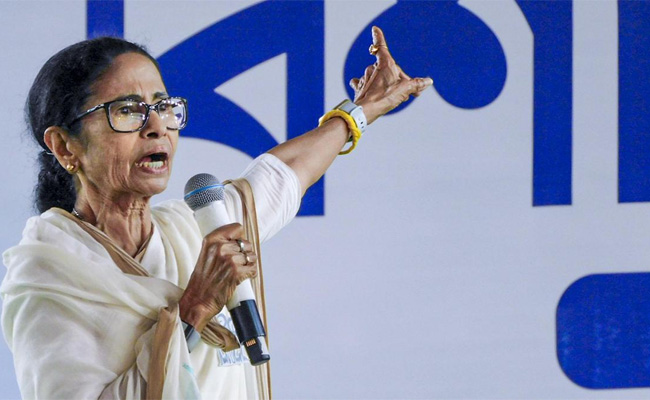
Harirampur (WB) (PTI): West Bengal Chief Minister Mamata Banerjee on Friday blamed AIMIM and ISF for the gherao of judicial officers in Malda district and accused the Congress and the BJP of instigation.
Stating that the mastermind behind Wednesday's gherao of the judicial officers for several hours in Malda district's Mothabari was arrested by the state's CID, Banerjee claimed that this police organisation is still under her control and not of the Election Commission.
"The BJP loaned him (the accused) from the AIMIM and brought him here," she alleged, while addressing an election rally at Harirampur in Dakshin Dinajpur district.
"ISF is with them; Congress and BJP have also provided instigation," the Trinamool Congress chief alleged, stating that the Criminal Investigation Department (CID) arrested the main accused, advocate Mofakkarul Islam, from Bagdogra airport when he was trying to flee.
"It is they who engineered the violence in Malda's Mothabari," she said.
ALSO READ: Delhi Police busts LPG black marketing racket in Bawana, 75 cylinders seized; 1 held
Alleging that goons are being brought in from outside to create unrest in poll-bound West Bengal, Banerjee said, "They don't even spare the judges."
Banerjee accused the AIMIM, whose chief Asaduddin Owaisi has come out in support of Aam Janata Unnayan Party (AJUP), floated recently by former TMC MLA Humayun Kabir, of having divided votes in the Bihar assembly elections to help the BJP win the polls.
Kabir has vowed to take on the TMC and also the BJP in all assembly seats in Muslim-majority Murshidabad district.
Pointing out that voters' names were deleted during the ongoing special intensive revision (SIR) exercise and expressing agreement with their anguish, Banerjee said she has fought for their rights and for their names to be included in the electoral rolls.
She questioned why the assembly polls cannot be conducted with the same electoral rolls used in the 2024 general elections.
"If the voter list contained names of infiltrators, Modi also won with their votes earlier, so he should resign first," she said.
"Money is being brought in using CRPF vehicles," she alleged, claiming that she knows where these were going.
"I have a record of these movements and will expose them at the appropriate time," she said.
Banerjee said that the presence of Union Home Minister Amit Shah in West Bengal during the polls will lead to a reduction in the BJP's vote share.
Shah has said he would camp in West Bengal for 15 days during the two-phase assembly elections in the state on April 23 and 29.
"You may stay in West Bengal for 365 days, but that will not change anything," Banerjee said.
Accusing the BJP of having created a ruckus near her Kalighat residence on Thursday during the nomination rally of Leader of Opposition Suvendu Adhikari, led by Shah, she said, "It is futile to expect any courtesy from them."
Claiming that the names of 40,000 voters of Bhabanipur constituency, from where she is contesting to get reelected, have been deleted in the SIR exercise, she asserted, despite that the TMC will win this election.
"I am your candidate in all the 294 constituencies in the state... Forget whose name is there as our party nominee," the TMC chief said.
She also accused the BJP of trying to impose a new version of religion on people.
"The BJP is trying to spread venom amongst people," she said, maintaining that she celebrates festivals of all religions.
Banerjee said her MPs have told her that the BJP is planning to bring in the Delimitation Bill in Parliament.
Asserting that the BJP will lose in the 2026 assembly polls, Banerjee said that the saffron party will be driven out of Delhi after defeat in West Bengal.
"They want to divide Bengal again," she said, claiming that a map had surfaced on social media showing a proposal to carve out a new state comprising some districts of Bihar and north Bengal.
The TMC supremo claimed to have done a lot for the development of the Santals.
"I have written poems in the Rajbangshi language and in Ol Chiki script; many decry me, let them do so, but people know that over 145 books written by me have already been published," she said.
The chief minister said that the Election Commission has appointed new DGP, police commissioners, district magistrates and other officers.
"I know they are all from West Bengal and will support the state," she said, maintaining that they should not listen to the BJP and instead work for the people.
"They don't need to support me; they should ensure that there is no violence, no money laundering, and firearms and drugs are not brought in," Banerjee said.
"For the time being, power has been taken away from us, but we will come back soon and take stock of everything," the TMC chief asserted.