India successfully launches latest communication satellite GSAT-31
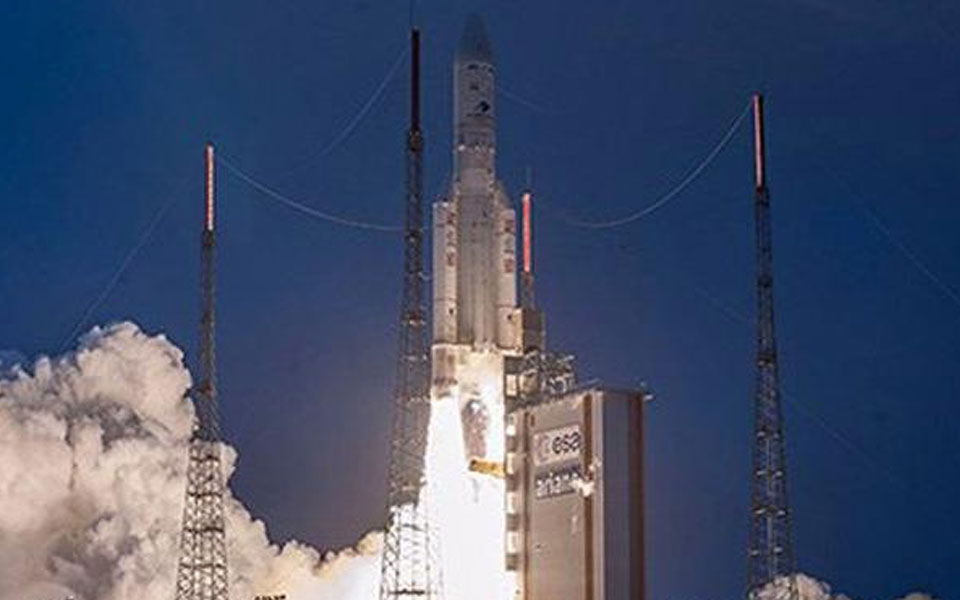
Bengaluru, Feb 6: India's latest communication satellite GSAT-31 was successfully launched by European launch services provider- Arianespace's rocket from French Guiana in the early hours of Wednesday.
Blasting off from Ariane Launch Complex at Kourou, a French territory located in northeastern coast of South America at at 2.31 am (IST), the Ariane-5 vehicle injected GSAT-31 into the orbit in a flawless flight lasting about 42 minutes.
"It gives me great pleasure on the successful launch of GSAT-31 spacecraft on board Ariane-5," Indian Space Research Organisation's (ISRO) Satish Dhawan Space Centre (SDSC) Director S Pandian said at Kourou soon after the launch.
"Congratulation to Arianespace on the successful launch and precise injection of satellite into the orbit," he added.
The GSAT-31 is a "high power" communication satellite with Ku-band, and it is going to serve and replace some of the satellites that are going to expire soon, he said further.
Arianespace CEO Stéphane Israël tweeted: "2019 is off to a roaring start for #Arianespace! Flight #VA247, carrying Saudi Geostationary Satellite 1/Hellas Sat 4 and GSAT-31, is a confirmed success that underscores our leadership position in the geostationary launch market. @KACST #HellasSat @ISRO @LockheedMartin."
The Ariane-5 vehicle (Flight VA247) also carried Saudi Geostationary Satellite 1/Hellas Sat 4 along with GSAT-31.
GSAT-31 separated from the Ariane-5 in an elliptical Geosynchronous Transfer Orbit with a perigee (nearest point to Earth) of 250 km and an apogee (farthest point to Earth) of 35,850 km, inclined at an angle of 3.0 degree to the equator, ISRO said in a release after the launch.
After separation from Ariane-5, the two solar arrays of GSAT-31 were automatically deployed in quick succession and ISRO's Master Control Facility at Hassan in Karnataka took over the command and control of GSAT-31 and found its health parameters normal, it said.
In the days ahead, scientists will undertake phase-wise orbit-raising manoeuvres to place the satellite in Geostationary Orbit (36,000 km above the equator) using its on-board propulsion system.
During the final stages of its orbit raising operations, the antenna reflector of GSAT-31 will be deployed, and following this, the satellite will be put in its final orbital configuration, the space agency said, adding that the satellite will be operational after the successful completion of all in-orbit tests.
Weighing about 2,536 kg, the Indian satellite, GSAT-31, will provide continuity to operational services on some of the in-orbit satellites.
The satellite derives its heritage from ISRO's earlier INSAT/GSAT satellite series, the space agency said, adding that it will provide communication services to Indian mainland and islands.
GSAT-31 is the country's 40th communication satellite which is configured on ISRO's enhanced 'I-2K Bus', utilising the maximum "bus capabilities" of this type.
This satellite will augment the Ku-band transponder capacity in Geostationary Orbit, ISRO said.
With a mission life of around 15 years, GSAT-31 will be used for supporting VSAT networks, Television uplinks, Digital Satellite News Gathering, DTH-television services, cellular backhaul connectivity and many such applications.
It will also provide wide beam coverage to facilitate communication over large oceanic region, comprising large parts of Arabian Sea, Bay of Bengal and Indian Ocean, using a wide band transponder.
According to ISRO, two Ku-band beacon down link signals are transmitted by the satellite for ground tracking purpose.
"GSAT-31 has a unique configuration of providing flexible frequency segments and flexible coverage," ISRO chairman K Sivan said.
"GSAT-31 will provide DTH Television Services, connectivity to VSATs for ATM, Stock-exchange, Digital Satellite News Gathering (DSNG) and e-governance applications. The satellite will also be used for bulk data transfer for a host of emerging telecommunication applications," he said in a release.
Riding in Ariane-5's upper position, HS-4/SGS-1 was released first in the flight sequence, with its separation occurring about 27 minutes after liftoff.
Comprising two payloads, Saudi Geostationary Satellite 1/Hellas Sat 4, also called HS- 4/SGS-1, is a geostationary condosat for KACST (King Abdulaziz City for Science and Technology Saudi Arabia) and Hellas Sat (Greece Cyprus).
HS- 4/SGS-1 will provide telecommunication capabilities, including television, Internet, telephone and secure communications in the Middle East, South Africa and Europe, Arianespace said on its website.
GSAT-30 is another geostationary satellite to be lofted soon by Arianespace for ISRO.
"Soon we will be getting back to French Guiana some time in June, July to launch GSAT-30," Pandian said.
Let the Truth be known. If you read VB and like VB, please be a VB Supporter and Help us deliver the Truth to one and all.
National Synodal Assembly 2026 begins in Bengaluru with over 220 delegates
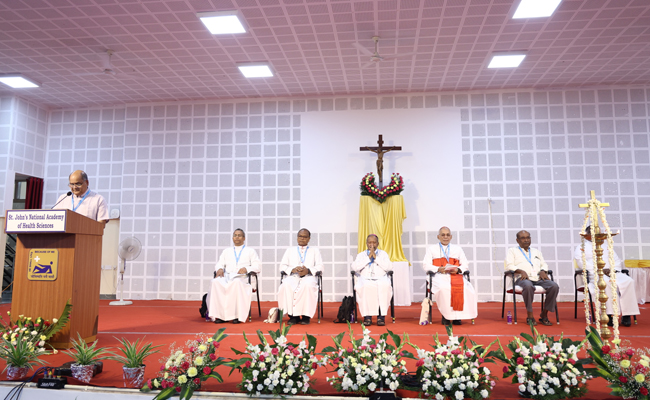
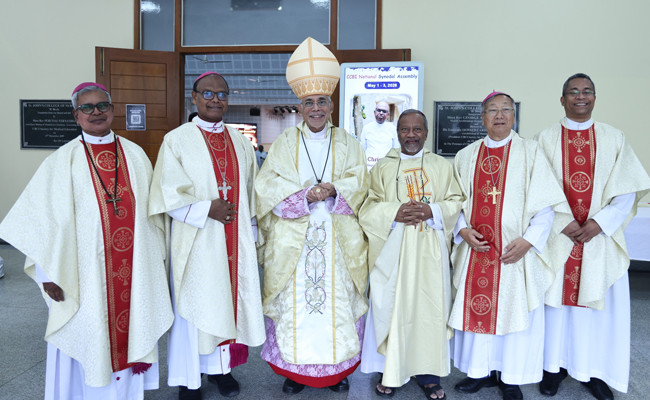
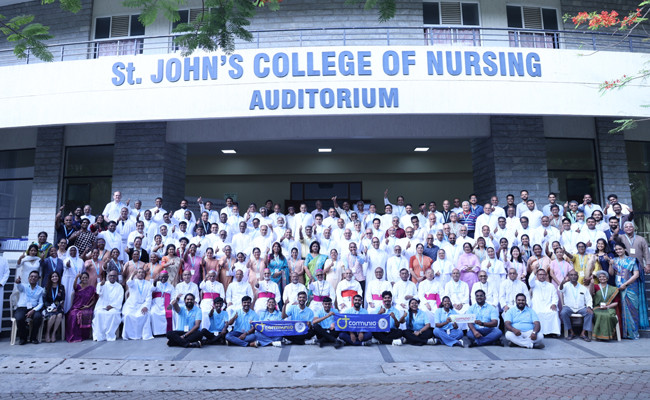
Bengaluru: The Conference of Catholic Bishops of India (CCBI) on May 1 inaugurated its National Synodal Assembly 2026 at St. John’s Medical College, bringing together more than 220 delegates from across the country under the theme Synodal Pilgrims of Hope.
The assembly is part of the global synodal process initiated in 2021 by Pope Francis, which calls for greater participation, dialogue and shared responsibility within the Church. In India, the process has involved consultations at diocesan, regional and national levels.
Participants at the assembly include two Cardinals, 25 Bishops, 65 priests, more than 20 women religious, and over 100 lay faithful, including youth and women leaders.
The gathering began with a Eucharistic celebration led by Filipe Neri Ferrão. In his homily, he described the assembly as a moment of grace and discernment and called on delegates to walk together in prayer, listening and missionary commitment.
He spoke about the importance of the Risen Christ in the mission of the Church and urged the faithful to be witnesses of the Gospel. Referring to the conversion of St Paul, he said every baptised person has a role in spreading the message of Christ. He also highlighted the example of St Joseph the Worker, stressing the dignity of labour and the call to holiness in everyday life.
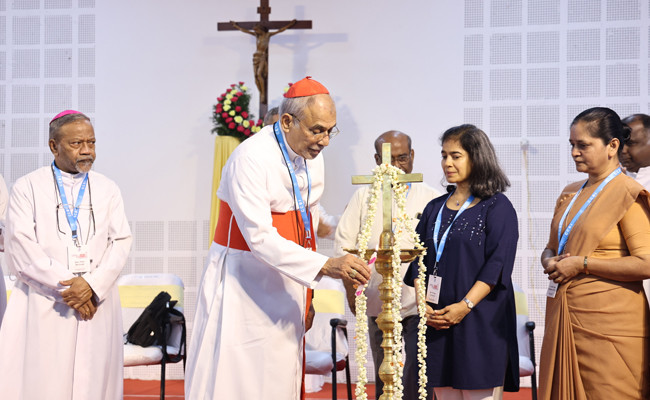
The formal inauguration included the invocation of the Holy Spirit through Veni Creator Spiritus and the lighting of the ceremonial lamp. Deputy Secretary General Fr. Stephen Alathara welcomed the delegates and described the gathering as a spiritual journey.
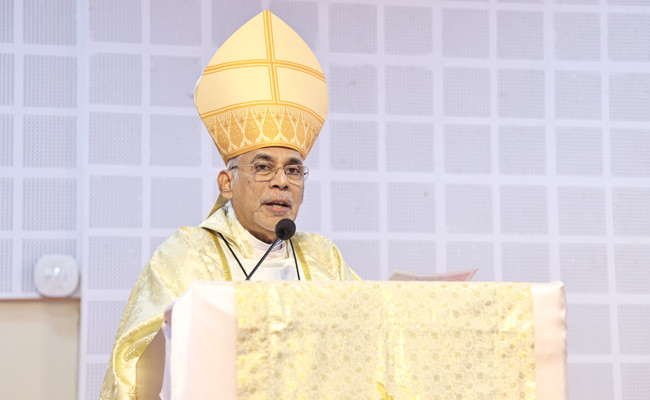
In his presidential address, Cardinal Ferrão referred to the CCBI pastoral plan titled Journeying Towards a Synodal Church: Mission 2033 and called on participants to build on the vision outlined at the 36th Plenary Assembly held in Bhubaneswar in 2025.
Delegates will reflect on four key themes identified from 16 pastoral priorities: interreligious dialogue and peacebuilding, inclusion of the excluded, poverty and integral ecology, and support for children and youth.
The discussions are being conducted through a method of spiritual conversation aimed at encouraging listening, dialogue and collective decision-making. The focus is on translating these discussions into practical actions within the Church.
The assembly also looks ahead to the Jubilee Year 2033, which will mark 2,000 years of the Redemption, and aims to strengthen the Church’s mission in the coming years.
Further consultations are scheduled for September 2026, with the process expected to conclude at the 38th Plenary Assembly of the CCBI in January 2027.
Organisers said the assembly seeks to strengthen unity within the Church and promote participation of all sections, including women and youth, in shaping its future direction.