India successfully test-fires long-range hypersonic missile; Rajnath describes it as 'historic'
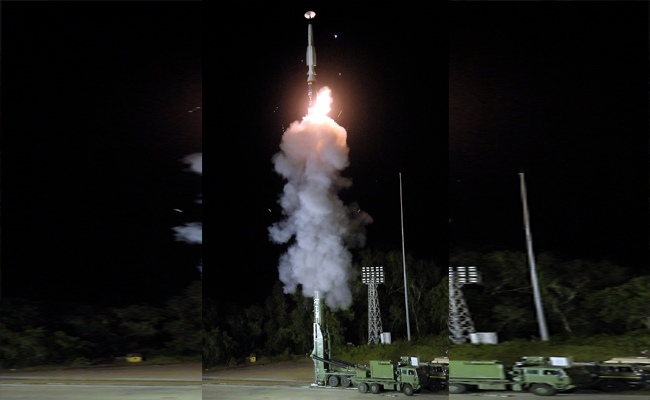
New Delhi (PTI): In a major boost to its military prowess, India has successfully flight-tested a long-range hypersonic missile off the coast of Odisha, an achievement that has put the country in a select group of nations having the weapon that can strike with extreme speed and evade most air defence systems.
Defence Minister Rajnath Singh described the missile test on Saturday under the country's first long-range hypersonic mission as a "stupendous" achievement and a "historic moment".
The missile, developed by the Defence Research and Development Organisation (DRDO), is designed to carry various payloads for ranges greater than 1,500 km, an official readout said.
"India has achieved a major milestone by successfully conducting flight trial of long range hypersonic missile from Dr APJ Abdul Kalam Island, off-the-coast of Odisha," Singh said on 'X'.
"This is a historic moment and this significant achievement has put our country in the group of select nations having capabilities of such critical and advanced military technologies," he said.
Generally, the hypersonic missiles, capable of carrying conventional explosives or nuclear warheads, can fly in the range of five times the speed of sound (Mach 5 which is roughly 1,220 km) per hour at sea level.
However, some advanced versions of hypersonic missiles can even fly at the speed of over 15 mach.
At present, Russia and China are way ahead in developing hypersonic missiles while the US is in the process of developing a range of such weapons under an ambitious programme.
Several other countries, including France, Germany, Australia, Japan, Iran, and Israel, are also pursuing projects to develop hypersonic missile systems.
Defence Minister Singh also congratulated the DRDO, the armed forces and the industry for the "stupendous" achievement.
The defence ministry said the missile was tracked by various range systems, deployed in multiple domains.
"The flight data obtained from down range ship stations confirmed the successful terminal maneuvers and impact with high degree of accuracy," it said in the readout.
This missile has been indigenously developed by the laboratories of the Dr APJ Abdul Kalam Missile complex, Hyderabad along with various other DRDO laboratories and industry partners.
The flight-trial was carried out in the presence of senior scientists of DRDO and officers of the armed forces.
Let the Truth be known. If you read VB and like VB, please be a VB Supporter and Help us deliver the Truth to one and all.
UP man gets life term for electrocuting mentally challenged wife to death in Bareilly

Bareilly (UP) (PTI): A local court here has sentenced a man to life imprisonment for murdering his mentally challenged wife by repeatedly electrocuting her while she was tied to a cot, lawyers said on Thursday.
Additional district government counsel Harendra Singh Rathore said Additional Sessions Judge Avinash Kumar Singh on Wednesday convicted Vinod Kumar (45) for killing his wife, Satyavati, in Chaina village of Bareilly district and imposed a fine of Rs 15,000 on him.
According to the prosecution, he was allegedly frustrated with his wife Satyavati's mental illness and often assaulted her.
Rathore said the prosecution examined nine witnesses to establish the charges against him.
As per court records, on the night of May 1-2, 2022, when Satyavati was asleep, Vinod tied her hands and legs to a cot using ropes and then connected an aluminium cable to an electric board to repeatedly administer electric shocks to her.
"She writhed in pain, but the accused continued to electrocute her until she died," the prosecution said.
The court observed that the murder was carried out in an inhuman manner.
After committing the crime, the accused threw the rope and cable on the roof and left for work at a brick kiln around 2 am to create a false alibi.
He later tried to mislead the police and the victim's family by claiming that Satyavati, whose mental condition was unstable, had accidentally died by suicide after grabbing a live electric wire.
However, the victim's brother, Sanjeev, a resident of Shahjahanpur district, suspected foul play and lodged an FIR under sections 498A (husband subjecting wife to cruelty) and 302 (murder) of the Indian Penal Code at Nawabganj police station.
During the trial, the prosecution relied on the post-mortem report prepared by Dr Faraz Anwar, who stated that multiple electrocution marks found on different parts of the victim's body could not have been self-inflicted.
The police also recovered the rope and electric wire used in the crime on the accused's identification, officials said.