India to focus on taking domestic defence production to 100 per cent: Rajnath
_vb_75.jpeg)
Nashik (PTI): India is looking at taking domestic defence production to 100 per cent as dependence on foreign military supplies creates "strategic vulnerability", Defence Minister Rajnath Singh said on Friday.
He said this after inaugurating a third production line of Tejas Light Combat Aircraft (LCA)-Mk1A and a second manufacturing facility of trainer jet HTT-40.
"There was a time when the country was dependent on other countries to meet its defence needs, and almost 65-70 percent of defence equipment was imported," Singh said in his address.
"But today, this situation has changed; now India is doing 65 per cent manufacturing on its own soil. Very soon, we will take our domestic manufacturing to 100 per cent as well," he said.
Listing out major feats achieved in view of the government's efforts to promote self-reliance in defence, Singh said India's annual defence production has surged to over Rs 1.50 lakh crore in 2024-25 from Rs 46,429 crore in 2014-15.
Singh said the defence exports touched an all-time high of Rs 25,000 crore from less than Rs 1,000 crore a decade ago.
"We have now set a target to achieve Rs three lakh crore in domestic defence manufacturing and Rs 50,000 crore in defence exports by 2029," he said.
The defence minister said India can never be secure without achieving self-reliance in the defence sector.
"When we came to power in 2014, we realised that without self-reliance, we can never be truly secure. In the beginning, we faced numerous challenges, the biggest being 'limited defence preparedness' and 'import dependency'," he said.
Singh said everything was limited to government enterprises, and the private sector had no significant participation in the production ecosystem.
"In addition, there was not enough focus on defence planning, advanced technology, and innovation. This forced us to depend on other countries for critical equipment and cutting-edge systems, which increased costs and created strategic vulnerabilities," he said.
Singh said this challenge "encouraged us to move forward in the direction of new thinking and reforms."
"The results are visible today. We not only reduced import dependency, but also strengthened our commitment to indigenisation. Whatever we used to buy from abroad, we are now manufacturing it domestically, be it fighter aircraft, missiles, engines and electronic warfare systems," he said.
On the constantly-evolving nature of modern-day warfare, Singh underscored the importance of staying ahead of the curve as Artificial Intelligence, cyber warfare, drone systems and next-generation aircraft are shaping the future, and wars are being fought across multiple frontiers.
"India must always stay ahead in this new race, and not lag behind," he said, exhorting HAL to make its mark in the fields of next-generation aircraft, unmanned systems and civil aviation, and not limit itself to LCA Tejas or HTT-40," he said.
Let the Truth be known. If you read VB and like VB, please be a VB Supporter and Help us deliver the Truth to one and all.
Engine issue forces SWISS Delhi flight to abort takeoff; six passengers injured
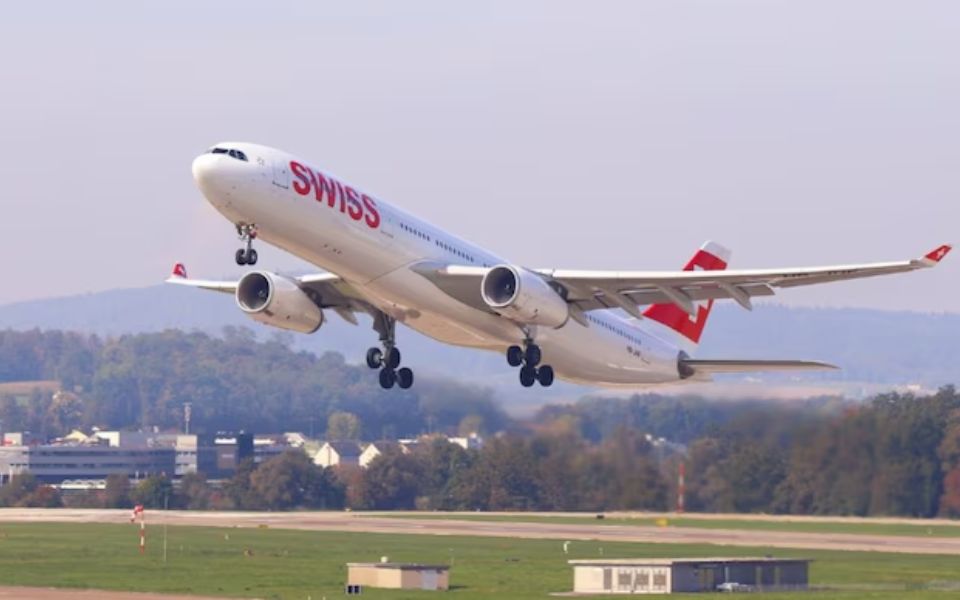
New Delhi (PTI): A Zurich-bound Swiss International Air Lines' flight carrying 232 passengers aborted take off at the Delhi airport early Sunday due to an engine issue, sources said.
Six passengers are undergoing medical evaluation, an airline spokesperson said without elaborating.
Smoke was observed from the port side of one of the landing gears of the A330 aircraft that was operating the flight LX147 to Zurich. The flight crew aborted the take off and full emergency response was initiated, the sources said.
In a detailed statement, an airline spokesperson said there were 228 passengers and four infants on board.
"Shortly after takeoff, just after 1:00 am. local time in India, an issue occurred with one of the engines. The crew rejected the takeoff and, following an assessment of the situation, decided as a precaution to evacuate the aircraft," the spokesperson said.
Six passengers were receiving medical attention, the spokesperson added.
"All passengers and crew evacuated the aircraft via the emergency slides.Six passengers are currently undergoing medical evaluation. For a small number of individuals who were unable to use the slides, stairs were provided," the spokesperson said.
According to the spokesperson, Swiss technical specialists will travel to Delhi to inspect the aircraft and initiate the next steps.
The airline is known as Swiss.
At the same time, the spokesperson said the airline was working intensively to find a swift and suitable onward travel solutions for all passengers.