India to grow at 7 pc in FY23, lose fastest growing economy tag
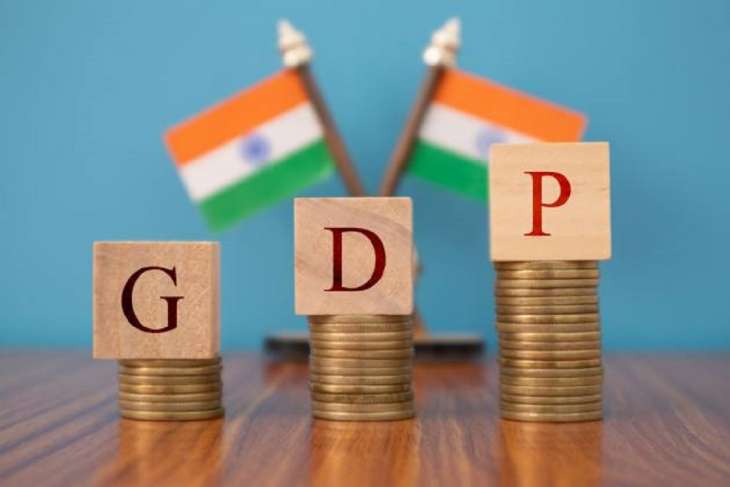
New Delhi, Jan 6: Hit by weakening demand, the Indian economy is expected to grow at a slower 7 per cent rate in the current fiscal ending March 2023, setting the stage for the country losing the fastest-growing major economy tag.
The 7 per cent expansion projected in the first official estimate released by the Statistics Ministry compares with 8.7 per cent gross domestic product (GDP) growth in 2021-22.
The projections are much lower than government's earlier forecast of 8-8.5 per cent growth but above the Reserve Bank's projection of 6.8 per cent. If the forecast comes true, India's GDP growth will be lower than Saudi Arabia's expected 7.6 per cent expansion.
In fact, India's GDP growth in the July-September quarter at 6.3 per cent was lower than the 8.7 per cent of Saudi Arabia.
The first advance GDP estimates, which are used to work out allocations and other fiscal projections for the next Budget due on February 1, proved to be more optimistic than the actual growth in three out of the last four years.
The projections suggest that despite the global headwinds and continued geopolitical uncertainty caused by the Russia-Ukraine conflict, the recovery is on track though there are pressure points. Inflation has been sticky despite a 225 basis points increase in interest rates since last May, which is likely to moderate demand.
"We believe that buoyant albeit mixed domestic consumption should help to stave off some of the pain arising from weak exports during this period," said Aditi Nayar, Chief Economist, ICRA Ltd.
"Given the full-year projections released today by the NSO, we expect there to be some revisions in either the H1 or the H2 FY2023 sectoral numbers, in the subsequent data releases."
Sunil Sinha, Senior Director and Principal Economist, India Ratings & Research, said the road ahead is not going to be easy so long as private final consumption expenditure (PFCE) does not recover fully and become broad-based.
"The household sector, which accounts for 44-45 per cent of the GVA, saw their nominal wage growth decline to 5.7 per cent during FY17-FY21 from 8.2 per cent during FY12-FY16. In fact, the real wage growth became nearly flat or even turned negative in some months of FY23 due to high inflation.
"Since much of the growth in consumption demand is driven by the wage growth of the household sector, a recovery in their wage growth is an imperative for a sustainable economic recovery," he noted.
The first advance estimates for 2022-23 factored in discrepancies of Rs 4,06,943 crore, which is nearly double the amount of Rs 2,16,842 crore as per provisional estimates of GDP growth for 2021-22 released on May 31, 2022. The discrepancies were Rs 2,38,638 crore in 2020-21.
Discrepancies in the statistical GDP data refer to the difference in national income under production method and expenditure method.
As per the first advance estimates of national income released by the National Statistical Office (NSO) on Friday, the manufacturing sector output is estimated to decelerate to 1.6 per cent in the current fiscal from 9.9 per cent in 2021-22.
Similarly, mining sector growth is estimated at 2.4 per cent in the current fiscal as against 11.5 per cent in 2021-22.
"Real GDP or GDP (Gross Domestic Product) at Constant (2011-12) Prices in the year 2022-23 is estimated at Rs 157.60 lakh crore, as against the Provisional Estimate of GDP for the year 2021-22 of Rs 147.36 lakh crore, released on 31st May, 2022," an NSO statement said.
It stated that growth in real GDP during 2022-23 is estimated at 7.0 per cent as compared to 8.7 per cent in 2021-22.
It also said the nominal GDP or GDP at Current Prices in the year 2022-23 is estimated at Rs 273.08 lakh crore, as against the Provisional Estimate of GDP for the year 2021-22 of Rs 236.65 lakh crore.
The growth in nominal GDP during 2022-23 is estimated at 15.4 per cent as compared to 19.5 per cent in 2021-22.
The agriculture sector is projected to see a growth of 3.5 per cent in FY2022-23, higher than the 3 per cent expansion recorded in the previous financial year.
Trade, hotel, transport, communication and services related to broadcasting segment is estimated to grow at 13.7 per cent from 11.1 per cent in 2021-22.
Financial, real estate and professional services segment is projected to grow at 6.4 per cent in the current fiscal, up from 4.2 per cent in 202-22.
However, construction sector growth is expected to decelerate to 9.1 per cent from 11.5 per cent a year ago.
Similarly, public adminstration, defence and other services growth is estimated to drop to 7.9 per cent this fiscal from 12.6 per cent in FY22.
The growth in gross value added (GVA) at basic prices is pegged at 6.7 per cent this fiscal, down from 8.1 per cent in 2021-22.
Let the Truth be known. If you read VB and like VB, please be a VB Supporter and Help us deliver the Truth to one and all.
Rickelton's ton in vain as SRH beat MI by 6 wickets

Mumbai (PTI): Ryan Rickelton's whirlwind unbeaten ton was overshadowed by Heinrich Klaasen's unbeaten 65 as Sunrisers Hyderabad defeated Mumbai Indians by six wickets in an IPL match here on Wednesday.
Chasing an imposing 244-run target, Travis Head (76 off 30) and Abhishek Sharma (45 off 24) shared 129 runs for the opening wicket to set the platform for SRH.
Klaasen (65 not out off 30 balls) then displayed his all-round hitting abilities to guide SRH home with the help of Nitish Kumar Reddy (21) and Salil Arora (30 not out off 10) in 18.4 overs.
Earlier, Rickelton's knock powered MI to 243 for five.
MI rode on a 93-run stand between Rickelton (123 not out off 55 balls) and Will Jacks (46 off 22) in 7.1 overs for the opening stand to power the side.
MI skipper Hardik Pandya scored a valuable 31 off 15 balls before being dismissed.
Praful Hinge (2/54), Eshan Malinga (1/29), Sakib Hasan (1/39) and Nitish Kumar Reddy (1/31) were the wicket-takers for SRH.
Brief Scores:
Mumbai Indian: 243 for 5 in 20 overs (Ryan Rickelton 123 not out; Praful Hinge 2/54).
Sunrisers Hyderabad: 249 for 4 in 18.4 overs (Travis Head 76, Heinrich Klaasen 65 not out; AM Ghazanfar 2/51).