India will function according to the wishes of the majority: Allahabad High Court judge at VHP event

Prayagraj: In a speech at an event organised by the legal cell of the Vishwa Hindu Parishad (VHP) at the Allahabad High Court's historic library hall, Justice Shekhar Kumar Yadav made several remarks that are bound to spark controversy. His statements, particularly those about the functioning of India, minority communities, and the need for a Uniform Civil Code (UCC), have drawn significant criticism for their inflammatory nature.
Justice Yadav asserted, "I have no hesitation in stating that this is Hindustan, and this country will function according to the wishes of the majority living here. This is the law. It is not about speaking as a High Court Judge; rather, the law operates in accordance with the bahusankyak (majority). Consider this in the context of a family or society - only what ensures the welfare and happiness of the majority will be accepted."
He did not stop at this controversial declaration. The judge went further, using the derogatory term “kathmullah,” a slur commonly used to describe Muslims, which he referred to while discussing extremism. He said, "This may not be the right word... but I won't hesitate to say it because they are harmful to the country... they are detrimental, against the nation, and people who incite the public. They are the kind of people who do not want the country to progress, and we need to be cautious of them."
In his speech, Justice Yadav also highlighted the cultural differences he believes exist between communities in India. "In our country, we are taught from a young age to respect all living beings, even the smallest animals, and to avoid harming them. This lesson becomes a part of who we are, which is perhaps why we are more tolerant and compassionate, feeling pain when others suffer. But this isn't the case for everyone. In our culture, children are raised with guidance towards God, taught Vedic mantras, and instilled with the values of non-violence. However, in some other cultures, children grow up witnessing the slaughter of animals, which makes it difficult to expect them to develop tolerance and compassion."
Regarding the Uniform Civil Code (UCC), a topic frequently discussed by right-wing groups, Justice Yadav voiced his opinion, stating that the personal laws of the Muslim community, such as those permitting multiple marriages, Halala, and Triple Talaq, should be reformed. He said, "You say, we have the right to say 'triple talaq,' and not give maintenance to women. This right will not work. UCC isn't something that VHP, RSS, or Hinduism advocates. The country's top court also talks about it... This is the historic library hall of the court, where so many great personalities have been..." He emphasised that these practices are incompatible with the Constitution and the rights of women.
In a particularly provocative remark, Justice Yadav stated, "A woman will receive maintenance, bigamy will not be allowed, and a man will have only one wife, not four. If one woman receives maintenance while another does not, it leads to discrimination, which is against the Constitution." He further went on to say that Muslim personal laws, including the practice of Triple Talaq, should not be allowed, as they contradict the constitutional guarantee of equality.
When discussing the issue of national identity and religious tolerance, Justice Yadav said: “Being a Hindu is not limited to those who bathe in the Ganga or apply chandan (sandalwood). Anyone who views this land as their mother and is ready to sacrifice their life for the nation during a crisis, irrespective of their religious beliefs—whether they follow the Quran or the Bible—is a Hindu.”
In his closing comments, Justice Yadav discussed the Ayodhya judgment. He stated, “Could you have ever imagined seeing the Ram Mandir with your own eyes? Many of our ancestors made sacrifices with the hope of seeing Ram Lalla freed and witnessing the grand temple’s construction. Although they couldn’t live to see it, they played their part, and now, we are witnessing it ourselves.”
Justice Yadav also cautioned against misinterpreting Hindu values of non-violence, stating, “While Hindus are known for their non-violence and kindness, it should not be mistaken for cowardice. We must teach our children that the country, our religious practices, and our revered personalities should always come first.”
The remarks made by Justice Yadav have sparked strong reactions, particularly from the All India Lawyers’ Union, which has condemned his statements as a violation of the oath of office and accused him of promoting hate speech. The Union has called for the Supreme Court to intervene and take appropriate action against the judge. They also condemned the very participation of a sitting judge in an event organised by a right-wing group like the VHP, accusing it of being shameful.
This controversy follows a similar incident in September 2024 when another Allahabad High Court judge, Justice Rohit Ranjan Agarwal, made inflammatory remarks about the future demographic changes in India, suggesting that Hindus could become a minority due to religious conversions.
Let the Truth be known. If you read VB and like VB, please be a VB Supporter and Help us deliver the Truth to one and all.
No need for guv: DMK leader Kanimozhi
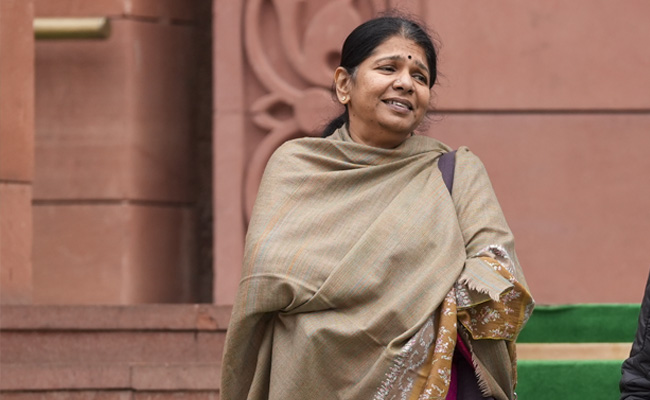
Chennai (PTI): Senior DMK leader Kanimozhi Karunanidhi on Friday reiterated her party’s opposition to the office of the governor amid uncertainty over government formation in Tamil Nadu after a fractured election mandate.
Speaking to PTI Videos, Kanimozhi emphasised that the DMK’s demand for the abolition of the governor’s post remained unchanged, especially as questions arise over constitutional propriety during the current political transition.
"Our position that we do not need a governor at all is something the DMK has never changed at any point in time," she said.
When asked about the governor’s actions following the election results—particularly the delay in inviting the leading party to form the government—Kanimozhi pointed to what she described as the "inherent friction" between the office of the governor and the political interests of the state.
She said the current situation "raises a lot of questions" and requires introspection regarding constitutional procedures.
Kanimozhi described the election results as lacking a "clear mandate", which she identified as the primary reason for the prevailing political uncertainty in the state.
"What the people decide is supreme," she said, adding that while the mandate was not decisive, it must be respected.
The Thoothukudi MP attributed the ongoing delays and "many confusions" to the absence of a decisive majority for any single party.
She firmly dismissed rumours about the DMK potentially supporting the AIADMK from outside to help stabilise the government.
She described such reports as mere "speculation" and "rumours".
"We can’t be responding to every rumour," she said, declining to comment on the AIADMK’s claims regarding its numbers to form the government.
The political situation in Tamil Nadu remains fluid as stakeholders await the governor’s next constitutional step in an Assembly where no party has secured a clear majority.
The DMK and AIADMK—both of which suffered significant losses to the TVK—are reportedly exploring tactical manoeuvres to navigate the hung Assembly.
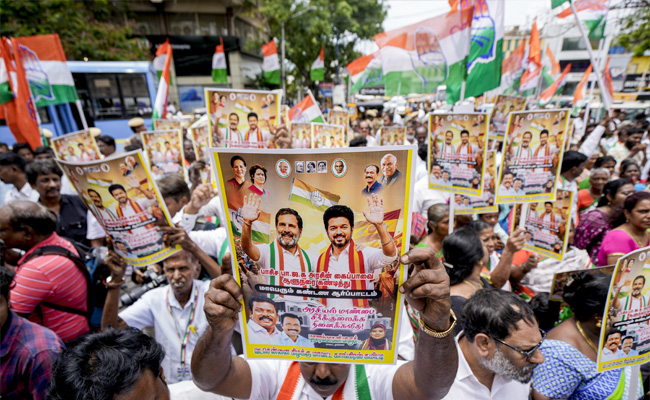
The TVK, with 108 seats and the support of Congress’s five MLAs, is still short of the majority mark. The DMK and AIADMK secured 59 and 47 seats, respectively.