Indian-American Abhijit Banerjee, Esther Duflo and Michael Kremer win Nobel Economics Prize
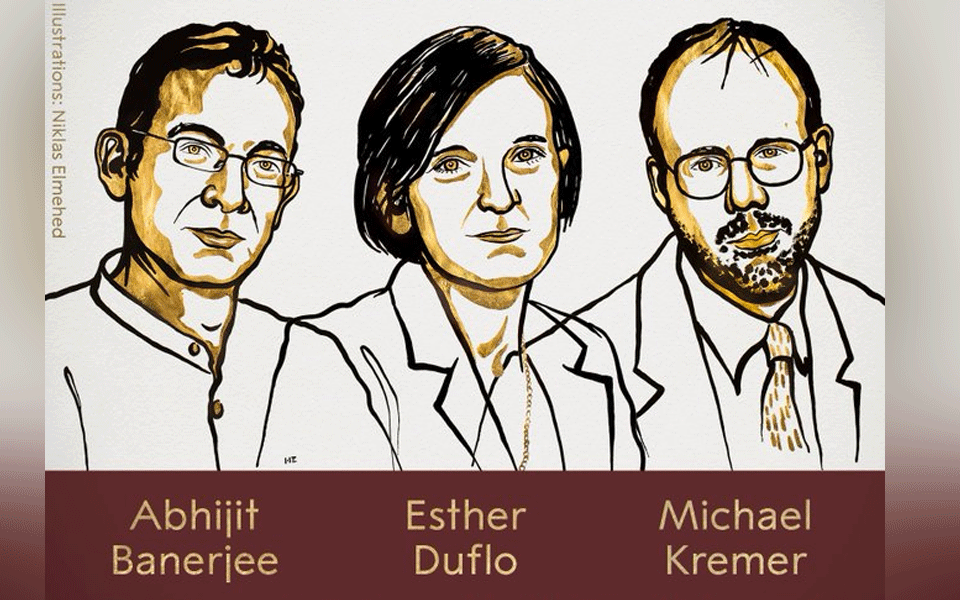
Stockholm: Indian-American Abhijit Banerjee, his wife Esther Duflo and Michael Kremer jointly won the 2019 Nobel Economics Prize on Monday "for their experimental approach to alleviating global poverty."
Banerjee and French-American Duflo both work at the prestigious Massachusetts Institute of Technology while Kremer is at Harvard University. Duflo is the second woman and the youngest ever to win the economics prize.
The prize includes 9 million-kronor (USD 918,000) cash, a gold medal and a diploma. The winners will equally share the prize money.
"The research conducted by this year's Laureates has considerably improved our ability to fight global poverty. In just two decades, their new experiment-based approach has transformed development economics, which is now a flourishing field of research," the Royal Swedish Academy of Sciences said.
They have introduced a new approach to obtaining reliable answers about the best ways to fight global poverty, it added.
Their "research findings - and those of the researchers following in their footsteps - have dramatically improved our ability to fight poverty in practice," it said.
As a direct result of one of their studies, more than five million Indian children have benefitted from effective programmes of remedial tutoring in schools. Another example is the heavy subsidies for preventive healthcare that have been introduced in many countries, it added.
"Showing that it is possible for a woman to succeed and be recognised for success I hope is going to inspire many, many other women to continue working and many other men to give them the respect they deserve," Duflo said at a press conference soon after the announcement.
Banerjee, 58, was educated at the University of Calcutta, Jawaharlal Nehru University and Harvard University, where he received his Ph.D in 1988.
He is currently the Ford Foundation International Professor of Economics at the Massachusetts Institute of Technology, according to his profile on the MIT website.
In 2003, Banerjee founded the Abdul Latif Jameel Poverty Action Lab (J-PAL), along with Duflo and Sendhil Mullainathan, and he remains one of the lab's directors.
He also served on the UN Secretary-General's High-level Panel of Eminent Persons on the Post-2015 Development Agenda.
Duflo, born in 1972, is the Abdul Latif Jameel Professor of Poverty Alleviation and Development Economics in the Department of Economics at the Massachusetts Institute of Technology and a co-founder and co-director of the Abdul Latif Jameel Poverty Action Lab (J-PAL).
With Banerjee, she wrote Poor Economics: A Radical Rethinking of the Way to Fight Global Poverty, which won the Financial Times and Goldman Sachs Business Book of the Year Award in 2011 and has been translated into more than 17 languages.
She has worked on health, education, financial inclusion, environment and governance. Her first degrees were in history and economics from Ecole Normale Superieure, Paris. She subsequently received a Ph.D. in Economics from MIT in 1999.
Duflo has received numerous academic honours and prizes including the Princess of Asturias Award for Social Sciences (2015), the A.SK Social Science Award (2015), Infosys Prize (2014), the David N. Kershaw Award (2011), a John Bates Clark Medal (2010), and a MacArthur Genius Grant Fellowship (2009).
She is the Editor of the American Economic Review, a member of the National Academy of Sciences and a Corresponding Fellow of the British Academy.
Kremer, 54, is a development economist, who is currently the Gates Professor of Developing Societies at Harvard University.
Let the Truth be known. If you read VB and like VB, please be a VB Supporter and Help us deliver the Truth to one and all.
Strictest action promised after students forced to remove sacred thread at Bengaluru CET exam centre
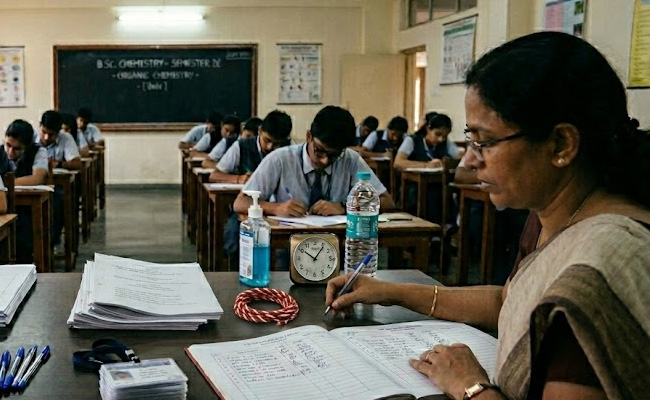
Bengaluru (PTI): Bengaluru Urban Deputy Commissioner Jagadeesha G on Monday said the government has decided to take the “strictest possible action” against those responsible for allegedly forcing some students to remove their ‘janivara’ (sacred thread) before entering the venue of the CET exam last week.
He said a committee of senior officials constituted to inquire into the incident reported that, prima facie, it appears the students were “intentionally” made to remove the ‘janivara’.
The city police have already booked three staff members of a private college in Bengaluru for allegedly forcing some students to remove their ‘janivara’ before entering the venue of the Common Entrance Test (CET-2026) last week.
Similar incidents last year in Shivamogga and Bidar had triggered controversy, following which the Karnataka Examinations Authority (KEA) issued clear directions not to force students to remove any religious identification or symbol during exams.
“Despite KEA taking measures such as appointing dress code officials and providing training on dos and don’ts to prevent such incidents from recurring after last year’s cases, there has been a dereliction of duty this time,” Jagadeesha told reporters here.
“To take strict action against those responsible, an FIR has been registered, and arrests have been made. An inquiry has been conducted by senior officials, and those responsible have been suspended,” he added.
Stating that the inquiry report has been submitted at the district level, he said it will be forwarded to the government.
Based on the findings, it has also been decided that KEA will not conduct CET exams at the institution where the incident occurred, he added.
“The strictest possible action is being taken by the district administration and the government,” he added.
The deputy commissioner had constituted a committee headed by the additional deputy commissioner to investigate the incident and submit a report within two days.
“Exams have been held at several centres across the state, and nowhere else has this issue occurred. If students were forced to remove ‘janivara’ at this centre, it appears that it was intentional. We have taken it seriously,” he said, adding that strict action has been recommended to ensure such incidents do not recur.
Noting that senior officials were appointed for the inquiry, the DC said that after a thorough investigation and verification—which included statements from students, the school principal, exam observers, CCTV footage, and documents—it prima facie appears that students were intentionally made to remove the ‘janivara’.
“We are recommending strict action. The government has also ordered a detailed police investigation, and an FIR has been registered in connection with the incident,” he added.