Indian economy to shrink 9% in FY21: ADB
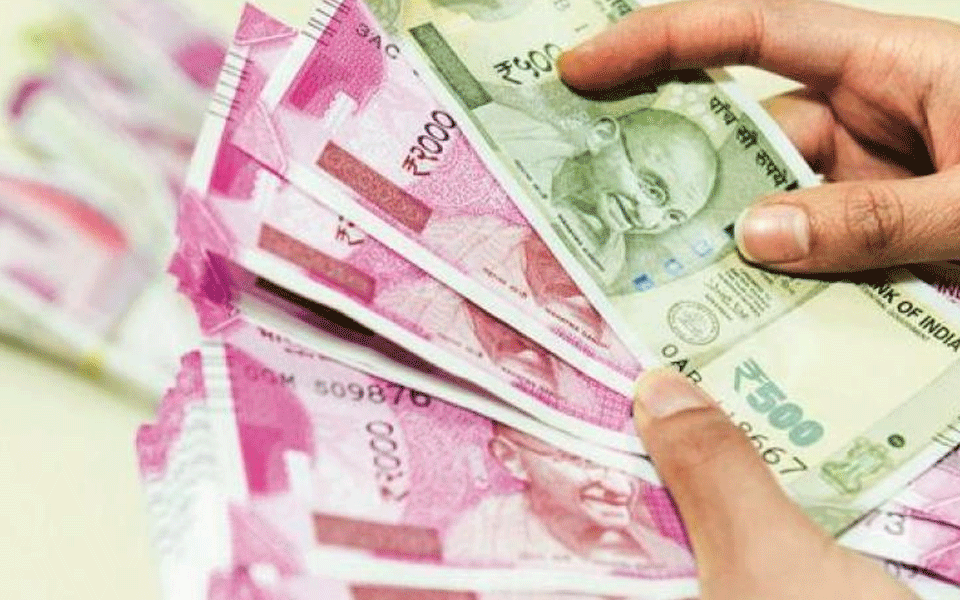
New Delhi: India's coronavirus-battered economy will shrink by 9 per cent this fiscal, the Asian Development Bank (ADB) predicted on Tuesday saying growth outlook remains highly vulnerable to either a prolonged outbreak of the pandemic or a resurgence of cases.
This will be the first time in four decades that the Indian economic growth will contract.
In its Asian Development Outlook (ADO) 2020 Update, ADB forecasts a strong recovery for the economy in FY2021, with gross domestic product (GDP) growing by 8 per cent as mobility and business activities resume more widely.
"India imposed strict lockdown measures to contain the spread of the pandemic and this has had a severe impact on economic activity," said ADB Chief Economist Yasuyuki Sawada.
Sawada further noted that "it is crucial that containment measures, such as robust testing, tracking, and ensuring treatment capacities, are implemented consistently and effectively to stop the spread of COVID-19 and provide a sustainable platform for the economy's recovery for the next fiscal year and beyond."
With lockdowns stalling private spending, ADB said GDP will shrink by 9 per cent in April 2020 to March 2021, sharply down from its June's forecast of (-) 4 per cent.
"The growth outlook remains highly vulnerable to either a prolonged outbreak or a resurgence of cases, with the country now having one of the highest number of COVID-19 cases globally," It said.
Other downside risks include increasing public and private debt levels that could affect technology and infrastructure investment, as well as rising non-performing loans caused by the pandemic that could further weaken the financial sector and its ability to support economic growth.
ADB joins a chorus of international agencies that have predicted a contraction in the Indian economy in the current fiscal.
S&P Global Ratings on Monday slashed its FY21 growth forecast for India to (-) 9 per cent, from (-) 5 per cent estimated earlier, saying that rising COVID-19 cases would keep private spending and investment lower for longer.
Last week, two other global rating agencies Moody's and Fitch projected the Indian economy to contract 11.5 per cent and 10.5 per cent respectively in the current fiscal. However, Goldman Sachs has estimated the contraction at 14.8 per cent.
India Ratings and Research expects contraction at 11.8 per cent, while Crisil estimates the contraction at 9 per cent. For the 2021-22 fiscal, S&P expects economic growth at 10 per cent.
ADB said Government initiatives to address the pandemic, including the rural employment guarantee program and other social protection measures, will aid rural incomes protecting the vulnerable people, but private consumption may continue to suffer.
Investment is also expected to contract as investors remain deterred by heightened risks and uncertainties. The fiscal deficit is expected to rise significantly in FY2020 as government revenues fall and expenditures rise.
The government also initiated reforms in response to the COVID-19 pandemic focusing on enhancing agriculture markets, upgrading industrial park infrastructure, and implementing the National Infrastructure Pipeline.
"These efforts will promote foreign investment, incentivize global supply chains to reallocate to India, and create manufacturing hubs across the country. Financial support to low-income groups and small businesses can also help revive the economy in a more inclusive way," it said.
Inflation is expected to fall in the remainder of 2020-21 to 4.5 per cent with tamed food prices and decreased economic activity, and then further decline to 4 per cent in the next fiscal.
India's current account deficit is forecast to shrink to 0.3 per cent of GDP this fiscal year, then widen to 0.6 per cent of GDP in FY22 with exports expected to recover as global growth rebounds.
For Developing Asia, ADB forecasts a 0.7 per cent decline in the GDP in 2020. The contraction this year would be the first since 1962.
China is however forecast to buck the trend with a 1.8 per cent growth this year. Its growth is forecast to accelerate to 7.7 per cent in 2021.
Developing Asia excludes advanced nations like Japan.
Let the Truth be known. If you read VB and like VB, please be a VB Supporter and Help us deliver the Truth to one and all.
AIITA welcomes Karnataka’s ban on obscene songs in school events
Bhatkal: The Karnataka unit of the All India Ideal Teachers Association (AIITA) has welcomed the Karnataka government’s decision to strictly ban school children from dancing to obscene songs during educational and cultural programmes in government, aided, and private schools across the state.
AIITA Karnataka State President M. R. Manvi congratulated the government for taking what he termed an important step to preserve the sanctity of education.
“Such decisions to safeguard the dignity of school children and uphold the values of education are the need of the hour. This rule should not be limited to government schools alone but must be strictly implemented in all private educational institutions as well,” he said.
He further urged the government to address other concerns within school programmes.
“The government should not only prohibit obscene dances in the name of school anniversaries, but also ensure that plays and dialogues that incite religious hatred are avoided. Schools should be centres of harmony, not platforms for spreading hatred,” he added.
According to a recent circular issued by the Department of School Education and Literacy, obscene dances are adversely affecting the mental health and moral values of students.
In this regard, schools have been advised to use songs that promote nationalism, positive thinking, the greatness of Kannada culture, and value-based traditions instead of inappropriate content during programmes.
The circular also emphasises that students should be dressed in decent attire.
AIITA also backed the department’s warning that disciplinary action would be taken against head teachers if such guidelines are violated. The association has further demanded that district Deputy Directors of Public Instruction strictly monitor the implementation of these rules.