Indian-origin man in US jailed for life for sexually exploiting minor

New York: A 41-year-old Indian-origin man in the US has been sentenced to life in prison for enticing a minor to engage in sexual conduct and 30 years' imprisonment for production of child pornography.
Deepak Deshpande of California, who pleaded guilty in October last year, was sentenced by US District Judge Carlos Mendoza on Thursday.
According to court documents and evidence presented during the sentencing hearing, Deshpande contacted the minor in Orlando through an online chat application in July 2017.
At that time, Deshpande posed as a modelling agent and persuaded the minor to send him nude images of herself.
In the months that followed, Deshpande contacted the same minor, posing as two other individuals, and threatened to disseminate her nude images if she did not continue producing additional child pornography for him.
In September 2017, Deshpande travelled to Orlando in Florida from California to meet the minor in person for the first time.
He brought her to a local hotel and filmed himself sexually assaulting the victim multiple times. Between September 2017 and April 2018, he repeated the same conduct during four additional visits to Orlando.
In early May 2018, following an anonymous tip, the FBI began investigating Deshpande. An undercover FBI agent then began posing as the minor in communications with Deshpande.
As a result of the undercover investigation, Deshpande returned to Orlando and was arrested upon his arrival at the Orlando International Airport.
Following his arrest, Deshpande plotted to kidnap and murder the minor victim in advance of his trial. He recruited a fellow inmate, whom he believed would soon be released, to serve as a middleman.
Deshpande gave the inmate names and contact information for individuals who might be willing to carry out the abduction and murder and furnished personal details concerning the victim and her family, including her residence and schedule.
However, the FBI conducted an undercover investigation thwarting his efforts.
"This case is particularly noteworthy in the level of planning conducted and depravity displayed by the perpetrator.
"I would like to recognise the courage of the victim who helped make sure this predator cannot hurt others and also encourage our community to remain vigilant online and report any suspicious activity to law enforcement," Special Agent in Charge of the FBI Tampa Division Eric Sporre said.
Let the Truth be known. If you read VB and like VB, please be a VB Supporter and Help us deliver the Truth to one and all.
CM Siddaramaiah alleges ‘criminal conspiracy’ in Sringeri recount, vows legal action
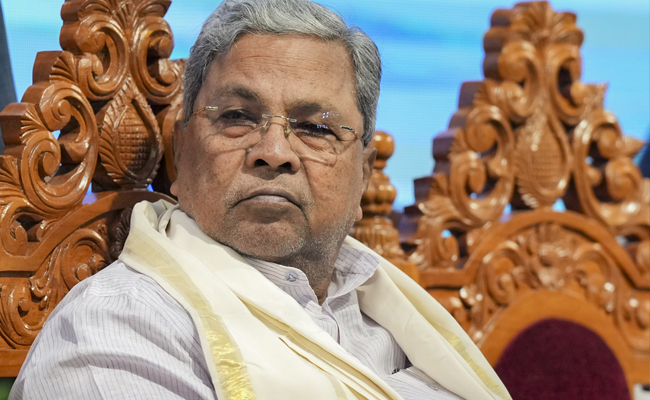
Bengaluru (PTI): Alleging a “criminal conspiracy” by BJP candidate D N Jeevaraj in the Sringeri Assembly poll recounting, Karnataka CM Siddaramaiah on Tuesday said the outcome was manipulated after valid postal ballot votes in favour of Congress leader T D Raje Gowda were tampered with during the recounting process.
Following a Karnataka High Court order on an election petition filed by Jeevaraj, challenging Raje Gowda’s election, the reverification and recounting were conducted on Saturday.
After the reverification and recount of postal ballots for the Sringeri Assembly constituency, votes polled in favour of Raje Gowda were reduced by 255, the returning officer said.
A report on the matter has been submitted to the Election Commission of India for further action, the officer added.
Congress leader Raje Gowda had won the 2023 Assembly polls from Sringeri by 201 votes, defeating his nearest rival Jeevaraj.
Addressing a press conference in Bengaluru, Siddaramaiah said the High Court had directed the recounting of postal ballots and that irregularities were noticed during the exercise conducted on May 2.
“This is a clear case of criminal conspiracy,” Siddaramaiah said, alleging that valid votes cast in favour of Raje Gowda were altered after being accepted by counting agents of all parties, including Congress, BJP, and JD(S).
He claimed that during the recounting of postal ballots, 255 votes were initially accepted as valid by all agents but were later tampered with by subordinate officials.
“There is a second mark on the votes polled in favour of Raje Gowda. They had accepted these as valid votes. Subsequently, another mark was made by officials. This is a clear case of criminal conspiracy,” he said.
When asked who was behind the alleged conspiracy, the CM replied, “It was hatched by Jeevaraj and others. It is planned.”
Siddaramaiah further alleged that the returning officer acted improperly by declaring the result despite the presence of an Election Commission observer during the recounting.
“Immediately after the counting, the returning officer announced the result. He should not have done so; this is against the law,” he said.
He pointed out that Raje Gowda had originally won by 201 votes, but after the recounting, the BJP candidate was declared the winner by 52 votes.
“The BJP has committed a criminal act of conspiracy. This is not vote chori but vote dacoity,” he alleged.
The CM said a police complaint had already been filed by Raje Gowda’s election agent, Sudhir Kumar, and emphasised the need for electoral integrity.
“We want transparency and free and fair elections. That is what our Constitution mandates,” he added.
Stating that the government would pursue legal remedies, Siddaramaiah said, “We are preparing an appeal challenging the returning officer’s announcement in a court of law.”
Responding to a separate query on elections in other states, the CM said there appeared to be an anti-incumbency factor in West Bengal, while results in Tamil Nadu were “surprising,” adding that Vijay’s party was emerging as the largest there.
Following the victory of party candidates in Bagalkote and Davanagere South, Siddaramaiah expressed confidence about future electoral prospects in Karnataka.
“Even in 2028, we will win the Assembly elections. We will come back,” the CM said.
Siddaramaiah added that he would order a forensic examination into the alleged tampering of postal ballots.