Indian pharma industry capable of producing COVID-19 vaccines for entire world: Bill Gates
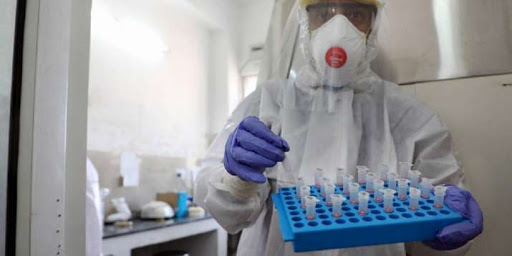
New Delhi: India's pharmaceutical industry will be able to produce COVID-19 vaccines not just for the country but also for the entire world, according to Microsoft co-founder and philanthropist Bill Gates.
A lot of "very important things have been done" in India and its pharma industry is doing work "to help make the coronavirus vaccine building on other great capacities that they have used for other diseases", said the Co-Chair and Trustee of Bill and Melinda Gates Foundation.
Speaking in a documentary -- COVID-19: India's War Against The Virus -- to be premiered on Discovery Plus this (Thursday) evening, Gates said India also faces a huge challenge due to the health crisis because of its gigantic size and urban centres with a lot of population density.
Commenting on the strength of India's pharma industry, he said, "India has a lot of capacity there -- with the drug and vaccine companies that are huge suppliers to the entire world. You know, more vaccines are made in India than anywhere-- starting with Serum Institute, that's the largest."
He further said, "But (there are) also Bio E, Bharat (Biotech), many others. They are doing work to help make the coronavirus vaccine, building on other great capacities that they have used for other diseases."
Stating that India joined Coalition for Epidemic Preparedness Innovations (CEPI), which is a group working on a global basis to build vaccines platforms, Gates said, "I am excited that the pharmaceutical industry there will be able to produce not just for India but also for the entire world. (This is) What we need to reduce the deaths and make sure we are immune, which is how we end the epidemic."
Gates said Bill and Melinda Gates Foundation is also a "partner with the government, particularly with the department of biotechnology, the Indian Council of Medical Research (ICMR) and the office of the principal scientific advisor provide advice and help about getting these tools going".
Commenting on the deadly virus breaching India's borders in the documentary which was shot extensively during the period of lockdown, he said, "India is still at the beginning of this, but there's a lot of very important things have been done.
It's a huge challenge with India because you've got a gigantic country. You've got your urban centers with a lot of density-- and so that-- drives the spread. You have people moving around."
He, however, added: "Yet people are stepping up... Looking at how we reduce the spread while trying not to reduce food availability, equipment that people need."
Highlighting Gates foundation's role, he said it has "worked for the Indian government on health issues like introducing new vaccines over the last decade; and so when COVID-19 came along, we stepped in and said you know where are the gaps, we have been funding work on detection and isolation.
We have been particularly active in UP and Bihar where we have done health delivery in the past."
The foundation is also working with the department of personnel and training to take their online training platforms and "are now using that guidance to help their frontline health workers", Gates said.
Let the Truth be known. If you read VB and like VB, please be a VB Supporter and Help us deliver the Truth to one and all.
CM Siddaramaiah ready to "sacrifice power" or continue, as per Rahul's directions: Rajanna
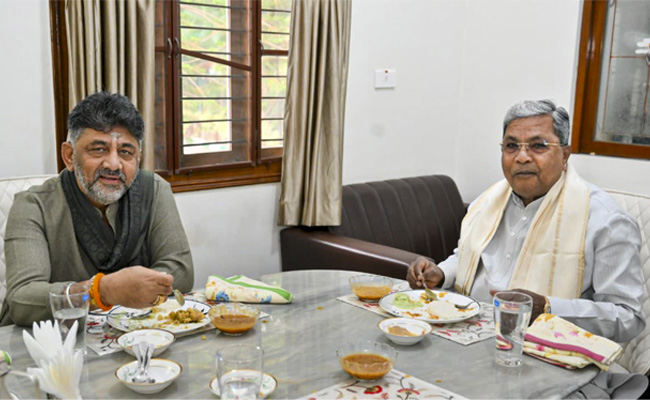
Bengaluru (PTI): As the speculation about leadership change in Karnataka rages yet again, a senior party leader and close aide of Siddaramaiah on Tuesday said the Chief Minister was ready to "sacrifice power" or continue in the top post, based on the directions of Congress leader Rahul Gandhi.
KN Rajanna also seemed to support the idea of a change in the party leadership as well, an apparent reference to deputy CM and Karnataka Congress president D K Shivakumar, whose supporters want him to be made CM.
Urging the Congress high command to clear the confusion on the leadership issue, Rajanna, a former minister who is considered close to Siddaramaiah, warned that continued uncertainty would be detrimental for the party and governance.
He also insisted that if the chief minister is changed, there should be a "Dalit CM" in Karnataka.
The development comes amid speculations within the party and political circles about a possible decision on leadership change and cabinet reshuffle after May 4, once the results for assembly elections in four states and one union territory, along with bypolls to two assembly segments in Karnataka, are announced.
"The Chief Minister has an open mind and has said he will abide by the directions of the high command and Rahul Gandhi, and that everyone should cooperate. The CM has repeatedly reiterated that he will abide by Rahul Gandhi's directives and suggested that everyone follow the decision. All ministers have agreed to it," Rajanna said in response to a question about the CM's recent discussion with his close cabinet colleagues and MLAs.
Speaking to reporters here, he said, "power is not permanent for any politician, those who lose it will try to gain it and those who have gained it will try to maintain it. The CM's mindset is that he is ready to sacrifice power or continue in power as per Rahul Gandhi's directions. He will abide by Rahul Gandhi's decision."
When asked whether supporters of Siddaramaiah demanded that he continue as CM, and if he steps down, that an AHINDA leader should take over, the MLA said the matter is for the high command to decide.
"We have told the high command what we had to. Ultimately it is left to high command and Rahul Gandhi," he said.
AHINDA (Kannada acronym for minorities, backward classes, and Dalits) is considered as the strong support base of Siddaramaiah and also the Congress party.
When asked about his past statement that there should be a Dalit CM after Siddaramaiah, Rajanna said, "What's wrong with it. I am committed to the statement that there should be a Dalit CM."
MLAs and leaders who want Shivakumar to be elevated have recently claimed they expect some "sweet news" by May 15, which is their leader's birthday.
When asked whether the party president should also be changed, the former minister said that everything has to change.
"If the ministers have to change, why shouldn't the party president. Everything will be decided by high command," he said.
Shivakumar is the state Congress President and has completed six years in the post.
For the government to function more actively towards the welfare of the people it is important that the high command clears the existing confusion in the Congress party at the earliest, Rajanna said, adding, the ministers have gone to discuss the same with the leadership.
"I too urge that the high command should not allow the confusion to continue; as long as the confusion continues, it is detrimental for the party and governance. I will also go to Delhi after May 4," he said.
"The high command is at it (resolving the confusion), but because of elections, the leaders are busy. The matter cannot be decided hastily, it must be decided with a clear state of mind, as it involves the future of the people of Karnataka and the party," he said, expressing confidence that the party will take appropriate decisions after examining all aspects.
PWD Minister Satish Jarkiholi on Monday met Congress President Mallikarjun Kharge and General Secretary (in charge of Karnataka) Randeep Surjewala in New Delhi and requested them to address the speculation regarding the change of leadership in the state.
Subsequently Social Welfare Minister H C Mahadevappa too met the party leadership in Delhi.
Both Jarkiholi and Mahadevappa are considered close to Siddaramaiah.
Regarding the demand for cabinet reshuffle, Rajanna said there is an expectation within both the party and the public that the administration should be sensitised more, and there is nothing wrong in new people getting opportunities.
Responding to a question, Rajanna said, there is a feeling among AHINDA communities that their expectations from the current government have not been fulfilled. "I too agree with it," he said.
Rajanna, who recently alleged that the Chief Minister is "helpless" and under some "compulsion," reiterated his statement by saying, "compare Siddaramaiah as CM during 2013-18 and 2023 to now, there is a huge difference, people are saying it."
The leadership issue is being hotly debated as Shivakumar's supporters have been demanding his elevation since late 2025, in lines with a rumoured power-sharing agreement involving Siddaramaiah when the party won the 2023 Assembly elections.