Indian student dies after being assaulted during deadly carjacking in Canada
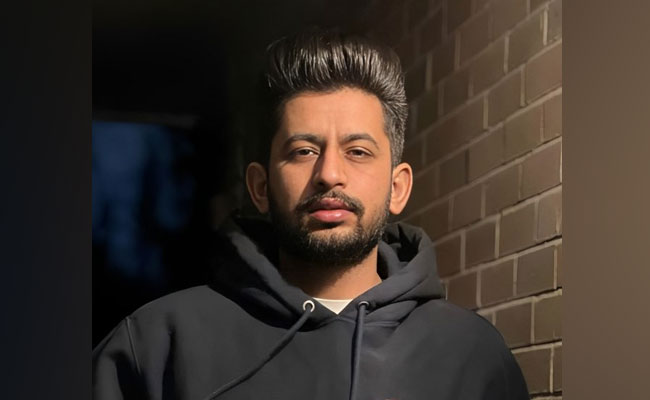
Toronto (PTI): A 24-year-old Indian student, who worked as a food delivery partner in Canada, has been killed after he was violently assaulted during a deadly carjacking, according to media reports.
Gurvinder Nath was delivering pizza at around 2:10 am on July 9 in Mississauga's Britannia and Creditview roads, when unknown suspects confronted him and tried to steal his vehicle, CTV News channel reported.
"Investigators do believe that there are multiple suspects involved and that the food order was placed as a means of luring the driver to this specific area," Inspector Phil King of Peel Regional Police's Homicide Bureau said, adding that investigators have obtained an audio recording of the Pizza Pizza order placed before the attack.
After Nath arrived, he was "violently assaulted" and left critically injured by a suspect who robbed him of his vehicle and fled the scene, police said.
Multiple witnesses came to his aid and called for help before Nath was rushed to a trauma centre where he was pronounced dead on July 14.
Siddhartha Nath, Consul General of India in Toronto, said Nath's death is a "heartrending loss" and he extended his condolences to family members, friends and the wider community, the CBC reported.
He said the consulate general has contacted the family after his death.
"It was heartening for me to see how the community responded, came together both online and physically to support the family in this time of grief," the Consul General said.
"Of course, nothing can make good the loss, but it will be some solace to the grieving family and it's also a signal of the spirit of the community because it is in times like this when the spirit and the solidarity and the sense of empathy is tested."
The Consul General said he hopes the people responsible are brought to justice.
Inspector King said despite the infancy of the investigation, police believe Nath was an innocent victim.
Nath's vehicle was found abandoned in the hours following the attack in the area of Old Creditview and Old Derry roads -- less than five kilometres from the crime scene, King said.
"The working theory is that perhaps there may have been extensive injuries (to Nath) that may not have been anticipated and that may have caused (the suspects) to get rid of the vehicle early," he said.
The vehicle has since been forensically examined and "several" pieces of evidence have been retrieved, King added.
Police say there is no known connection between Nath and his attackers.
"I would like to remind those involved that regardless of your level of participation, you are complicit in the murder of Gurvinder Nath and you will be arrested and charged accordingly," King said.
Nath's body will be flown to India on July 27 with the help of the Consulate General of India in Toronto, Canadian Broadcasting Corporation (CBC) reported.
Last week, CTV News Toronto spoke to family and friends of Nath, who said the Brampton resident was on summer break before he returned to his final semester of business school.
"He was innocent, he was just delivering pizza [when] random people hit him on his head," Nath's cousin, Balram Krishan, said.
Nath arrived in Canada from India in July of 2021 and had plans to open his own business.
On Saturday, more than 200 people gathered in Mississauga at a candlelight vigil for Nath, the CBC reported.
Speakers at the vigil said that Nath came to Canada carrying his family's hopes and now his family is dealing with grief at the loss of one of its three sons.
"You come to Canada with a dream. You start your life. But these people stole a dream," Bobby Sidhu, a friend of a relative of Nath, said.
Sidhu said: "Canada was known for peace. And I hope that in our country such senseless and merciless crime will come to an end. Everyone could relate to Gurvinder. I think that's the reason the community has come together."
Let the Truth be known. If you read VB and like VB, please be a VB Supporter and Help us deliver the Truth to one and all.
Putin meets Iran's FM Araghchi, says Russia ready to do its best to help bring peace to West Asia
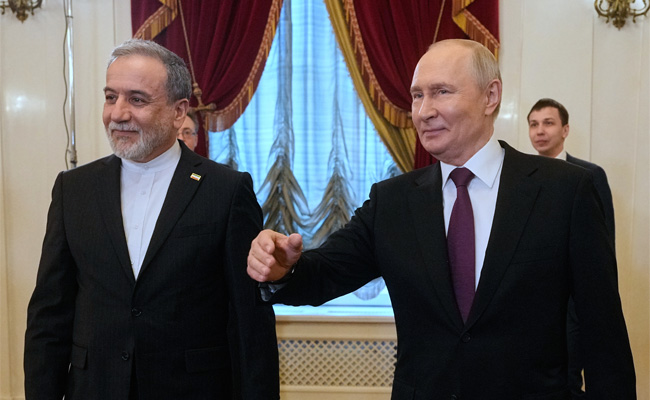
Moscow (PTI): Iran's Foreign Minister Abbas Araghchi on Monday met Russian President Vladimir Putin, who hailed the Iranian people for fighting bravely and heroically for their sovereignty and said Moscow is ready to do its best to help bring peace to West Asia as soon as possible.
Araghchi, who held talks with Omani and Pakistani leadership before arriving in Russia, met Putin in St. Petersburg and thanked him for supporting Iran, state-owned TASS news agency reported.
"Russia is ready to do everything in its power to ensure that peace in the Middle East is achieved as soon as possible," Putin said during his meeting with Araghchi, which was also attended by Russian Foreign Minister Sergey Lavrov.
Revealing that he received a message from Iranian Supreme Leader Mojtaba Khamenei last week, Putin asked Araghchi to convey his "gratitude for this message and best wishes for his health and well-being."
He praised the Iranian people for fighting "bravely and heroically" for their sovereignty, Iran's state-run PRESS TV reported.
"We really hope that, based on the courage and desire for independence, the Iranian people, under the guidance of the new leader, will weather this difficult period of trials and peace will come,” Putin said.
He also stressed that Russia “intends to maintain” its strategic relations with Iran.
Araghchi said that the world witnessed Iran’s strength in countering the US during the recent war, and that the Islamic Republic is a "stable and powerful establishment."
"With their courage, the Iranian people succeeded in resisting the US aggression and will be able to endure it,” he said.
He said that it became clear that Iran has “great friends and allies” like Russia, and conveyed “warmest greetings” from Supreme Leader Mojtaba Khamenei and President Masoud Pezeshkian to the Russian leader.
Araghchi said relations between Moscow and Tehran represent a “strategic partnership at the highest level” and will continue to develop "regardless of circumstances."
"We are grateful to you for the solid and strong positions in support of the Islamic Republic of Iran," he said.
Foreign Minister Lavrov said that the talks between President Putin and the Iranian Foreign Minister were "useful and constructive."
Kremlin Spokesman Dmitry Peskov later said that Russia is "ready to provide any good offices, any mediation services that are acceptable to the parties."
"We will be ready to do everything so that ultimately peace ensues, guaranteed peace, and that there is no return to hostilities," Peskov was quoted as saying by TASS.
He was asked how Moscow can assist in future negotiations on the Iranian settlement.
Araghchi arrived in Russia after his whirlwind trip to Islamabad, which, according to him, was “very productive” and involved “good consultations" with Pakistan's Army Chief Field Marshal Asim Munir, amid uncertainty over the second round of peace talks to resolve the war in West Asia.
"We held good consultations with our friends in Pakistan. The trip was successful. We assessed the outcome of our recent (meetings) and discussed in what direction and under what conditions talks can move on,” Araghchi said in a video posted on his Telegram channel upon his arrival in St Petersburg.
Referring to the second round of talks between the US and Iran to resolve the conflict in West Asia, Araghchi said: "Developments have taken place in the negotiations."
"Despite some progress in earlier rounds, the talks failed to reach their objectives due to the Americans' approach, the excessive demands they made, and the wrong approaches they adopted. Therefore, it was necessary to consult with our friends in Pakistan to review the latest situation,” Iran's official news agency IRNA quoted him as saying.
He said that the trip to Pakistan was a good opportunity to review developments related to the US-Israeli war against Iran, expressing confidence that “these consultations and coordination between the two countries will be highly significant.”
Araghchi arrived at St. Petersburg's Pulkovo Airport early Monday, where he was welcomed by Russian officials and Iran’s ambassador to Russia, Kazem Jalali, the report said.
The first round of peace talks between Iran and the US, held on April 11 and 12, failed to bring the desired result for the parties to the conflict.
The Iranian minister arrived in Islamabad for the second time on Sunday after a short visit to Oman, where he held talks with Sultan Haitham bin Tariq al-Said on security in the Strait of Hormuz and diplomatic efforts to end the Iran-US conflict.
After Araghchi left Pakistan for Oman on Saturday, President Donald Trump announced that US negotiators Steve Witkoff and Jared Kushner would no longer be going to Islamabad for talks with Iran, contending that Washington held all the cards on the matter.
Trump on Sunday reiterated that the US and Iranian officials can talk by phone for a peace solution to the conflict.
On Tuesday, Trump extended the two-week ceasefire with Iran indefinitely to give Tehran more time to prepare a unified proposal to end the war, just hours before the truce was set to expire.
The war began when the US and Israel jointly attacked Iran on February 28, killing Iranian Supreme Leader Ayatollah Ali Khamenei and several top commanders. The retaliation by the Islamic Republic extended the war to the entire Gulf region.