India's abstention from UN resolution on Israel-Hamas conflict shocking', says AIMIM chief Owaisi
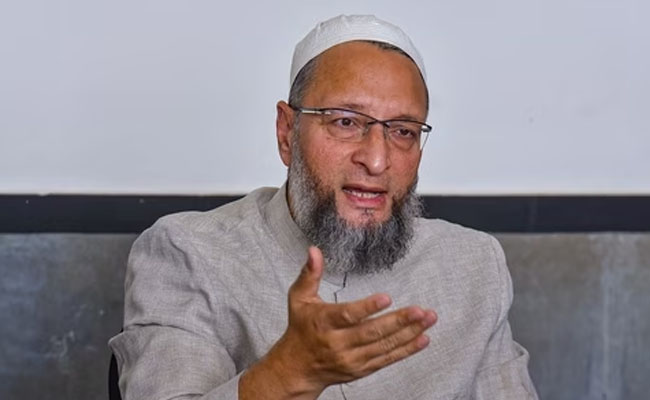
Hyderabad (PTI): AIMIM chief Asaduddin Owaisi on Saturday said it is "shocking" that India abstained from the UN General Assembly resolution on the Israel-Hamas conflict and termed the abstention as "an inconsistent foreign policy" of the country.
In a message posted on "X", the Hyderabad MP said that Prime Minister Narendra Modi condemned the "Hamas attack", but couldn't agree to a UN resolution seeking a truce.
"@narendramodi condemned the Hamas attack but couldn't agree to a UN resolution seeking a truce. He spoke to the Jordanian King a few days ago, but abstained on a resolution that was introduced by Jordan. It is an inconsistent foreign policy," he said in the message.
"It is SHOCKING that @narendramodi govt abstained on the @UN resolution for a humanitarian truce & protection of civilian lives", Owaisi said.
India on Friday abstained from the UN General Assembly on a Jordanian-drafted resolution titled Protection of civilians and upholding legal and humanitarian obligations' that called for an immediate humanitarian truce in the Israel-Hamas conflict and unhindered humanitarian access in the Gaza strip.
According to Owaisi, as many as 7,028 people have been allegedly killed by Israel in Gaza and over 3,000 of them are children and 1,700 women.
He further said at least 45 per cent of housing in Gaza has been allegedly destroyed, displacing over 1.4 million people. Even in peacetime, Gazans face a complete blockade and have to depend on humanitarian aid. Things have only worsened since the war began.
"This is a HUMANITARIAN issue, not a political one. In abstaining on the resolution, India stands alone in the Global South, in South Asia & in BRICS. Why did India abstain on an issue concerning civilian life? After sending aid to Gaza, why abstain? What happened to "one world one family"? & "vishwaguru"?," Owaisi questioned PM Modi.
It is SHOCKING that @narendramodi govt abstained on the @UN resolution for a humanitarian truce & protection of civilian lives.
— Asaduddin Owaisi (@asadowaisi) October 28, 2023
7028 people have been killed by Israel in Gaza. Over 3000 of them are children & 1700 women. At least 45% of housing in Gaza has been destroyed. Over… pic.twitter.com/kfg6ayoeZv
Let the Truth be known. If you read VB and like VB, please be a VB Supporter and Help us deliver the Truth to one and all.
Vaishnaw flags off Jammu-Srinagar Vande Bharat, services from May 2
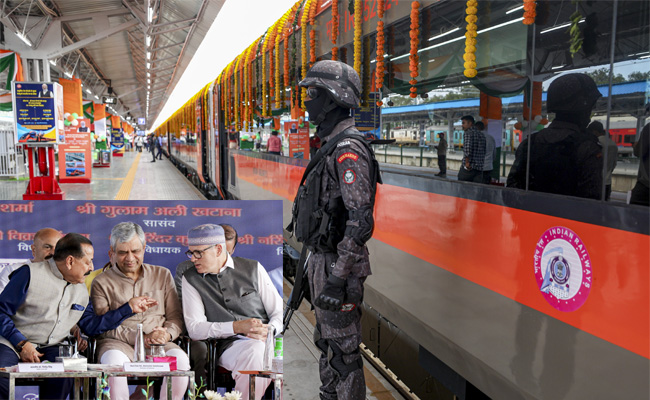
Srinagar (PTI): Railways Minister Ashwini Vaishnaw on Thursday flagged off the 20-coach Vande Bharat Express train between Jammu and Srinagar, the first direct train between the twin capitals of Jammu and Kashmir.
Chief Minister Omar Abdullah and Minister of State in the Prime Minister's Office, Jitendra Singh, were among the dignitaries present at the flagging off ceremony.
The direct train services between Srinagar and Jammu will reduce travel time between the twin capitals of Jammu and Kashmir, and boost tourism, besides providing an all-weather surface transport link.
Prime Minister Narendra Modi inaugurated the first direct train service between Katra and Srinagar on June 6, 2025. This service is now being extended up to the Jammu Tawi Railway Station.
The work on the Rs 43,780-crore rail project, linking Kashmir to the rest of the country, began in the late 1990s, with the first train operating in the Kashmir Valley in October 2008.
While train services had reached Udhampur by 2005, the treacherous terrain through the mountainous Pir Panjal range made it tough to link the valley with the rest of the country until 2025.
"The modern 20-coach Vande Bharat train will commence its maiden journey from Jammu Tawi, traversing the route up to Srinagar while connecting the challenging geographical terrains of the Valley," an official said, adding that a train from Srinagar has also started moving towards Jammu simultaneously.
Before the commencement of the Jammu-Srinagar service, a trial run of the Vande Bharat was conducted on Tuesday from Jammu to Shri Mata Vaishno Devi Katra railway stations, officials said.
The inaugural Vande Bharat train, equipped with state-of-the-art amenities and comprising 20 coaches, will cover a total distance of 267 kilometres.
The Jammu-Srinagar train service -- scheduled to start on May 2 -- will operate six days a week. There will be no train service on this route on Tuesdays.
"Constructed using indigenous technology, this Vande Bharat Express will offer passengers a world-class travel experience," Senior Divisional Commercial Manager Uchit Singhal said.
"It features amenities such as the 'Kavach' safety system for passenger security, a GPS-based information system, and comfortable rotating seats. This service will not only reduce travel time but also provide a massive boost to the local economy and tourism," he added.
The extension of the Vande Bharat to Jammu Tawi is the latest milestone in a decade-long effort to transform railway connectivity in Jammu & Kashmir.
The Udhampur-Katra section was commissioned in 2014. The Kashmir Valley saw its first electric train in February 2024, while a dedicated Jammu Railway Division was created in January 2025.
Stations at Jammu Tawi, Katra, Udhampur, and Budgam are being redeveloped under the Amrit Bharat Station Scheme.
The Udhampur-Srinagar-Baramulla Rail Link, built at a total cost of Rs 43,780 crore with 36 tunnels spanning 119 km and 943 bridges, is the connective tissue that makes all of this possible, an official said.