India's COVID-19 fatality rate slides to 1.76%, one of the lowest globally: Health ministry
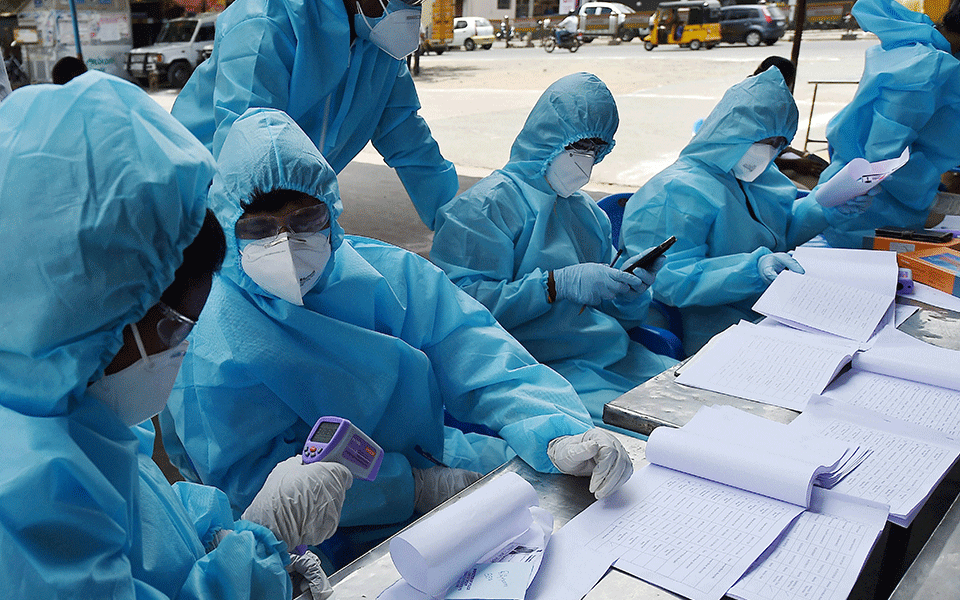
New Delhi: India has been reporting one of the lowest COVID-19 fatality rates in the world with the figure further declining to 1.76 per cent as on date against a global average of 3.3 per cent, the Union Health Ministry said on Wednesday. It also said that COVID-19 deaths per million population in India is one of the lowest in the world.
"While the global average is 110 deaths per million population, India is reporting 48 deaths per million population. The comparative figure for Brazil and the UK is 12 and 13 times higher, respectively," the ministry highlighted.
India's COVID-19 tally of cases galloped past 37 lakh on Wednesday with 78,357 new instances of the disease reported in a day, while the number of recoveries crossed 29 lakh pushing the recovery rate to 76.98 per cent, the Union health ministry data showed.
The death toll climbed to 66,333 with 1,045 more fatalities reported in 24 hours. India has so far reported 37,69,523 cases of the viral disease, according to the data updated at 8 am.
As part of the COVID-19 management and response policy, the Centre's sharp focus has been not only on containing the coronavirus-related fatality, but also to reduce deaths by providing quality clinical care to the critical and severe patients, it said.
Collaborative efforts of the Centre, states and union territories have resulted in strengthening of the health facilities across the country, the ministry said.
As many as 1,578 dedicated COVID hospitals are providing quality medical care. The Central government has also issued the standard of care guidelines incorporated in the Clinical Treatment Protocol.
The AIIMS, New Delhi, has been conducting e-ICU sessions to build the capacities of the ICU doctors in clinical management of critical patients towards reducing the fatality. Knowledge and domain experts have been holding tele- or video-consultation sessions twice every week from July 8 for the doctors manning ICUs in state hospitals.
Till date, 17 tele-sessions have been held and 204 institutions have participated in them, the ministry said.
To further build the ICU, clinical management capacities of doctors for treatment of critical patients, AIIMS, New Delhi, in collaboration with the Health Ministry, has developed frequently answered questions (FAQs).
One of these clarifies that Remdesivir and tocilizumab are experimental therapies and should not be used as empirical therapy for suspected cases. They should be used only in proven COVID-19 patients, where clinically indicated, the ministry said, underlining that there is no evidence to support the use of these two drugs in asymptomatic patients with comorbidities.
In one of the answers, the ministry said, Tocilizumab is an experimental therapy, has a limited role, and should be used only in patients with cytokine syndrome after ruling out active infections.
As for the role of Favipiravir, the ministry said studies have used this drug mainly in mild or asymptomatic COVID-19 cases, claiming to prevent progression, whereas the majority of this cohort recover with just supportive care and monitoring and usually require no specific therapy.
Evidence is weak for the use of Favipiravir and is currently not recommended in national guidelines, it said.
According to the FAQs, depression is a common finding in patients with COVID which may be because of a number of reasons including staying in isolation, anxiety related to disease, social stigma, among others. Such patients need empathy and psychological counselling preferably by a trained healthcare worker like a psychologist / psychiatrist, it said.
The ministry said that sudden deaths have been reported both at presentation to emergency department as well as in hospital. Reasons that have been proposed include a sudden cardiac event/ACS, preceding silent hypoxia that went unnoticed or due to a thrombotic complication such as pulmonary thromboembolism.
"Patients with risk factors to develop severe COVID-19 or with prior comorbid conditions such as CAD or chronic lung disease should be strictly monitored for their saturation. They should not be allowed to move unattended. Anticoagulant should be used on all at-risk patients who do not have any risk factors of bleeding," the ministry elaborated.
As far as the role of plasma therapy is concerned, the FAQs said that convalescent plasma collected from ABO matched donors with high neutralizing titers can be given to patients at risk of developing severe COVID in early stages of the disease. However, it should also be considered an experimental therapy and should be used with caution, it stated.
Let the Truth be known. If you read VB and like VB, please be a VB Supporter and Help us deliver the Truth to one and all.
SC asks Centre to consider amending law on terminating pregnancy of rape survivors
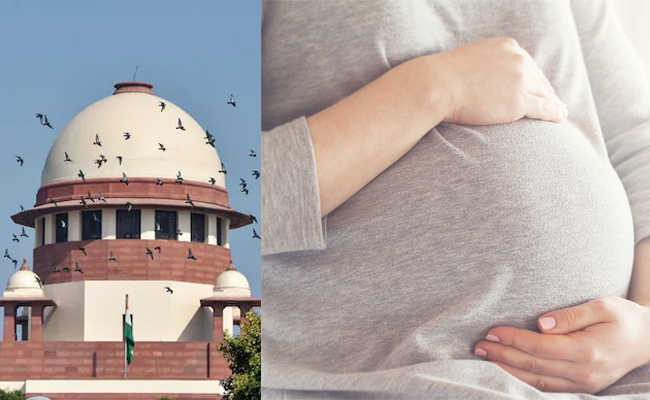
New Delhi (PTI): The Supreme Court on Thursday took strong exception to a plea by AIIMS seeking to set aside its order allowing a 15-year-old girl to medically terminate her 30-week pregnancy, and asked the Centre to consider amending the law to permit rape survivors to terminate unwanted pregnancies even beyond 20 weeks.
The top court said when there is pregnancy due to rape, there should not be a time limit.
Law needs to be organic and in sync with evolving time, it stressed.
A bench of Chief Justice Surya Kant and Justice Joymalya Bagchi said this is a case of child rape and the survivor will have a lifelong scar and trauma if termination is not allowed.
The top court said if the mother does not have permanent disability then it should be carried out.
ALSO READ: Chlorine gas leaks at defunct water purification plant in Pune; 24 persons hospitalised
It asked AIIMS to counsel parents of the survivor over the issue and said the decision has to be of the person concerned.
"There are children for adoption. In this country we have lot of sympathies...There are deserted, abandoned children on the streets and even mafias on it. We have to look at them. This is an unwanted pregnancy of a 15-year-old child.
"This is a curative petition. Unwanted pregnancy cannot be thrusted on a person. Imagine she is a child. She should be studying now. But we want to make her a mother. Imagine the pain, the humiliation the child has suffered in this," the bench said.
Additional Solicitor General Aishwarya Bhati, appearing for AIIMS, mentioned the curative plea, and said the termination of pregnancy is not possible.
"It will be a live baby with severe deformities. Minor mother will have lifelong health issues and cannot reproduce. Minor mother will have lifelong health issues. This child can be given for adoption. It has been 30 weeks now. It is a viable life now," she said.
The top court said the decision on termination has to choice of the survivor and her parents and AIIMS may help them take an informed decision.
On April 24, a bench of Justices B V Nagarathna and Ujjal Bhuyan had allowed the girl to medically terminate her pregnancy of 30 weeks.