India's daily COVID-19 testing numbers one of the highest in the world: Health Ministry
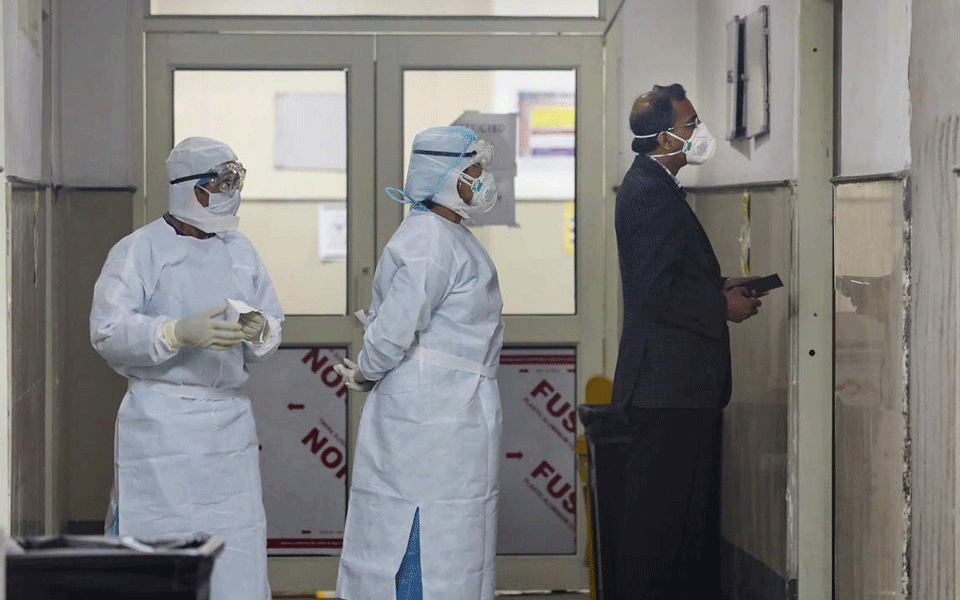
New Delhi: Cumulative tests for detection of COVID-19 surged to 4,55,09,380 in the country with a record 11,72,179 tests being conducted in a single day on Wednesday, said the Union Health Ministry underlining that "India's daily testing numbers are one of the highest in the world".
Higher testing numbers subsequently result in lowered positivity rate, it said. India has witnessed an unprecedented surge in testing. Over 11.7 lakh tests were done in 24 hours," the ministry said.
From conducting merely 10 tests per day on January 30, the daily average has crossed more than 11 lakh, the ministry adding this demonstrates an exponential increase in the daily COVID-19 testing in the country.
"Such high levels of testing on a sustained basis over a period of time in widespread areas enables early diagnosis, and in turn facilitates seamless isolation and effective hospitalisation. This eventually leads to lower mortality rate.
"Higher numbers of testing also subsequently result in lowered positivity rate," the ministry said.
India's COVID-19 case fatality rate due to the disease has further dropped to 1.75 per cent as on date, while the national recovery rate has risen to 77.09 per cent.
There are 8,15,538 active cases of coronavirus infection in the country which comprises 21.16 per cent of the total caseload, the data stated.
The surge in testing has been made possible by an equally speedy expansion in the testing lab network across the country. India has as on date 1,623 labs in the country with 1,022 labs in the government sector and 601 private labs, the ministry said.
With a record single-day spike of 83,883 infections, India's COVID-19 caseload mounted to 38,53,406, while the death toll climbed to 67,376 with 1,043 people succumbing to the disease in a day, the ministry's data updated at 8 am showed.
Let the Truth be known. If you read VB and like VB, please be a VB Supporter and Help us deliver the Truth to one and all.
Women BJP MLAs protest against opposition in UP assembly premises
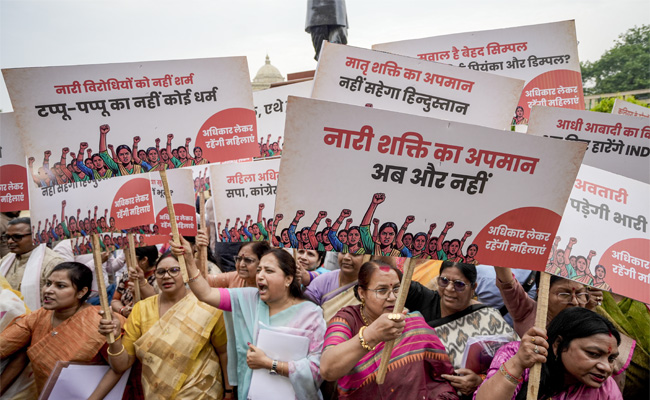
Lucknow (PTI): Women BJP MLAs held a protest in the Vidhan Bhawan complex before the one-day special session of Uttar Pradesh assembly, slamming the opposition for defeating the passage of a bill, which would have led to implementation of the Women's Reservation Law, in the Lok Sabha.
This followed another demonstration by Samajwadi Party MLAs, who alleged that the BJP was misleading public in the name of women's reservation.
The women BJP legislators assembled in front of Chaudhary Charan Singh's statue in the assembly premises, holding banners inscribed with the slogan "Insult to Matrushakti (women's power), India will not tolerate it". The protesting members entered the main hall of Vidhan Bhawan carrying the banners.
Participating in the protest, the state Minister for Women Welfare and Child Development, Baby Rani Maurya, told reporters that all opposition parties, including the Samajwadi Party and the Congress, had opposed the women's reservation, a stance for which they would have to pay a heavy political price.
"On this issue, all of us women stand united. We will ensure that we secure our reservation," she said.
BJP MLA Ketki Singh remarked that their protest represents the collective outrage of millions of women across the state.
Singh asserted that the opposition has betrayed women by creating hurdles in the path of women's reservation. The current demonstration is merely the beginning, and very soon, women from every street, intersection and household will join the protest movement, she said.
Minister Vijaylakshmi Gautam said, "We strongly condemn the despicable act committed by the Samajwadi Party and the Congress in an attempt to hold back 'half the population' (women). Their action was directed against the very bill that Prime Minister Narendra Modi had introduced to empower and strengthen Nari Shakti (women's power), and which he strived to pass expeditiously."
Uttar Pradesh assembly is holding a one-day special session on Thursday. During the session, the government is set to move a censure motion against the opposition parties over their failure to pass the Constitution Amendment Bill, which would have led to implementation of the Women's Reservation Act, in the Lok Sabha.