India's decision to let Iranian ship to dock in Kochi guided by humanitarian principles: Jaishankar
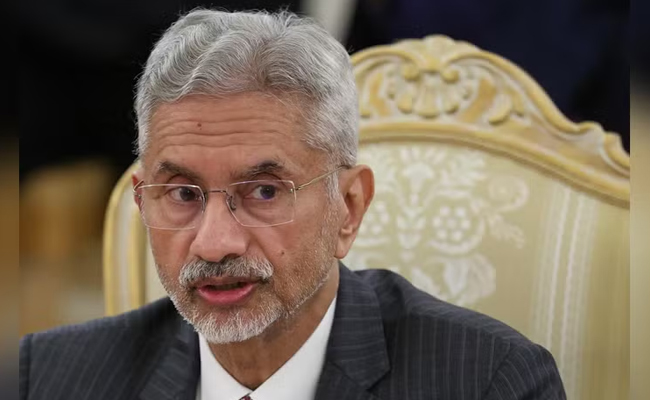
New Delhi (PTI): External Affairs Minister S Jaishankar confirmed on Saturday that India permitted an Iranian ship to dock in Kochi on humanitarian grounds following a request from the Iranian side on February 28 as the vessel faced some problems.
Permission was given for the vessel to dock on March 1 and the warship, IRIS Lavan, docked in Kochi on March 4. The vessel remains in Kochi, with its 183 crew members currently accommodated at Indian naval facilities.
Speaking at an interactive session at the Raisina Dialogue, Jaishankar also made an indirect reference to the sinking of Iranian warship IRIS Dena off the coast of Sri Lanka on March 4.
"For us, when this ship wanted to come in and that too in difficulties, it was the humane thing to do. We were guided by that principle," he said.
"Of the other ships, one had a similar situation in Sri Lanka and they took the decision which they did. And one unfortunately didn't make it," he said, referring to the sinking of IRIS Dena.
IRIS Dena was returning home after participating in the Milan multilateral naval exercise hosted by India. At least 87 Iranian sailors were killed in the attack on Wednesday.
In his remarks, Jaishankar emphasised that India continues to be net security provider in the Indian Ocean region.
The external affairs minister was joined at the interaction by his counterparts from Sri Lanka, Mauritius and Seychelles.
The ministers underscored the necessity of adhering to international law, specifically the United Nations Convention on the Law of the Sea (UNCLOS), when addressing maritime incidents.
Jaishankar also underlined India's priority of ensuring the safety of Indian seafarers and the 10 million Indian nationals living in West Asian countries in view of the crisis in the region.
"Indians are a very large segment of the people who man merchant ships. Every time there is an attack on a tanker or vessels carrying goods, it is very likely that all or part of that vessel is manned by Indians," he said.
Sri Lankan Foreign Minister Vijitha Herath, responding to a question on the sinking of IRIS Dena, emphasised the importance of following UNCLOS and international laws.
"Sri Lanka faces so many challenges. We need to strengthen (the) implementation of international laws," he said.
"In this incident we are also following the international laws and we have taken all steps according to the international laws. I think we need not support any party. We took all steps in a humanitarian way," Herath said.
Let the Truth be known. If you read VB and like VB, please be a VB Supporter and Help us deliver the Truth to one and all.
Rupee falls 11 paise to 94.27 against US dollar in early trade

Mumbai (PTI): The rupee depreciated 11 paise to 94.27 against US dollar in early trade on Monday driven by persistent dollar demand and a broader shift toward safe-haven assets.
Forex traders said the Indian rupee has hit a rough patch, falling for five consecutive sessions, weighed down by a combination of factors such as the RBI loosening its grip on currency rules and rising oil prices caused by global tensions.
Moreover, investors are becoming cautious again, with foreign institutions pulling money out of the market after a brief period of buying amid rising geopolitical uncertainty.
At the interbank foreign exchange market the rupee opened at 94.25 against the US dollar, then lost some ground and touched 94.27 against the US dollar in initial trade, registering a fall of 11 paise over its previous close. On Friday, the rupee had settled at 94.16 against the American currency.
ALSO READ: Death toll in Mundathikode fireworks explosion rises to 16
Meanwhile, the dollar index, which gauges the greenback's strength against a basket of six currencies, was down 0.09 per cent at 98.44.
Brent crude, the global oil benchmark, was trading higher by 1.16 per cent at USD 106.55 per barrel in futures trade.
A mix of softer economic signals and renewed, even if fragile, hopes of diplomacy pulled the dollar lower again, CR Forex Advisors MD Amit Pabari said, adding that for Rupee, on one hand, a softer dollar offers relief. On the other, uncertainty remains the dominant force.
Meanwhile, India’s forex reserves have crossed USD 703 billion as of April 17, reflecting a consistent build-up of buffers.
"For now, the rupee continues to lean toward gradual weakness. Uncertainty remains the dominant force, shaping both global flows and local reactions," Pabari said.
He further noted that any dips are likely to be bought into, with the 92.80–93.20 zone acting as a strong support. On the upside, 93.50 to 94.50 is expected to define the near-term range.
On the domestic equity market front, the 30-share benchmark index Sensex was trading 518.96 points or 0.68 per cent higher at 77,183.17, while the broader Nifty was trading up 131.30 points or 0.55 per cent at 24,029.25.
Foreign Institutional Investors offloaded equities worth Rs 8,827.87 crore on Friday, according to exchange data.