India's economy growing but wealth not getting distributed: Rahul Gandhi
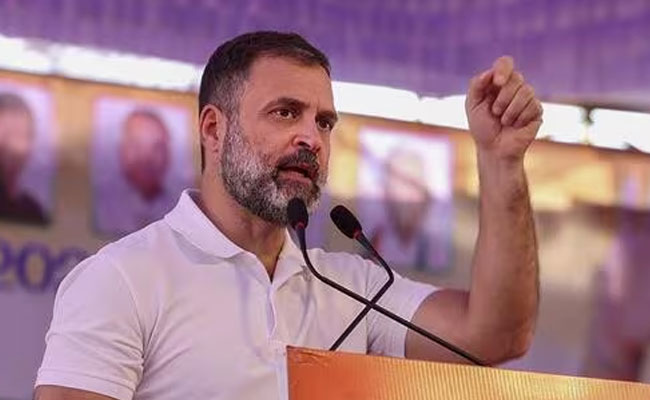
New Delhi(PTI): India's economy is growing but the wealth is getting concentrated in a few hands and the challenge of unemployment continues, Congress leader Rahul Gandhi said in an interaction with some students of Harvard University.
The former Congress president on Saturday shared on X a video of the interaction held on December 15, and said, "My advice to all students - True power comes from connecting with people, listening deeply to what they're saying, and being kind to yourself."
Asked about India's economic growth in the last 10 years during the interaction, the Congress leader said, "When you talk about economic development you have to ask the question in whose interest is that economic development."
"The question to ask is, what is the nature of that growth and who is benefiting from that. Right next to the figure of growth in India, you have the figure of unemployment in India. So India's growing, but the way it's growing is by massively concentrating wealth towards very few people," he said.
"We are operating on a debt sort of model and we are no longer producing. The real challenge in India is how do we set up a production economy that is able to give large numbers of people jobs. We have two or three businesses that are pretty much entire businesses," he said.
"We have Mr. Adani, everybody knows he is directly connected to the prime minister, he owns all our ports, airports, our infrastructure! With that kind of concentration, you will get growth but you will not get any distribution," he said.
Asked why this has not translated into an electoral outcome or mobilisation of people, Gandhi there is a massive mobilisation but there is a requirement for an "infrastructure to fight an election".
"...you need a fair media, fair legal system, fair election commission, access to finance, institutions that are neutral. Imagine a United States where the IRS, the FBI, their full time job is destroying the lives of the opposition. So that's the paradigm we're in. I didn't walk 4,000 kilometers because I like walking 4,000 kilometers. I walked 4,000 kilometers because there was no other way to get our message across," he said, referring to his Bharat Jodo Yatra.
"Even my social media is fully capped. I've got a shadow ban 24/7...my Twitter's under control, my YouTube is under control and I'm not alone, the entire opposition.... I don't think India is running a free and fair democracy anymore...," he said.
He said caste is a real problem in the country and likened it to "apartheid".
The Congress leader also accused the BJP-led central government of not treating India as a union of states, but as a nation with "one ideology, one religion, one language".
"So they kill the negotiation, they try to capture the institutions. So that's really the political fight in India right now," he said.
"We feel if you end the negotiation in India, the conversation between the union India collapses, India tears itself apart. So you can see that Manipur is burning, you can see Jammu and Kashmir is burning. You can see Tamil Nadu has a problem...," he said.
He said a "full scale civil war" is going on in Manipur.
In response to a question on India's relations with Russia, he said, "A solid Russian-Chinese alliance is a real problem for the United States. We have traditionally had a relationship with Russia. Being an ally of the United States or a partner of the United States...doesn't mean we don't talk to anyone else."
Asked about his experience from the Bharat Jodo Yatra, he said, "I realised what is called the politician in the West and in India is basically dead. It's a category that has collapsed on itself."
"...Huge part of why the politician is dead is that he is not listening anymore. Politician has gone into a zone where he just wants to please at all costs," he added.
Let the Truth be known. If you read VB and like VB, please be a VB Supporter and Help us deliver the Truth to one and all.
Putin meets Iran's FM Araghchi, says Russia ready to do its best to help bring peace to West Asia
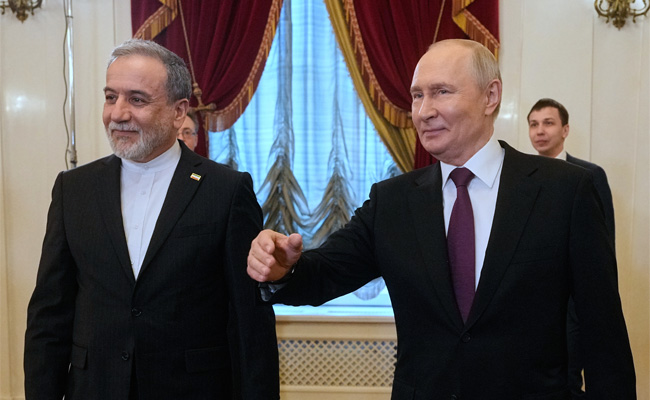
Moscow (PTI): Iran's Foreign Minister Abbas Araghchi on Monday met Russian President Vladimir Putin, who hailed the Iranian people for fighting bravely and heroically for their sovereignty and said Moscow is ready to do its best to help bring peace to West Asia as soon as possible.
Araghchi, who held talks with Omani and Pakistani leadership before arriving in Russia, met Putin in St. Petersburg and thanked him for supporting Iran, state-owned TASS news agency reported.
"Russia is ready to do everything in its power to ensure that peace in the Middle East is achieved as soon as possible," Putin said during his meeting with Araghchi, which was also attended by Russian Foreign Minister Sergey Lavrov.
Revealing that he received a message from Iranian Supreme Leader Mojtaba Khamenei last week, Putin asked Araghchi to convey his "gratitude for this message and best wishes for his health and well-being."
He praised the Iranian people for fighting "bravely and heroically" for their sovereignty, Iran's state-run PRESS TV reported.
"We really hope that, based on the courage and desire for independence, the Iranian people, under the guidance of the new leader, will weather this difficult period of trials and peace will come,” Putin said.
He also stressed that Russia “intends to maintain” its strategic relations with Iran.
Araghchi said that the world witnessed Iran’s strength in countering the US during the recent war, and that the Islamic Republic is a "stable and powerful establishment."
"With their courage, the Iranian people succeeded in resisting the US aggression and will be able to endure it,” he said.
He said that it became clear that Iran has “great friends and allies” like Russia, and conveyed “warmest greetings” from Supreme Leader Mojtaba Khamenei and President Masoud Pezeshkian to the Russian leader.
Araghchi said relations between Moscow and Tehran represent a “strategic partnership at the highest level” and will continue to develop "regardless of circumstances."
"We are grateful to you for the solid and strong positions in support of the Islamic Republic of Iran," he said.
Foreign Minister Lavrov said that the talks between President Putin and the Iranian Foreign Minister were "useful and constructive."
Kremlin Spokesman Dmitry Peskov later said that Russia is "ready to provide any good offices, any mediation services that are acceptable to the parties."
"We will be ready to do everything so that ultimately peace ensues, guaranteed peace, and that there is no return to hostilities," Peskov was quoted as saying by TASS.
He was asked how Moscow can assist in future negotiations on the Iranian settlement.
Araghchi arrived in Russia after his whirlwind trip to Islamabad, which, according to him, was “very productive” and involved “good consultations" with Pakistan's Army Chief Field Marshal Asim Munir, amid uncertainty over the second round of peace talks to resolve the war in West Asia.
"We held good consultations with our friends in Pakistan. The trip was successful. We assessed the outcome of our recent (meetings) and discussed in what direction and under what conditions talks can move on,” Araghchi said in a video posted on his Telegram channel upon his arrival in St Petersburg.
Referring to the second round of talks between the US and Iran to resolve the conflict in West Asia, Araghchi said: "Developments have taken place in the negotiations."
"Despite some progress in earlier rounds, the talks failed to reach their objectives due to the Americans' approach, the excessive demands they made, and the wrong approaches they adopted. Therefore, it was necessary to consult with our friends in Pakistan to review the latest situation,” Iran's official news agency IRNA quoted him as saying.
He said that the trip to Pakistan was a good opportunity to review developments related to the US-Israeli war against Iran, expressing confidence that “these consultations and coordination between the two countries will be highly significant.”
Araghchi arrived at St. Petersburg's Pulkovo Airport early Monday, where he was welcomed by Russian officials and Iran’s ambassador to Russia, Kazem Jalali, the report said.
The first round of peace talks between Iran and the US, held on April 11 and 12, failed to bring the desired result for the parties to the conflict.
The Iranian minister arrived in Islamabad for the second time on Sunday after a short visit to Oman, where he held talks with Sultan Haitham bin Tariq al-Said on security in the Strait of Hormuz and diplomatic efforts to end the Iran-US conflict.
After Araghchi left Pakistan for Oman on Saturday, President Donald Trump announced that US negotiators Steve Witkoff and Jared Kushner would no longer be going to Islamabad for talks with Iran, contending that Washington held all the cards on the matter.
Trump on Sunday reiterated that the US and Iranian officials can talk by phone for a peace solution to the conflict.
On Tuesday, Trump extended the two-week ceasefire with Iran indefinitely to give Tehran more time to prepare a unified proposal to end the war, just hours before the truce was set to expire.
The war began when the US and Israel jointly attacked Iran on February 28, killing Iranian Supreme Leader Ayatollah Ali Khamenei and several top commanders. The retaliation by the Islamic Republic extended the war to the entire Gulf region.