India's exports to US dip 11.93 pc, imports up 11.78 pc in Sep

New Delhi (PTI): India's merchandise exports to the US declined by 11.93 per cent to USD 5.46 billion in September due to the high tariffs imposed by Washington while imports increased by 11.78 per cent to USD 3.98 billion during the month, according to the commerce ministry data.
During the April-September period of this fiscal, the country's exports to the US increased by 13.37 per cent to USD 45.82 billion, while imports rose 9 per cent to USD 25.6 billion, the data showed.
The US has imposed a sweeping 50 per cent tariffs on Indian goods entering American markets from August 27. The two countries are negotiating a bilateral trade agreement to boost two way commerce. The Indian team is in Washington for the trade talks.
According to think tank GTRI, shipments to the United States plunged in September, down 17.9 per cent from USD 6.87 billion in August, the sharpest monthly fall of 2025 and the fourth consecutive decline.
"September was also the first full month in which Indian goods faced Washington's 50 per cent tariff on most products," GTRI Founder Ajay Srivastava said. Exports to the US have been falling since June 2025 on a monthly basis. In May, exports rose by 4.8 per cent to USD 8.8 billion, marking the last month of growth before the duties took hold.
He added that between May and September, India's exports to the US have dropped by almost 37.5 per cent, wiping out more than USD 3.3 billion in monthly shipment value.
"The data confirm that the United States has become India's most severely affected market since the tariff escalation began, with sectors such as textiles, gems and jewellery, engineering goods, and chemicals suffering the heaviest losses," Srivastava said.
India and the US are negotiating a bilateral trade agreement.
China, another major trading partner of India, saw a 34.18 per cent jump in exports from India to USD 1.46 billion in September and a 21.96 per cent growth in April-September 2025-26 to USD 8.41 billion.
Imports from the neighbouring country in September rose 16.35 per cent to USD 11.31 billion while during the first half of this fiscal, shipments rose by 11.25 per cent to USD 62.88 billion.
The UAE, the UK, Germany, Saudi Arabia, Australia, Bangladesh, Brazil, and Italy were also among the countries, which saw positive growth in exports from India during the month under review.
However, exports to the Netherlands, Singapore, and France declined in September.
On the imports front, inbound shipments in September declined from nations, including Russia, Korea, Australia, Vietnam, Germany, and Taiwan.
However, imports rose from the UAE, Saudi Arabia, Singapore, Japan, Malaysia, the UK and Thailand.
Let the Truth be known. If you read VB and like VB, please be a VB Supporter and Help us deliver the Truth to one and all.
Case registered over social media posts 'threatening' Kerala CM’s security officer
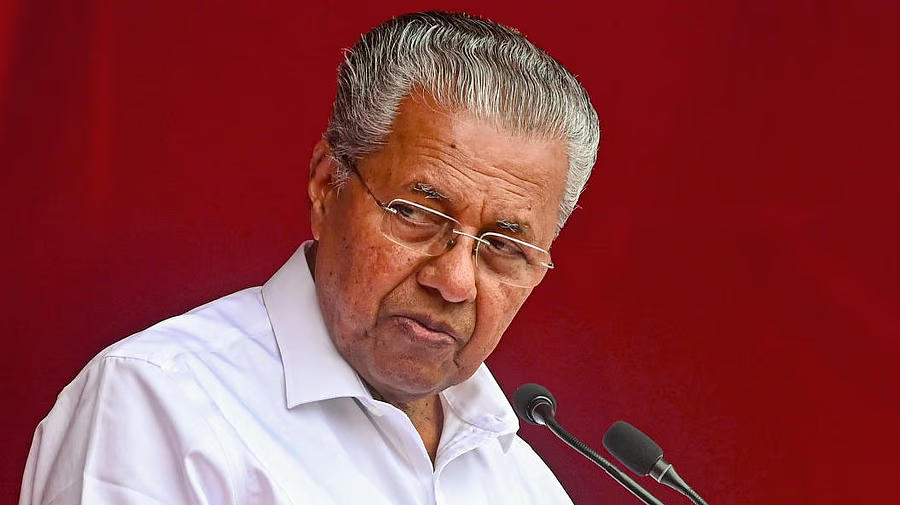
Thiruvananthapuram (PTI): A case has been registered and a probe launched into social media posts allegedly threatening a member of Chief Minister Pinarayi Vijayan’s security team with consequences once the UDF comes to power, officials said on Sunday.
The Thiruvananthapuram City Cyber Police registered the case based on a complaint filed by Chief Minister’s security staff member Sandeep Sasidharan.
The Congress had earlier alleged that Sandeep and another officer, Anil Kumar, brutally assaulted two Youth Congress-KSU activists including using flower pot when they protested against the Chief Minister during the Navakerala Sadas programme in Alappuzha in 2023.
A subsequent probe was conducted against both officers, and the Crime Branch later gave them a clean chit.
Recently, following the conclusion of the state assembly election on April 9, several social media posts allegedly made by Congress, Youth Congress and KSU activists claimed that revenge would be taken once the LDF government is removed and the UDF comes to power.
Police said cases have been registered against Facebook accounts named Arun Rajendran, Tom Kuriakose, Yaser KP, Sony Panamthanam, Sarath Pillai, KSU Kanjiramkulam, Rahul John C and Youth Congress Battle.
According to the FIR, the complainant’s photograph and name were used in several social media posts threatening him with consequences and containing abusive language.
Police said the social media account holders have been identified and will soon be summoned as part of the investigation.
The case has been registered under Sections 296(b) (uttering obscene words causing public annoyance), 351(2) (criminal intimidation), and 3(5) (acts done by several persons) of the Bharatiya Nyaya Sanhita.