India's services sector expands at fastest rate in a year in Feb; employment falls further: Survey
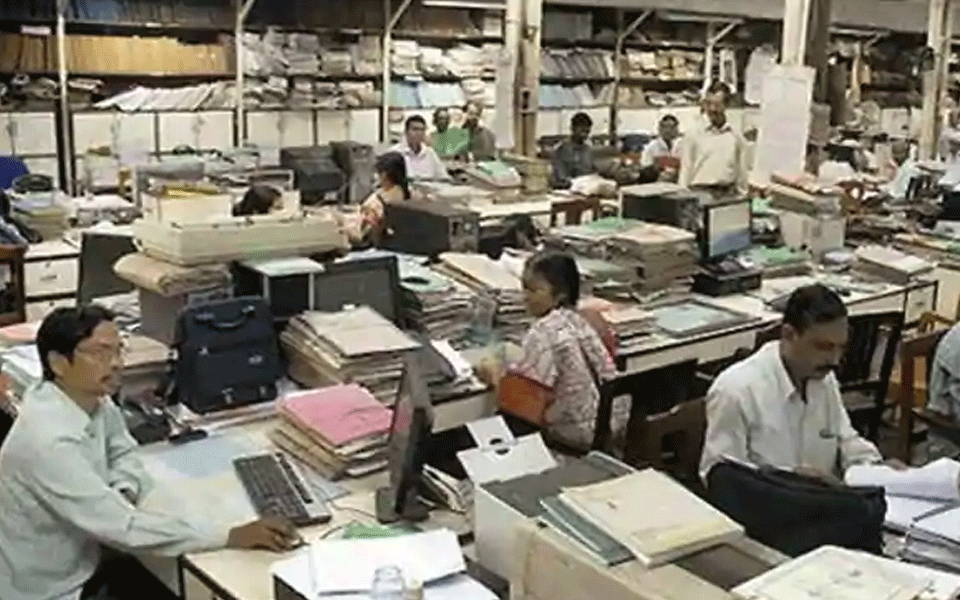
New Delhi: India's services activity expanded at the fastest rate in a year during February, while employment fell further and companies noted the sharpest rise in overall expenses, a monthly survey said on Wednesday.
The seasonally adjusted India Services Business Activity Index rose from 52.8 in January to 55.3 in February, pointing to the sharpest rate of expansion in output in a year amid improved demand and more favourable market conditions.
The index was above the critical 50 mark that separates growth from contraction for the fifth month in a row during February as the roll-out of COVID-19 vaccines led to an improvement in business confidence towards growth prospects.
While, new work intakes expanded for the fifth straight month, panellists continued to indicate that the COVID-19 pandemic and travel restrictions curbed international demand for their services.
"New export orders declined for the twelfth month running, albeit at the weakest rate since last March," the survey noted.
Meanwhile, Indian private sector output rose at the quickest pace in four months during February. The Composite PMI Output Index, which measures combined services and manufacturing output, increased from 55.8 in January to 57.3 in February.
"Economic activity is generally expected to recover in the final quarter of fiscal year 2020/21 after coming out of technical recession in Q3, and the latest improvement in the PMI indicators points to a strong expansion in the fourth quarter, should growth momentum be sustained in March," said Pollyanna De Lima, Economics Associate Director at IHS Markit.
On the domestic macro-economic front, after contracting for two quarters in a row, the Indian economy recorded a 0.4 per cent growth in the October-December quarter, mainly due to a good show by farm, manufacturing, services and construction sectors.
The IHS Markit India Services PMI further noted that despite ongoing growth of total new business, service sector employment fell further during February and a number of companies suggested that the COVID-19 pandemic restricted labour supply.
"There were further jobs losses across both the manufacturing and service sectors, which also could restrict domestic consumption in the coming months. However, with capacity pressures mounting, business sentiment strengthening and the vaccination programme widening, it seems that the best days are ahead of us regarding employment growth," Lima said.
On the prices front, amid reports of higher freight, fuel and retail prices, overall input costs increased in February. Furthermore, the rate of inflation accelerated to the strongest since February 2013.
However, competitive pressures prevented companies from lifting their own fees. "Once firms' additional cost burdens start to feed through to clients via price hikes, demand strength may come under pressure," Lima noted.
Hopes that the COVID-19 vaccine programme will be successful in reducing case numbers across the country underpinned positive expectations towards growth prospects. The overall degree of optimism regarding the 12-month outlook for business activity strengthened to a one-year high, the survey said.
Let the Truth be known. If you read VB and like VB, please be a VB Supporter and Help us deliver the Truth to one and all.
Bengaluru airport introduces AI-based system to enhance safety at vehicle-aircraft intersections
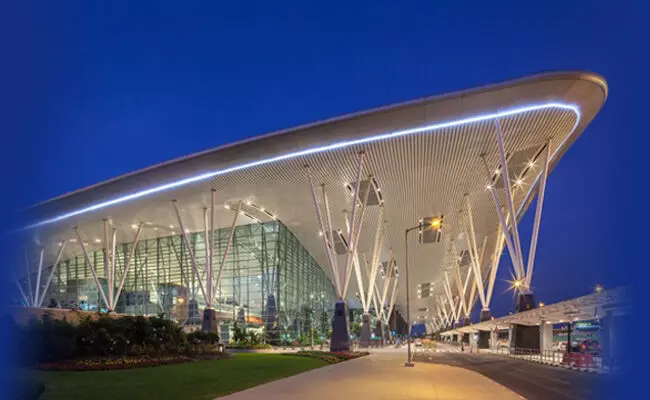
Bengaluru: Bangalore International Airport Limited (BIAL) has introduced an integrated smart airside safety system at Kempegowda International Airport to improve operational safety at key intersection zones.
According to The Hindu, the system has been designed to enhance safety at Cross Service Roads (CSRs), where aircraft and ground vehicle movements intersect.
According to BIAL, the system integrates AI-based computer vision, automation, and centralised monitoring to manage right-of-way movements and reduce the risk of human error.
“CRSs are among the most sensitive areas within airport operations, requiring precise and seamless coordination between aircraft and ground vehicles. Traditionally, right of way protection at these intersections relied on manual or semi-manual inset light activation, creating dependencies on human intervention, increasing the risk of delays and limiting operational visibility,” TH quoted BIAL as saying.
The new system uses real-time detection of vehicle movement, risk assessment, and automated signalling. AI-enabled cameras identify potential conflicts and trigger automated inset light signals to ensure aircraft priority. Normal operations resume once the area is confirmed clear.
“Based on these detections, the system triggers automated inset light activation to protect aircraft right‑of‑way and restores normal signalling once the intersection is confirmed clear. A centralised monitoring and analytics platform digitally logs all events, strengthening governance, compliance, and operational control,” BIAL said.
By embedding technology into operations, the system creates a data-driven separation layer between aircraft and ground vehicles, significantly reducing human error, especially during night and low-visibility conditions.
“Precision-led signal activation improves traffic flow, minimises unnecessary stoppage and enhances turnaround efficiency. It also establishes a scalable foundation for predictive safety analytics, enabling trend analysis, peak-hour optimisation, compliance mapping and risk forecasting to support continuous improvement and stronger airside governance,” BIAL said.