India's unemployment rate at 6-year low of 3.2 pc during Jul 2022-Jun 2023: Govt data
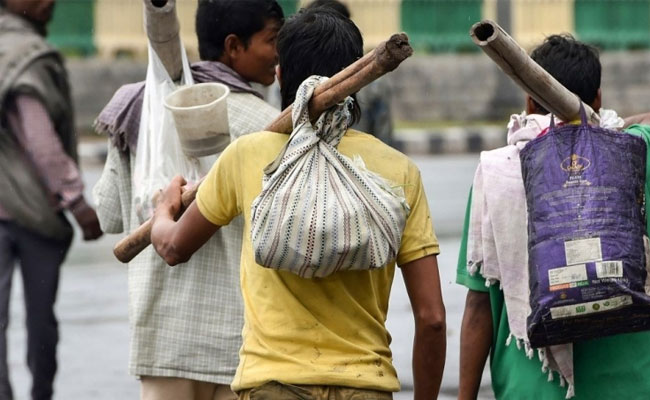
New Delhi (PTI): India's unemployment rate for persons aged 15 years and above was recorded at a six-year low of 3.2 per cent during July 2022-June 2023, as per the Periodic Labour Force Survey Annual Report 2022-2023 released by the National Sample Survey Office on Monday.
Joblessness or unemployment rate is defined as the percentage of unemployed persons in the labour force.
Considering the importance of the availability of labour force data at more frequent time intervals, the NSSO launched the Periodic Labour Force Survey (PLFS) in April 2017.
The reference period here is from July 2022 to June 2023. The Unemployment Rate (UR) in usual status for persons of age 15 years and above at the all-India level came down to 3.2 per cent in 2022-23 from 4.1 per cent in 2021-22.
The UR was 4.2 per cent in 2020-21, 4.8 per cent in 2019-20, 5.8 per cent in 2018-19 and 6 per cent in 2017-18, the PLFS data showed.
The usual status means that the employment (status of a person) is determined based on the reference period of 365 days preceding the date of the survey.
The statement on the data said that 2022-23 refers to the period of July 2022 to June 2023 and likewise for 2021-22, 2020-21, 2019-20, 2018-19 and 2017-18.
"In rural areas, UR decreased from 5.3 per cent in 2017-18 to 2.4 per cent in 2022-23 while for urban areas it decreased from 7.7 per cent to 5.4 per cent. The UR for male in India decreased from 6.1 per cent in 2017-18 to 3.3 per cent in 2022-23 and corresponding decrease in UR for females was from 5.6 per cent to 2.9 per cent," it stated.
The survey also showed that the Labour Force Participation Rate (LFPR) in usual status for persons of age 15 years and above increased to 57.9 per cent from 49.8 per cent in 2017-18.
The LFPR is defined as the percentage of persons in the labour force -- working or seeking or available for work -- in the population.
"In rural areas, LFPR increased from 50.7 per cent in 2017-18 to 60.8 per cent in 2022-23 while for urban areas it increased from 47.6 per cent to 50.4 per cent. The LFPR for male in India increased from 75.8 per cent in 2017-18 to 78.5 per cent in 2022-23 and corresponding increase in LFPR for female was from 23.3 per cent to 37.0 per cent," it stated.
The Worker Population Ratio (WPR) in usual status (ps+ss) for persons of age 15 years and above also increased to 56 per cent in 2022-23 from 46.8 per cent in 2017-18.
The WPR is defined as the percentage of employed persons in the population.
"In rural areas, WPR increased from 48.1 per cent in 2017-18 to 59.4 per cent in 2022-23 while for urban areas it increased from 43.9 per cent to 47.7 percent. The WPR for male in India increased from 71.2 per cent in 2017-18 to 76.0 per cent in 2022-23 and the corresponding increase in WPR for female was from 22.0 per cent to 35.9 per cent," it stated.
Five Annual Reports are brought out on the basis of the data collected in PLFS during July 2017-June 2018, July 2018-June 2019, July 2019-June 2020, July 2020-June 2021 and July 2021-June 2022.
Now the sixth Annual Report has been brought out by the NSSO on the basis of the Periodic Labour Force Survey conducted during July 2022-June 2023.
"The field work for the collection of information in respect of the samples, allotted for the period of July 2022-June 2023, was completed timely for the first visit as well as revisit samples, except for 51 first visit and 68 revisit FSUs for the State of Manipur, allotted in the last quarter, April-June 2023, which were treated as casualties, due to disturbed field situation and unavailability of internet services," the report said.
Let the Truth be known. If you read VB and like VB, please be a VB Supporter and Help us deliver the Truth to one and all.
Mamata visits Bhabanipur EVM strong room, warns against counting irregularities
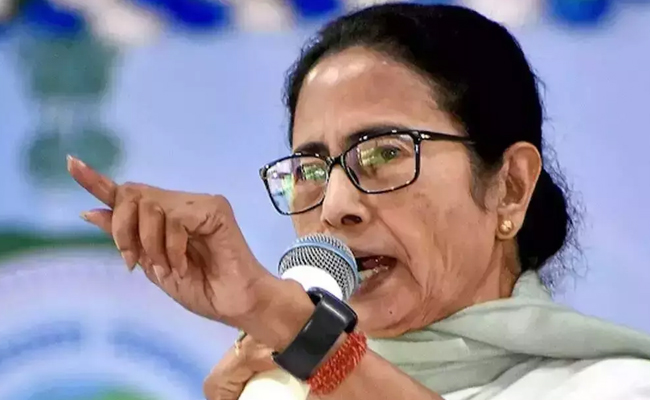
Kolkata (PTI): West Bengal Chief Minister and TMC supremo Mamata Banerjee early Friday warned against any attempt to tamper with the counting process, hours after she visited an EVM strong room in Bhabanipur, alleging possible malpractice.
Banerjee, who emerged around 12:07 am after spending nearly four hours at the counting centre for her Bhabanipur constituency housed in Sakhawat Memorial School in south Kolkata, said only one person would be allowed inside the designated counting area.
"Either the candidate or one agent can stay upstairs. I have also suggested installation of a CCTV camera for the media," she told reporters.
Stressing the need for transparency, she said, "It is essential to maintain transparency. People’s votes must be protected. I rushed here after receiving complaints. The central forces initially did not allow me to enter."
Sounding a stern note ahead of the May 4 counting, she added, "If there is any plan to tamper with the counting process, it will not be tolerated."
On Thursday evening, Banerjee had reached the Bhabanipur Assembly segment counting centre, which houses the strong room for EVMs used in the April 29 polling, citing suspicion of tampering with the machines.
She entered the premises along with her election agent and remained inside for hours, even as Kolkata Mayor and TMC candidate from the Kolkata Port segment Firhad Hakim reached the spot but could not meet her.
"I reached here upon learning that the chief minister has arrived. But I couldn’t meet her since she was already inside the premises, exercising her right as a candidate to visit strong rooms. I wasn’t allowed there. I will not be able to confirm what exactly is transpiring inside," Hakim said.
The development coincided with protests by TMC candidates Kunal Ghosh and Shashi Panja outside the Khudiram Anushilan Kendra in north Kolkata, where they staged a sit-in alleging irregularities and possible tampering of EVMs stored in strong rooms, leading to face-offs between TMC and BJP supporters.
Earlier in a video message, Banerjee had urged party leaders, workers and polling agents to maintain a 24-hour vigil on EVM strong rooms, alleging that the BJP could attempt to tamper with the machines before counting begins.
Her remarks come amid heightened political tension in the state following a fiercely contested Assembly election, with parties closely monitoring arrangements and raising concerns over transparency.