India's water will be now be utilised for the country: PM Modi
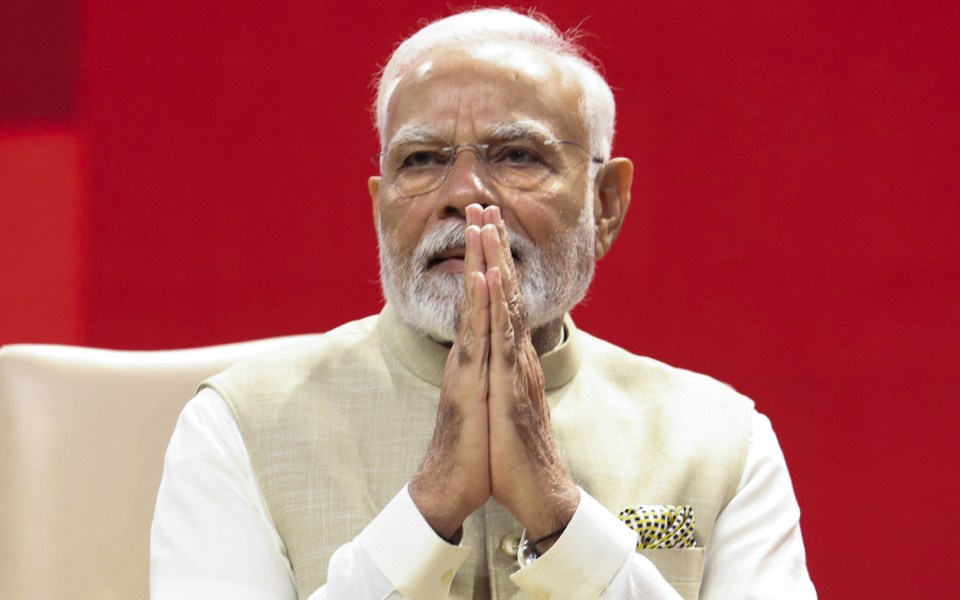
New Delhi, May 6 (PTI): Prime Minister Narendra Modi affirmed on Tuesday that India's water will no longer flow outside the country but will be utilised in the nation's interest, remarks which were clearly aimed at Pakistan following his government’s decision to put the Indus Waters Treaty in abeyance after the Pahalgam terror attack.
Addressing the ABP Network's ‘India@2047’ Summit, Modi highlighted his government’s focus on interlinking of rivers, noting that water used to be a source of conflict among states, before hinting at India’s move against Pakistan as he cited ongoing discussion around water.
“Pahle Bharat ke haq ka pani bhi bahar ja raha tha. Ab Bharat ka pani Bharat ke haq mein bahega. Bharat ke haq mein rukega. Aur Bharat ke hee kaam aayega. (Earlier, the water which rightfully belonged to India was going outside the country. Now India's water will flow and stop in the country's interest, and will be used for India),” he said in Hindi as the audience cheered.
Modi, however, made no direct reference to Pakistan or any other comment on the rising tensions between the two countries following the terror strike that killed 26 civilians, mostly tourists.
Speaking about the finalisation of the India-UK free trade agreement, Modi said it is a historic day and this pact between two big and open market economies will mark a new chapter in the development of the two countries.
“This will boost economic activity in India and will open new ways and opportunities for Indian businesses and MSMEs,” he said, adding that it will help the youth.
The prime minister said India is not only carrying out reforms, but by actively engaging with the world, it is also making itself a vibrant trade and commerce hub.
“For taking big decisions and achieving objectives, it is important to give primacy to national interest and believe in the capability of the country,” he said.
The prime minister focused on the country’s growth and development under his government’s nearly 11 years of rule, saying it has served the poor and deprived sections of society while prioritising development as it has been solely driven by the interest of the country.
“We are moving from a GDP-centric approach to progress based on Gross Empowerment of People (GEP),” he said, citing a host of welfare schemes, including for housing and health insurance, for different sections of society.
His government has combined tradition with development and technology, he said, adding that if India tops in digital transactions, then it has also taken yoga and ayurveda to the world.
When people look at the country now, they can proudly say “democracy can deliver”, he said, adding that their trust was running low before his government took over as he slammed the previous regimes for being beholden to extraneous interests, including vote bank compulsions.
Referring to the new Waqf law, Modi said the need for the reforms was felt for decades but to satisfy a vote bank even this noble work was defamed.
“Now the amendments have been made which in the real sense will help poor Muslim mothers and sisters and poor Pasmanda Muslims,” he said, while also touching on his government’s decision to ban triple talaq.
It harmed innumerable Muslim women but was allowed to continue, he said.
In his address, he said the biggest dream of this changing India is to become ‘Viksit Bharat’ by 2047.
“The country has the capabilities, resources and the willpower for it,” he said.
“For decades, a counterstream prevailed in the country. There was a time when, before taking a big decision, it was thought - ‘what would the world think? Will we get votes or not? And decisions and big reforms languished due to such reasons,” Modi said, adding that a country does not move forward like this.
It advances when the basis of decisions is ‘Nation First’, he stressed.
In the last decade, India has moved forward with this mantra, and the results are there for all to see, he said.
“Our government has taken decisions which had been languishing and did not see the light of day due to a lack of political willpower,” he said.
Modi said direct benefit transfer weeded out 10 crore fake beneficiaries, saving Rs 3.5 lakh crore.
India, he noted, has begun doing well in sectors where it was not traditionally strong. He spoke about India’s rising defence exports, with over 100 countries being supplied with its defence products, and its emergence as an exporter of electronic products as well.
Let the Truth be known. If you read VB and like VB, please be a VB Supporter and Help us deliver the Truth to one and all.
Rupee falls 20 paise to 95.43 against US dollar in early trade
Mumbai (PTI): The rupee depreciated 20 paise to 95.43 against US dollar in early trade on Tuesday as market sentiments remained fragile after renewed military exchanges between US and Iranian forces in the Gulf region.
Forex traders said investor anxiety due to instability in the Gulf is causing massive capital flight into safe-haven assets, with the US dollar acting as the primary beneficiary.
Moreover, Brent oil prices is hovering near USD 113 per barrel, maintaining pressure on oil-importing economies like India.
At the interbank foreign exchange market the rupee opened at 95.30 then lost ground to touch 95.43 against the US dollar, in initial trade, registering a fall of 20 paise over its previous close.
Rupee fell 39 paise to close at an all-time low of 95.23 against the US dollar on Monday.
"With oil boiling rupee on Monday fell to a closing low of 95.0875 and this morning the opening was still lower as it becomes more and more vulnerable when dollar index rises due to safe-haven buying and oil prices rise due to the continuous fighting in the Gulf Region," Anil Kumar Bhansali, Head of Treasury and Executive Director, Finrex Treasury Advisors LLP, said.
The higher oil prices will keep rupee sold off against the dollar as oil companies and FPIs intensify dollar buying, Bhansali added.
Meanwhile, the dollar index, which gauges the greenback's strength against a basket of six currencies, was trading at 98.51, up 0.15 per cent.
Brent crude, the global oil benchmark, was trading lower by 1.07 per cent at USD 113.22 per barrel in futures trade.
"Market sentiments remained fragile after renewed military exchanges between US and Iranian forces when Iranian forces launched fresh attacks in the Gulf as both sides sought to assert control over the strategic waterway," Bhansali said.
On the domestic equity market front, Sensex declined 361.62 points to 76,907.78 in early trade, while the Nifty dropped 134.90 points to 23,980.60.
Foreign Institutional Investors purchased equities worth Rs 2,835.62 crore on Monday, according to exchange data.