Indigo cancels 67 flights from multiple airports due to bad weather, operational issues
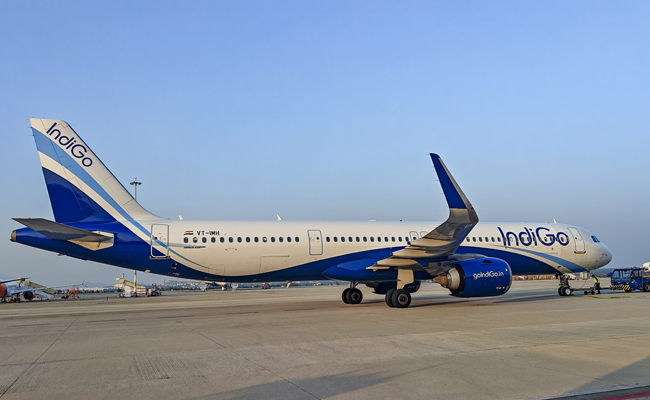
Mumbai (PTI): Domestic carrier IndiGo on Thursday cancelled 67 flights from multiple airports due to "forecasted" bad weather and operational reasons, according to the airline's website.
Of the 67 cancelled flights, only four were for operational reasons, and the rest were due to "forecasted" bad weather at various airports, including Agartala, Chandigarh, Dehradun, Varanasi, Bengaluru, among others, as per the website.
Aviation regulator, DGCA, has announced the period between December 10 and February 10 next year as the official fog window this winter.
ALSO READ: India reaching new heights in field of sports under PM Modi: Rajasthan CM
As part of the DGCA fog operations (CAT-IIIB) norms, airlines have to mandatorily roster pilots who are trained to operate in low-visibility conditions, as well as deploy a CAT-IIIB-compliant aircraft fleet for such operations.
Category-III is an advanced navigation system that empowers an aircraft to land under foggy conditions.
Category-III-A is a precision instrument approach and landing that enables a plane to land with a runway visual range (RVR) of 200 metres, while Category-III-B helps in landing with an RVR of under 50 metres.
IndiGo, whose operations are under DGCA monitoring after the cancellations of thousands of flights early this month, is already operating a curtailed schedule in compliance with the government's order.
Under its original winter flight schedule, the airline was permitted to operate 15,014 domestic flights per week, or about 2,144 flights per day, roughly six per cent higher than the 14,158 weekly flights it operated during the summer schedule of 2025.
However, after the massive disruptions, which saw the airline cancelling 1,600 flights on a single day on account of new rest norms for pilots, which allow more rest to the pilots, the government cut down the airline's domestic flight schedule by 10 per cent or 214 flights per day.
As a result of that, IndiGo can't operate more than 1,930 flights per day on domestic routes under its current winter schedule.
The Rahul Bhatia-controlled airline cancelled thousands of flights between December 1 and December 9 on account of a lack of proper planning, and crew shortage in implementing the new set of regulations for pilots' duty period and rest, which were put in place from November 1, thereby causing severe hardships to lakhs of air travellers.
Following this, the Directorate General of Civil Aviation (DGCA) formed a four-member panel, comprising Joint DG Sanjay Brahamane, Deputy Director General Amit Gupta, senior Flight Operations Inspector Kapil Manglik, and FOI Lokesh Rampal, with a mandate to identify the root causes of widespread operational disruptions at the Rahul Bhatia-controlled domestic carrier.
The panel, which has already grilled IndiGo CEO Pieter Elbers and Chief Operating Officer Isidre Porqueras as part of its probe, is expected to submit its report by this week.
Meanwhile, IndiGo, in a travel advisory on X, said, "Low visibility and fog over Bangalore has impacted flight schedule. We are keeping a close watch on the weather and doing our best where you need to be safely, smoothly".
Reacting to the advisory, an aggrieved passenger, in an X post, said, "My flight on December 20 from Bhubaneswar to Ahmedabad got delayed for more than five hours, and today my return flight from Ahmedabad to Bhubaneswar also got delayed more than three hours with the same excuse as bad weather. I am travelling with my senior citizen parents, and this delay is not acceptable. Need proper explanation, along with compensation".
Let the Truth be known. If you read VB and like VB, please be a VB Supporter and Help us deliver the Truth to one and all.
Thunderstorm hits Lucknow, IMD issues red alert across multiple UP districts
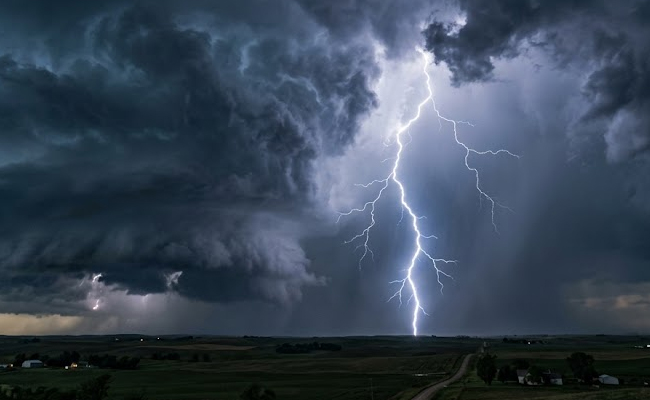
Lucknow: Shortly after the India Meteorological Department issued a red alert warning of severe weather conditions in the region, a sudden thunderstorm hit Lucknow and adjoining districts on Monday morning.
The Indian Express reported that the skies turned dark around 8:45 am as strong winds lashed parts of the city. Incidents of tree falls were reported from several locations, disrupting traffic and normal movement.
The weather department said thunderstorms accompanied by lightning, hail and gusty winds of 40 to 60 kmph are likely to continue over the next three hours across several districts.
A red alert has been issued for districts including Unnao, Barabanki, Hardoi, Sitapur, Bahraich, Gonda, Shravasti and Lakhimpur Kheri, where moderate thunderstorms with hail and strong winds may damage trees, power lines and temporary structures.
An orange alert is in place for Rae Bareli, Amethi, Kanpur Nagar, Ayodhya, Kanpur Dehat, Auraiya, Kannauj, Farrukhabad, Shahjahanpur and Balrampur, where thunderstorms with lightning and winds up to 60 kmph could lead to localised disruptions.
Major parts of the state remains under yellow alert, including districts such as Prayagraj, Agra, Bareilly, Aligarh and Moradabad, where light rain, lightning and winds of 30 to 40 kmph are expected.
Authorities have advised residents to remain indoors, avoid open areas and trees during lightning, and secure loose objects.