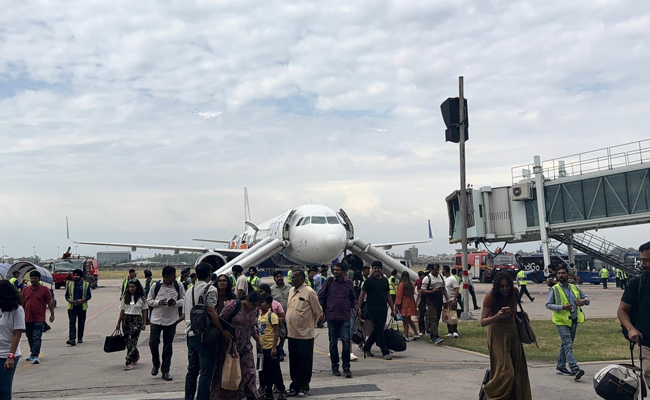
Indigo flight makes emergency landing in Karachi after medical emergency
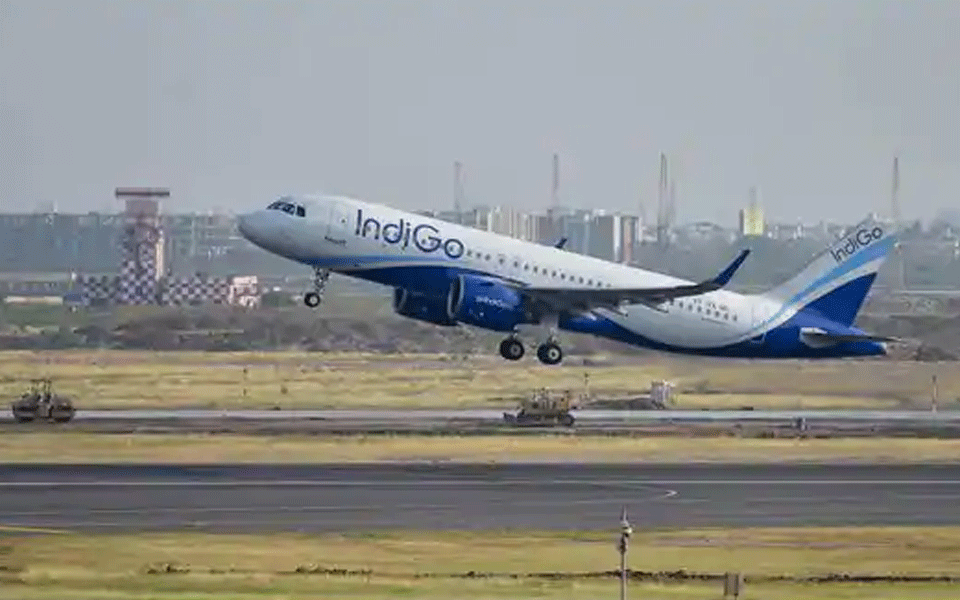
Karachi/New Delhi: An Indigo flight from Sharjah to Lucknow made an emergency landing at the Karachi airport in Pakistan on Tuesday morning after a passenger on board fell sick and later died.
An official of the Pakistan Civil Aviation Authority said the landing permission was granted to the Captain of the Lucknow-bound IndiGo flight 6E1412 after an elderly passenger identified as 67-year-old Habib ur Rehman - fell seriously ill.
"The passenger unfortunately expired on the plane even though the Indian aircraft was given permission to land at the Karachi airport," the official said.
In a statement, IndiGo said the passenger who had the medical emergency could not be revived and was declared dead on arrival by the airport medical team. "We are deeply saddened with the news and our prayers and wishes are with his family," it added.
The airline said the flight coming from Sharjah to Lucknow was diverted to Karachi.
The Pakistani official said that the request for an emergency landing was received as soon as the aircraft entered Pakistani airspace via Iran at 4 in the morning.
"The Captain contacted the air control tower and requested the aircraft be allowed to make an emergency landing on humanitarian grounds," he said.
The permission was granted and the aircraft landed around 5 am, he said. The official said that by the time the medical team boarded the flight to treat the passenger, he had died.
"The flight was allowed to take off around 8.36 am for Ahmedabad after completion of all formalities," the official added.
Pakistan reopened its airspace to international civil aviation in July, 2019 after months of restrictions imposed because of tensions with India, which forced long detours that cost airlines millions of dollars.
Let the Truth be known. If you read VB and like VB, please be a VB Supporter and Help us deliver the Truth to one and all.
Bengaluru airport introduces AI-based system to enhance safety at vehicle-aircraft intersections

Bengaluru: Bangalore International Airport Limited (BIAL) has introduced an integrated smart airside safety system at Kempegowda International Airport to improve operational safety at key intersection zones.
According to The Hindu, the system has been designed to enhance safety at Cross Service Roads (CSRs), where aircraft and ground vehicle movements intersect.
According to BIAL, the system integrates AI-based computer vision, automation, and centralised monitoring to manage right-of-way movements and reduce the risk of human error.
“CRSs are among the most sensitive areas within airport operations, requiring precise and seamless coordination between aircraft and ground vehicles. Traditionally, right of way protection at these intersections relied on manual or semi-manual inset light activation, creating dependencies on human intervention, increasing the risk of delays and limiting operational visibility,” TH quoted BIAL as saying.
The new system uses real-time detection of vehicle movement, risk assessment, and automated signalling. AI-enabled cameras identify potential conflicts and trigger automated inset light signals to ensure aircraft priority. Normal operations resume once the area is confirmed clear.
“Based on these detections, the system triggers automated inset light activation to protect aircraft right‑of‑way and restores normal signalling once the intersection is confirmed clear. A centralised monitoring and analytics platform digitally logs all events, strengthening governance, compliance, and operational control,” BIAL said.
By embedding technology into operations, the system creates a data-driven separation layer between aircraft and ground vehicles, significantly reducing human error, especially during night and low-visibility conditions.
“Precision-led signal activation improves traffic flow, minimises unnecessary stoppage and enhances turnaround efficiency. It also establishes a scalable foundation for predictive safety analytics, enabling trend analysis, peak-hour optimisation, compliance mapping and risk forecasting to support continuous improvement and stronger airside governance,” BIAL said.