Ink used for Maharashtra civic polls easy to wipe off, claims Oppn; SEC to conduct probe
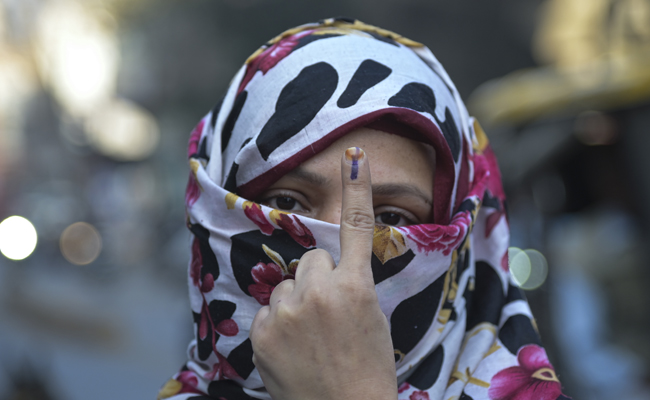
Mumbai (PTI): Maharashtra State Election Commission (SEC) on Thursday evening said it would conduct a thorough probe into the quality of the `indelible' ink in marker pens used for the civic polls, after opposition leaders alleged that the mark on a voter's finger could be removed easily, enabling bogus voting.
Amid polling for 29 municipal corporations including the Brihanmumbai Municipal Corporation (BMC), social media was flooded with videos claiming to demonstrate how the ink could be removed using chemicals such as acetone, even as Chief Minister Devendra Fadnavis dismissed the claims.
Speaking to PTI, State Election Commissioner Dinesh Waghmare said that in view of the controversy, the SEC will not use marker pens for the coming Zilla Parishad elections but revert to the traditional ink -- produced by Mysore Paints and Varnish Limited, a company of the Karnataka government -- used in assembly and Lok Sabha elections.
"The SEC has decided to conduct a probe.....it will cover not only the ink quality but also the videos which were circulated throughout the day. The probe into videos is to ascertain whether the ink was applied on the finger while voting or in a mischievous way," Waghmare said.
"We will do a random sampling of marker pens used today across the state and verify the quality of the ink supplied to us. The formula for the quality of the ink is finalised by the Election commission of India and a private company supplied the pens to the SEC," the state election commissioner said. "We have been using these pens since 2011 for all local body elections," he added.
Another SEC official said that Kores (India) Ltd had supplied the marker pens, and those were as per the commission's specifications. Three marker pens were provided for each polling booth, he added.
Earlier, following the allegations that the indelible ink applied to voters' fingers came off easily, SEC officials held a press conference.
"The ink takes about 10 to 12 seconds to dry after being applied. During this time the voter is still inside the polling booth. Once it dries, it cannot be removed. This is the same ink used by the Election Commission of India. If double voting takes place, action will be taken against the presiding officer of the polling booth," Waghmare said during the press conference.
Another SEC official said, "Compared to ink, using marker pen is easier and efficient. It was the sole reason behind SEC shifting from ink to marker pen. But after this controversy, we decided to use ink instead of marker pen."
Waghmare also claimed that a fake narrative was being spread, and voters were not supposed to rub off the ink before it dried. "If ink is removed before it dries, it is a voter's fault. A criminal case can also be registered against such voters," he added.
Videos circulating on social media would be investigated and action would be taken against anyone spreading misinformation, said Waghmare, while also blaming voters for confusion over polling booth locations, stating that they should have checked their booth details and names in advance.
Earlier, Mumbai Congress leader and Lok Sabha member Varsha Gaikwad posted a video of her party colleague using acetone to wipe off the ink from his finger.
“BMC wiping off accountability? Since morning we have been receiving several reports of how the marker ink is being wiped off easily. My colleague and his wife here demonstrate how this ink can be easily removed with acetone or nail polish remover,” she posted on X.
Maharashtra Navnirman Sena chief Raj Thackeray also raised the issue after casting his vote in Dadar.
"People come out, wipe the ink, and go back inside to vote again. Then they come out, wipe it again and re-enter. Is this what the government calls development?" he said.
The ink mark could be wiped off with a hand sanitiser, Thackeray said, alleging that "the entire system is working to ensure the victory of those in power...this is not how free and fair elections are conducted."
Shiv Sena (UBT) chief Uddhav Thackeray said he too received reports of ink being washed away. "This is shocking," the former chief minister said, accusing SEC Waghmare of siding with the ruling BJP-led alliance and demanding his suspension.
Maharashtra Congress Legislative Party leader Vijay Wadettiwar made the same allegation. Notably, state minister and Shiv Sena leader Sanjay Shirsat too endorsed the claim about the ink coming off fingers easily.
The SEC, however, claimed that even if someone tried to vote again by removing the ink mark, it was not possible as other safeguards were in place.
"After a voter casts their vote, an official record of the voting is maintained. Therefore, merely wiping off the ink does not make it possible for a voter to cast a vote again," it said in the statement.
Following orders issued on November 19, 2011, and November 28, 2011, marker pens have been used to apply ink on voters' fingers during local body elections. As per these orders, the ink must be applied clearly using a marker pen, and it should be rubbed three to four times on the nail and the skin above the nail, the SEC said.
Chief Minister Fadnavis dismissed the allegations. "The Opposition is looking for excuses in advance," he said after casting his vote in Nagpur.
Deputy Chief Minister Eknath Shinde said he spoke to SEC official Suresh Kakani. "He said the same ink has been used for the past several years. Now, instead of directly from bottle, they are using it from marker pens. I think the SEC is vigilant to avoid bogus voting," he added.
BJP national general secretary Vinod Tawde said, " If there is problem with the ink, concerned poll official should be held responsible. It was unfair to hold BJP responsible for the same."
State Women Commission chairperson and NCP leader Rupali Chakankar wrote to the SEC, demanding a probe into cases of ink removal and bogus voting.
Let the Truth be known. If you read VB and like VB, please be a VB Supporter and Help us deliver the Truth to one and all.
Representative of Iran's Supreme Leader in India calls current situation 'no war, no peace'
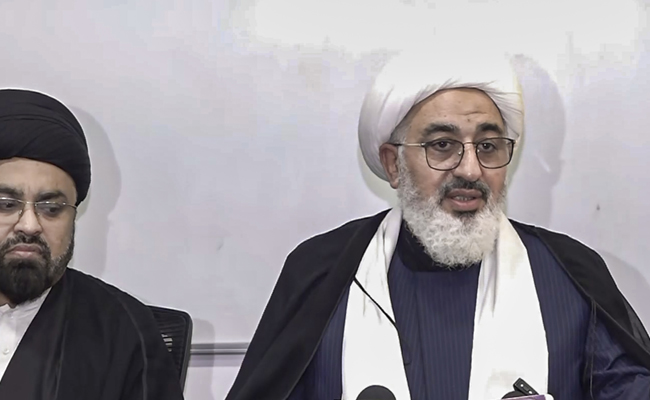
Bengaluru (PTI): Representative of Iran's Supreme Leader in India, Abdul Majeed Hakeem Ilahi on Saturday characterised the ongoing tensions between his country and the Israel-US alliance as a state of “no war, no peace”.
Calling for an immediate halt to the conflict, he said the global stability hinges on those who initiated the war.
He questioned why countries affected by the war and suffering from the energy crisis are not pressuring the US and Israel to stop the aggression.
Addressing a press conference here, Ilahi said Iran did not want the conflict, but was compelled to respond amid continued attacks, even as negotiations were expected to continue.
"Iran didn't want this war, but Iran was forced by the war and several times Iran tried to avoid this war... I don't know what is the condition of these people and these countries (US-Israel)... they want to impose on other countries what they want, and who gave them this authority?" he questioned.
Recalling the negotiations Iran held in Oman, he said talks later moved to Geneva and made progress before being disrupted by sudden attacks.
Ilahi claimed that airstrikes and missile attacks led to the deaths of Iran’s supreme leader Ayatollah Ali Khamenei, ministers, commanders and civilians.
"They killed a lot of civilians… They attacked a primary school, and they killed 175 innocent girls," he said, claiming over 4,000 deaths, more than 40,000 injuries, and widespread damage to houses, hospitals, universities and public infrastructure.
Despite these losses, he said Iran resisted calls for “unconditional surrender” and stood firm and defended itself.
"They wanted unconditional surrender. Which no one—no one can accept it. Iran said, 'Okay, we are ready to be sacrificed,' but we are not ready to submit ourselves," he added.
He argued that they (US-Israel) proposed the current ceasefire only after realising that they could not achieve any of their objectives after 40 days of conflict.
The envoy further claimed that the ceasefire is not an actual ceasefire, but a “no war, no peace” situation.
Explaining the current situation in Iran, he said conditions remain stable and people are going about their daily lives.
"They are working ....(leading) their ordinary life. They are working—they're going farming and they do everything....and they aren't scared of anything. And they are ready to defend themselves," he added.
Addressing the crisis in the Strait of Hormuz, he said the situation was stable before February 28 and all countries benefited from it.
"(For) 10,000 years, the Strait of Hormuz was open...and Iran daily yearly spent a lot for providing security in the Strait of Hormuz... so no one even complained anything about the Strait of Hormuz. Everyone was free...and even our enemies their warship was passing through the Strait of Hormuz," he said.
However, he linked the current maritime instability to the actions of the US and Israel.
"So Iran cannot do anything. Those people who initiated, created and started this war, they have to stop it. And everything will go back to normal," he said.
Criticising the mentality of the "great powerful country", Ilahi said, "they think they have the right to do whatever they want. It should change."
He sought to know why the countries affected by the conflict are not exerting pressure on the US and the "Zionist" regime to halt the war.
"Why are they not asking them? This crisis and problem by which a lot of countries are affected was created by them. A lot of factories are closed and even working days in some countries reduced... A lot of restaurants are closed," he said.
Seeking fairness and justice, Ilahi said instead of asking Iran, all those nations should ask those who initiated this war to stop it, by telling them, "we are suffering."
To a query on international mediation, Ilahi, referring to the US, asked, "Is it acceptable and reasonable that one country orders all countries -- you should not deal with this country, You should not purchase from this country. You should not have business with this country. You should not buy from this country."
Ilahi also highlighted Iran's long-standing ties with India and said, "It is a great country and we respect India and Indians."
"We have 5,000 years relationship and friendship. We are connected to India by education, by philosophy, by culture, by civilisation and by the economy," he said.
According to him, the bilateral cooperation remains strong, citing diplomatic engagement.
"At the moment also, our relationship, collaboration, cooperation with India is very good," he said, adding Iran allowing Indian ships to pass through Strait of Hormuz reflects the ties.
"Iran allowed Indian ships to pass through the Strait of Hormuz. Why? A lot of countries couldn't get this permission?... The relationship between Iran and India is very good," he added.
He expressed confidence that in future too, the ties between Iran and India will be strong.