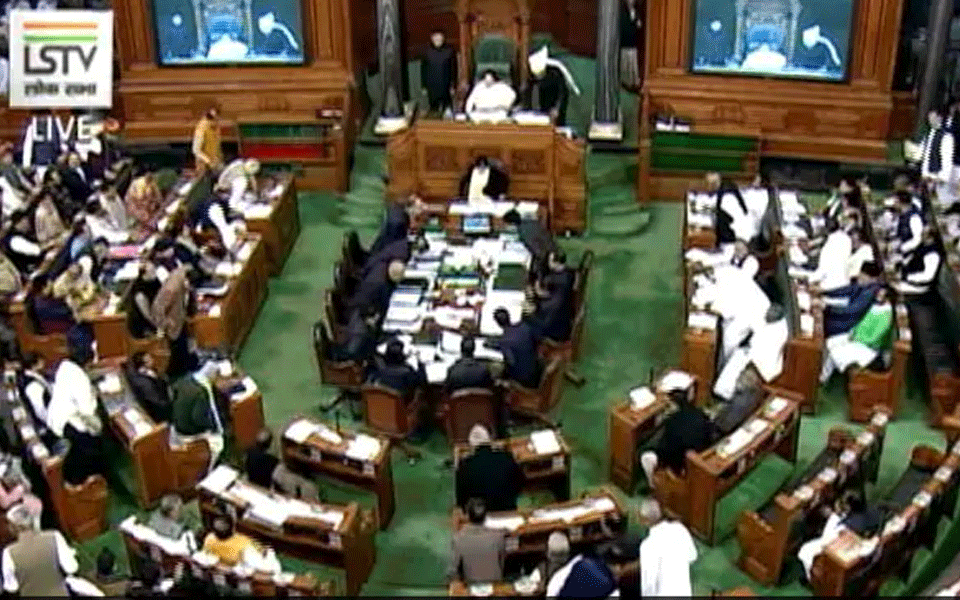
New Delhi, July 23 : A bill to amend the Insolvency and Bankruptcy Code, 2016, allowing an allottee of a real estate project to be treated as a financial creditor was introduced in the Lok Sabha on Monday, amid allegations from opposition parties that some changes were intended to "help just one industry".

The Insolvency and Bankruptcy Code (Second Amendment) Bill, 2018 was introduced by interim Finance Minister Piyush Goyal and seeks to replace an ordinance brought by the government earlier this year.

Taking part in the debate, Biju Janata Dal (BJD) member Bhartruhari Mahtab said he is opposed to the move to amend Section 33 of the Code to provide a reduced threshold from 75 per cent of voting share for obtaining the approval of the Committee of Creditors for making an application to the adjudicating authority to pass a liquidation order.

"That is the reason why I say that this is nothing but a fixed match. Bad loan resolution is becoming deep-rooted nexus between the bankers, auditors and promoters, which is undermining serious recovery," he said.

He was supported by some other opposition members as well.

Citing the resolution process of a textile company, Mahtab said two companies had jointly submitted before the Committee of Creditors (CoC) of the textile firm to acquire the company last April but the CoC failed to gather enough votes to act on the resolution plan.

"And here the crux of the problem lies. The proposal got 70 per cent of the votes when 75 per cent were needed. The government stepped in and an ordinance amending the IBC lowered the minimum vote needed for passing a resolution plan to 66 per cent from 75 per cent," he said.

Mahtab said the government "should stand up and do away with this type of crony capitalism".

Rejecting the allegations, Goyal said these are "baseless" and the amendments will have prospective effect.

He said that when the Insolvency and Bankruptcy Code was introduced, the country's banking sector was going through a serious crisis "because of indiscriminate and absolutely baseless lending" that happened during the period 2008 to 2014.

The Minister said the banking system gave money to promoters who had no business to get loans in the first place.

He said the cases being referred to "were also loans, which were given during that period and then subsequently restructured ... because of which the banking system was in dire straits."

Goyal said the laws to recover loans were weak and banks were unable to take back money from "big people", so notices were sent to others.

"No property of factory of big people were seized... The entire responsibility is of Congress," he said.

He said the amendments had been brought on the recommendations of a committee.


Let the Truth be known. If you read VB and like VB, please be a VB Supporter and Help us deliver the Truth to one and all.


Bengaluru (PTI): India is planning to collect samples from the Moon and bring them back to Earth under Chandrayaan-4, while Chandrayaan-5 will involve a heavier lander with a longer mission life, ISRO Chairman V Narayanan said on Wednesday.

He also spoke about ISRO's future missions including the one to study Venus and the other on Mars landing mission. 

"Now we are working on the continuation of the Chandrayaan programme. In Chandrayaan-4, we plan to collect samples and bring them back. Chandrayaan-5 will involve a heavier lander with a longer mission life," he said at the inaugural ceremony of ISRO's fourth edition of the Space Science and Technology Awareness Training (START 2026) programme here. 

He recalled that in Chandrayaan-3, the lander's mission life was only 14 days. 

"In the future mission, we are talking about a life of around 100 days. The rover will also be heavier. Chandrayaan-3 had a rover of about 25 kg, while the future mission will have a rover of about 350 kg," Narayanan said. 

Referring to ISRO's future programmes like the Venus Orbiter Mission, he said, "We have already accomplished the Mars Orbiter Mission, and now we are working on a Mars landing mission."

"These are some of the projects being discussed for government approval. So there is a lot of interest in the science area." 

He noted that under Prime Minister Narendra Modi, the vision of the space programme has been expanded and said, "We are currently working on the Gaganyaan programme and are planning to send our own astronauts into space and bring them back safely, possibly within the next two years." 

"We are also planning to build our own space station by 2035. Additionally, we are working on landing Indians on the Moon and bringing them back safely by 2040. Brainstorming activities have already begun. So there are many activities happening in the space sector. Apart from application-related activities that ensure food security, water security, communication, and safety for citizens, there are many initiatives planned in the science area as well," he added. 

Narayanan noted that India's space programme has accomplished 10 scientific missions so far, including AstroSat, which recently completed a decade in orbit and was still functioning very well.

He also highlighted India's various lunar exploration missions -- Chandrayaan-1, Chandrayaan-2, and Chandrayaan-3 -- saying they led to many scientific discoveries. 

"We are progressing in a big way," he added.

Highlighting the successful Chandrayaan-3 mission in the year 2023, the ISRO chairman said that India became the first country to successfully achieve a soft landing near the south pole of the Moon.

"Not only did we achieve the landing, but many discoveries were made. Around eight minerals were identified, seismic activity was studied, and the thermal profile of the Moon's surface was understood. Electron clouds were also studied. So many discoveries have come from that mission," he added. 

Referring to the launch of Aditya-L1, the ISRO chairman said, "India is the fourth country to successfully place a satellite to study the Sun, and a large amount of data has already come out, and we have released the data as well." 

Emphasising India's Space Vision 2047, he recalled that the country, which started with very humble beginnings, has developed significant capabilities.

"Today, we have the capability to conceive, design, and build our own launch vehicles, as well as conceive, build, and place satellites in orbit. Fifty years ago, we did not have this capability. Today, we can build satellites and the payloads required for them," Narayanan said.

Citing an example, he said that earlier optical cameras used lenses that were only about one inch in diameter. 

"But today, in ISRO, cameras with optics of about 1.7 metres in diameter and almost one foot in thickness are being developed. These optics are being built at the LEOS (Laboratory For Electro Optics Systems) laboratory in Bengaluru for space observation. Many such activities are happening in the space sector," he noted. 

He pointed out that the US, after 1969 and almost after 50-55 years, has again shown interest in landing on the Moon. 

"The Artemis programme is already a very vibrant programme, with many activities going on. An accord was signed in 2023, and India is also a signatory to that accord," he said. 

Speaking about China and Russia leading efforts to build the International Lunar Research Station (ILRS), the ISRO chairman noted, "When we talk about such space stations, one aspect is technology development. The second aspect is the large number of scientific experiments that will take place there. There is also a lot of competition today." 

"There was a time when only government organisations across the world carried out space activities. Today, companies like SpaceX have advanced significantly. In fact, they have overtaken many others in terms of launches," he added. 

He said that the main idea behind programmes like START 2026 is to encourage the next generation of youngsters to develop interest in this field and to build scientific temper so that they can become great leaders in building the nation.