Institutional collaboration precursor to solution finding: CJI Chandrachud
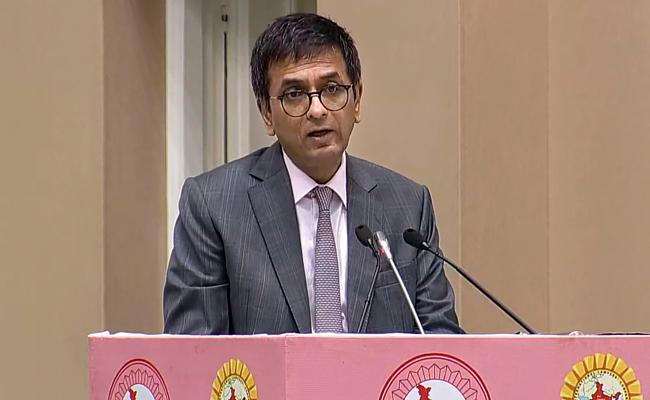
New Delhi (PTI): Chief Justice of India D Y Chandrachud on Saturday said institutional collaboration is the precursor to solution finding while adjudicating judicial questions and it also plays a significant role in increasing access to justice.
Addressing the inaugural ceremony of the Bar Council of India's (BCI) two-day 'International Lawyers Conference 2023' here, he said it is utopian to think that there will be a day when "we find perfect solutions with no challenges to the justice delivery".
"However, it is definitively not utopian to aspire for a world where nations, institutions and most importantly individuals are open to engage with and learn from one another without feeling threatened or belittled," the Chief Justice of India (CJI) said.
He said that while the Constitution provides for separation of power among the legislature, the executive and the judiciary, it also creates a space for institutions to learn from each other and deliver justice.
"Institutional collaboration is a precursor to solution finding not only while adjudicating judicial questions but it also plays a significant role in increasing access to justice," Justice Chandrachud said.
The CJI was the chief guest of the programme which was inaugurated by Prime Minister Narendra Modi.
Union Law Minister Arjun Ram Meghwal, Lord Chancellor and Secretary of State for Justice of the United Kingdom Alex Chalk KC, Attorney General for India R Venkataramani, Solicitor General Tushar Mehta, Bar Council of India chairman and senior advocate Manan Kumar Mishra and others, including several judges of the apex court, were present at the event.
In his speech, the CJI said that instead of addressing specific challenges to justice delivery, he seeks to present an "umbrella framework" to address these challenges and find innovative solutions.
Referring to engagement between nations, institutions and individuals, Justice Chandrachud said, "It is in this engagement that I believe lies the framework to find usual solutions."
Knowledge sharing is a two-way street and decisions of the Indian Supreme Court are being regularly cited and relied upon by foreign courts, he said.
"At the administrative level too, the Indian judiciary must remain receptive to collaborating with various nations. India has played a pivotal role by constructing the Supreme Court buildings in Mauritius and in Bhutan," the CJI said.
He said that drafting of the Constitution of India by the Constituent Assembly is a classic example of engaging beyond partisan lines.
"We find the same bi-partisan effort and this is something to which we, as citizens of India must be proud, has gone into the passing of the women's reservation bill in Parliament recently," Justice Chandrachud said.
He further said, "In our tendency to emphasise differences, we often forget the abundant examples of collaboration between institutions to further the interest of justice. This holds true not only in lofty constitutional challenges but more frequently in the everyday interaction between the courts and the government."
Citing an example, the CJI said a constitution bench of the Supreme Court is presently hearing a challenge pertaining to whether a person holding a driving licence for light motor vehicles can drive a commercial vehicle under the Motor Vehicles Act.
"Instead of viewing the case as an adversarial challenge, the court and the government are collaborating to protect the livelihoods of millions of drivers across the country," he said, adding that the ultimate aim of different institutions is the same and that is the progress and prosperity of the nation.
Justice Chandrachud said that last week, a meeting of the Union Cabinet, chaired by the Prime Minister, approved phase three of the e-courts project with a financial outlay of over Rs 7,000 crore.
He said the Supreme Court e-committee is not working in isolation but with constant cooperation with other forms of governmental institutions.
"The e-courts programme being implemented collectively by the e-committee, Supreme Court of India and the Union Ministry of Law and Justice is a perfect example of institutions collaborating to make justice more accessible, affordable and transparent," the CJI said.
He also talked about setting aside differences and engaging as individuals in the service of the nation.
"Indeed, nothing explains this push towards engagement across nations better than the slogan for the recently concluded G20 summit -- 'Vasudhaiva Kutumbakam' -- the world is one family," Justice Chandrachud said.
He applauded the Bar Council of India, the Law Society of England and Wales, the Bar Council of England and Wales and the Commonwealth Lawyers Association for collaborating and putting together a conference of "immense promise and relevance".
Let the Truth be known. If you read VB and like VB, please be a VB Supporter and Help us deliver the Truth to one and all.
Unruly scenes witnessed in Punjab Assembly
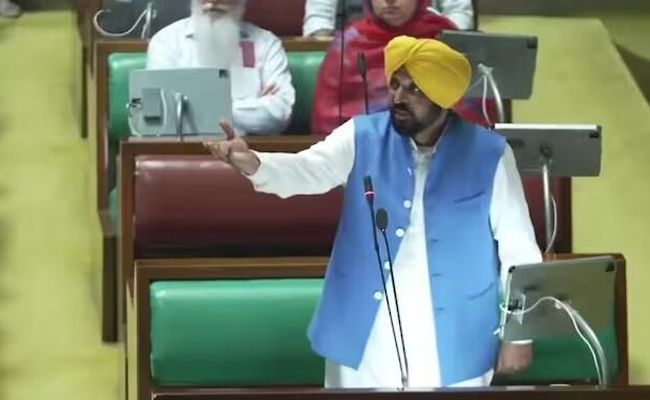
Chandigarh (PTI): The Punjab Assembly on Friday witnessed high drama on Friday after Congress MLA Sukhpal Singh Khaira made an allegedly objectionable remark against Chief Minister Bhagwant Mann during an intense argument over the alleged use of mobile phone in the house by the legislator.
During the one-day special session of the Punjab Vidhan Sabha here, Mann accused Khaira of using a mobile phone when Speaker Kultar Singh Sandhwan was reading out an official resolution on the revision of wages.
After rising from his seat, the chief minister pointed to the speaker, claiming that Khaira is busy on his mobile phone and urged him to ask the Congress MLA what Sandhwan had said about the resolution.
The speaker then asked Khaira to maintain order in the house and listen to the resolution carefully.
Mann then asked Khaira, "Why don't you go out and then use it (mobile phone)," which led to a strong verbal altercation during which the opposition MLA hurled an accusation against the chief minister. Meanwhile, the speaker appealed for order and insisted that the chair be addressed.
However, both Mann and Khaira continued arguing and could be seen pointing fingers at each other as the proceedings of the house were disrupted.
The AAP MLAs also rose from their seats with Finance Minister Harpal Singh Cheema condemning Khaira for his conduct and demanded action against him.
Cheema further alleged that Khaira "always tries to disturb the house" as he spoke about his conduct in the assembly.
The incident occurred as an official resolution on the revision of wages was presented at the special session by Labour Minister Tarunpreet Singh Sond who said it paid homage to labourers on the International Workers' Day.
"Workers are the axis of construction of the nation, the community, the state and society. Every construction project succeeds only through their blood and sweat," the resolution read.
As per the resolution, "The base rate of minimum wages for the working class in Punjab was last revised in the year 2012. Although the dearness allowance has continued to increase since 2012, there has been no increase in the base rate of minimum wages.
On this sacred occasion of May Day, in this special session of the legislative assembly, this house proposes to revise and increase the minimum wages of labourers and strongly recommends to the government to take a decision regarding the increase of minimum wages for workers, so that the contributions of the workers can be acknowledged." PRK