IPS officer transferred for shutting down RSS shakha
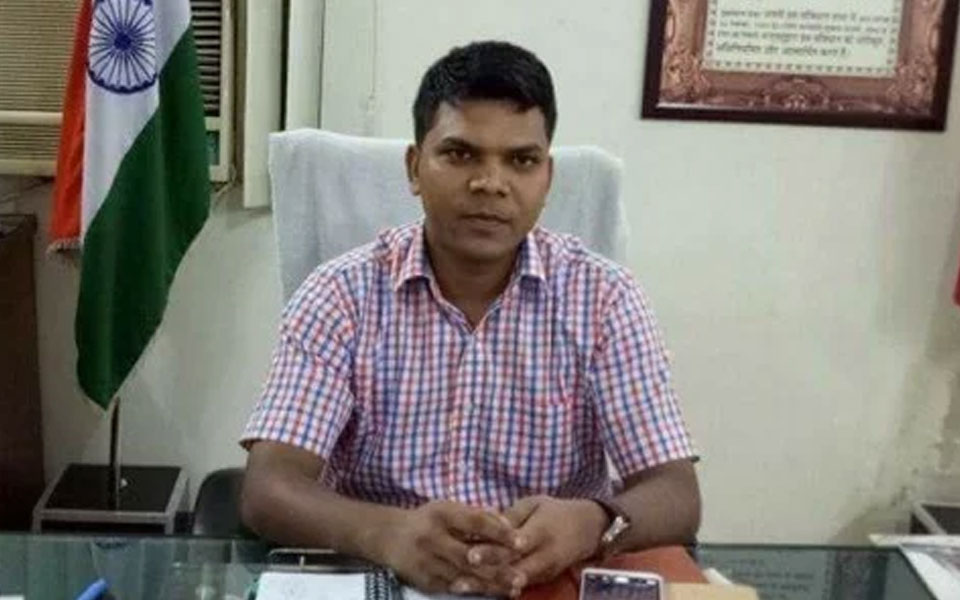
Agra:The IPS officer, who had shut down the RSS shakha that was being held on a disputed land, was transferred by the authorities after complaints from BJP legislators
The people who had raised a hue-and-cry over the transfer of IAS officer Durga Shakti Nagpal during the previous regime are now silent. An Indian Police Service (IPS) officer, who had shut down an Rashtriya Swayamsevak Sangh (RSS) shakha being held on a disputed land, has been transferred by the government following complaints from BJP MLAs.
In Tajganj area of Agra, Uttar Pradesh, there prevails a tension between the two communities, with each claiming ownership of a particular plot of land. Six months ago, the permission to hold Urs celebrations on this plot was not granted. This land lies close to a mazaar. Police forces have been deputed here since.
A month ago, RSS activists started holding shakhas here. Tension between the two communities started to get worse since. Last week on Wednesday, police prohibited the shakha from going ahead, saying the matter of ownership of the land was subjudice. The decision was taken by the local police station incharge, Rajkumar Yadav.
Immediately after that, the BJP MLAs reached the plot and started a dharna against the police. They went to the kotwal, Shailendra Singh, to register their complaint but he also supported his police station in charge. Later, SP (city) Kunwar Anupam Singh, supported the police action and praised the forces for being impartial in establishing law and order.
But the local police faced the music for their impartiality. SP (city) Kunwar Anupam Singh has been transferred. Kotwal Shailendra Singh and the local police station in charge, Rajkumar Yadav, too, have been given their transfer orders. Sources say that the action was taken after Chief Minister Yogi Adityanath’s personal intervention. The opposition is surprisingly quiet
After the episode, Agra has been on tenterhooks. On the evening of June 18, RSS workers held a shakha in Pawandham Colony, which was attended by 68 swayamsevaks. According to the head of publicity department of the RSS, “The local police station incharge threw away the saffron flag and said that we are grooming terrorists here. Such insult did not take place even during the SP, BSP or Congress regimes.”
According to Congress’ local president, Haji Jamiluddin, “Some anti-social elements have been trying to occupy the land of the dargah of Kareel wale Baba. The police force have been deputed here for six months. First the Urs programme, and then RSS shakha was stopped here by the administration. After that, all the three police officials were removed for taking impartial action.”
Before this, the MLA from south Agra, Yogendra Upadhyay, and Sikri MLA Udaybhan Singh met the chief minister on this issue. After the meeting, they blamed SP (city) Kunwar Anupam Singh for supporting the local police.
It is important to note that RSS workers have started holding shakhas here only recently. After the meeting of MLAs with the chief minister, the order for removing the SP (city) was issued from Lucknow.
Young Kunwar Anupam Singh has a reputation of being a strict, honest and an impartial police officer.
The leader of Samajwadi Party in Agra, Nadeem Mansoori, said that it was a matter of repressing the morale of the police officers who are impartial and honest. According to ADGP, Agra, Ajay Anand, transfer is part of normal police functioning. “It can’t be seen in context of a particular incident,” he said.
Sources say that RSS is still holding shakhas on that disputed land under tight security cover.
courtesy : nationalheraldindia.com
Let the Truth be known. If you read VB and like VB, please be a VB Supporter and Help us deliver the Truth to one and all.
Mamata visits Bhabanipur EVM strong room, warns against counting irregularities

Kolkata (PTI): West Bengal Chief Minister and TMC supremo Mamata Banerjee early Friday warned against any attempt to tamper with the counting process, hours after she visited an EVM strong room in Bhabanipur, alleging possible malpractice.
Banerjee, who emerged around 12:07 am after spending nearly four hours at the counting centre for her Bhabanipur constituency housed in Sakhawat Memorial School in south Kolkata, said only one person would be allowed inside the designated counting area.
"Either the candidate or one agent can stay upstairs. I have also suggested installation of a CCTV camera for the media," she told reporters.
Stressing the need for transparency, she said, "It is essential to maintain transparency. People’s votes must be protected. I rushed here after receiving complaints. The central forces initially did not allow me to enter."
Sounding a stern note ahead of the May 4 counting, she added, "If there is any plan to tamper with the counting process, it will not be tolerated."
On Thursday evening, Banerjee had reached the Bhabanipur Assembly segment counting centre, which houses the strong room for EVMs used in the April 29 polling, citing suspicion of tampering with the machines.
She entered the premises along with her election agent and remained inside for hours, even as Kolkata Mayor and TMC candidate from the Kolkata Port segment Firhad Hakim reached the spot but could not meet her.
"I reached here upon learning that the chief minister has arrived. But I couldn’t meet her since she was already inside the premises, exercising her right as a candidate to visit strong rooms. I wasn’t allowed there. I will not be able to confirm what exactly is transpiring inside," Hakim said.
The development coincided with protests by TMC candidates Kunal Ghosh and Shashi Panja outside the Khudiram Anushilan Kendra in north Kolkata, where they staged a sit-in alleging irregularities and possible tampering of EVMs stored in strong rooms, leading to face-offs between TMC and BJP supporters.
Earlier in a video message, Banerjee had urged party leaders, workers and polling agents to maintain a 24-hour vigil on EVM strong rooms, alleging that the BJP could attempt to tamper with the machines before counting begins.
Her remarks come amid heightened political tension in the state following a fiercely contested Assembly election, with parties closely monitoring arrangements and raising concerns over transparency.