'Irresponsible, builds media narrative': SC miffed over selective release of AI plane crash report
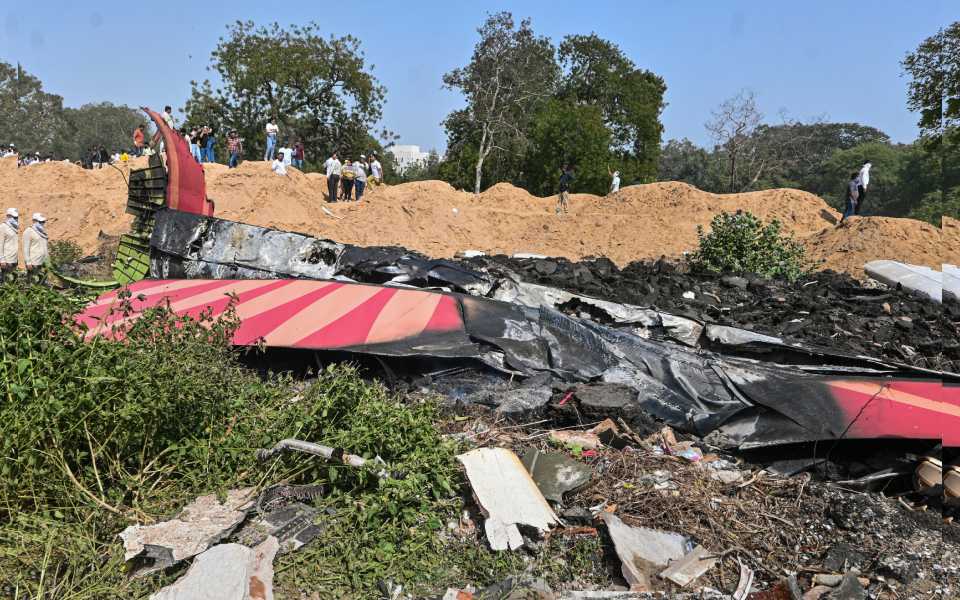
New Delhi, Sep 22 (PTI): The Supreme Court on Monday termed as "unfortunate and irresponsible" the selective publication of a preliminary report on the June 12 Air India crash which outlined lapses on the part of pilots and paved way for a "media narrative".
A bench of Justices Surya Kant and N Kotiswar Singh, which issued notices to the Centre and the Directorate General of Civil Aviation (DGCA) on the aspect of an independent, fair and expeditious probe of the crash, said an element of privacy and dignity of families of victims was also involved.
It took note of certain aspects of the Aircraft Accident Investigation Bureau (AAIB) preliminary report issued on July 12 and said "piecemeal and selective" publication of the findings which led to building of a media narrative was "unfortunate and irresponsible".
"There should be complete confidentiality of reports of this nature till the inquiry is complete. There is an element of privacy and dignity of the victims involved. That's why we should wait for the final report," the bench observed.
Advocate Prashant Bhushan, appearing for the NGO 'Safety Matters Foundation', earlier said one line of the preliminary report which blamed the pilots for the crash led to building of a narrative in the media across the world.
"Unless people know what was the cause of the accident, they are in danger as no preventive steps can be taken till then. It's been over 100 days since the crash and we still don't know the reason," Bhushan said.
He alleged in the probe panel constituted after the crash, three of the five-members were from the aviation regulator and there could be an issue of conflict of interest.
"There are three interested parties–manufacturer of aircraft, airline and the DGCA and involvement of any member of these three parties will be a conflict of interest. How can officers of the very organisation whose role is likely to be examined be part of the committee probing the incident," Bhushan said.
He said revealing information from the flight data recorder of the airplane would "clear the air" over the cause of the accident.
The bench said while the demand for free, fair and independent inquiry was understandable, the demand for information from the flight data recorder was "questionable".
While cautioning that releasing a particular information might be exploited by rival airlines, the bench suggested such information should not be released prematurely.
"We should not release the information piecemeal and maintain utmost confidentiality till the regular inquiry is taken to its logical conclusion. Then only we can say what was the actual reason," Justice Kant said.
Bhushan referred to a podcast, which claimed of having examined all aspects of the incident, and said it concluded that it was not a case of pilot's negligence.
"Media reporting from one isolated line from the preliminary report has actually distorted the larger picture," he submitted and added the probe panel could be headed by a judicial person.
When bench felt an independent inquiry by domain experts was a better option, Bhushan said a retired judge could head the panel to oversee the inquiry.
The top court said such inquiries should happen promptly to quell rumours and speculations and avoid selective leakage of information to media, social media and other forms of media.
Bhushan reiterated about the flight data recorder, but the bench pointed out the possibility of several "parallel theories" if information was released.
Bhushan said theories would anyway come even after the final report and there was no way to prevent it.
The plea has been filed by an aviation safety NGO led by Captain Amit Singh, alleging that the official probe violates citizens' fundamental rights to life, equality and access to truthful information.
The plea says the AAIB issued its preliminary report on July 12, attributing the accident to "fuel cutoff switches" being moved from "run" to "cutoff", effectively suggesting a pilot error.
It alleged that the report withheld critical information, including the full Digital Flight Data Recorder output, complete Cockpit Voice Recorder transcripts with time stamps and Electronic Aircraft Fault Recording data.
According to the plea, these are indispensable for a transparent and objective understanding of the disaster.
The PIL further criticises the report for downplaying systemic anomalies, such as fuel-switch defects, electrical faults, Ram Air Turbine deployment and electrical disturbances, and for prematurely attributing the crash to a pilot error.
The plea says a "selective and biased" inquiry into a disaster of this magnitude violates Article 21 of the Constitution by compromising citizens' right to life, safety and dignity, is arbitrary and contrary to Article 14, and suppresses truthful information in breach of Article 19(1)(a).
On June 12, Air India's Boeing 787-8 aircraft operating flight AI171 en route to London's Gatwick airport crashed into a medical hostel complex shortly after taking off from Ahmedabad, killing 265 people, including 241 passengers and crew on board.
Among the 241 dead were 169 Indians, 52 Britons, seven Portuguese nationals, one Canadian and 12 crew members.
The lone survivor of the crash was Vishwashkumar Ramesh, a British national.
Let the Truth be known. If you read VB and like VB, please be a VB Supporter and Help us deliver the Truth to one and all.
Putin meets Iran's FM Araghchi, says Russia ready to do its best to help bring peace to West Asia
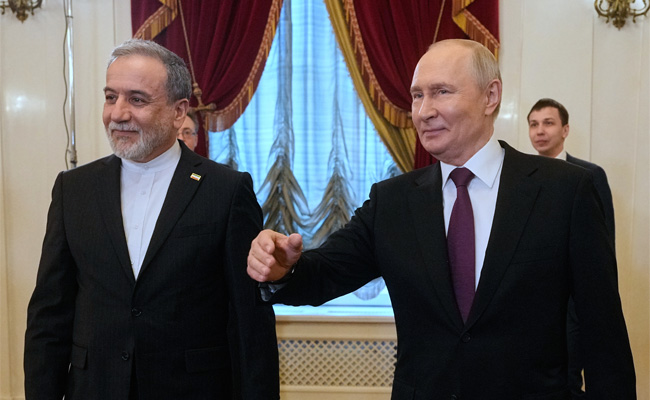
Moscow (PTI): Iran's Foreign Minister Abbas Araghchi on Monday met Russian President Vladimir Putin, who hailed the Iranian people for fighting bravely and heroically for their sovereignty and said Moscow is ready to do its best to help bring peace to West Asia as soon as possible.
Araghchi, who held talks with Omani and Pakistani leadership before arriving in Russia, met Putin in St. Petersburg and thanked him for supporting Iran, state-owned TASS news agency reported.
"Russia is ready to do everything in its power to ensure that peace in the Middle East is achieved as soon as possible," Putin said during his meeting with Araghchi, which was also attended by Russian Foreign Minister Sergey Lavrov.
Revealing that he received a message from Iranian Supreme Leader Mojtaba Khamenei last week, Putin asked Araghchi to convey his "gratitude for this message and best wishes for his health and well-being."
He praised the Iranian people for fighting "bravely and heroically" for their sovereignty, Iran's state-run PRESS TV reported.
"We really hope that, based on the courage and desire for independence, the Iranian people, under the guidance of the new leader, will weather this difficult period of trials and peace will come,” Putin said.
He also stressed that Russia “intends to maintain” its strategic relations with Iran.
Araghchi said that the world witnessed Iran’s strength in countering the US during the recent war, and that the Islamic Republic is a "stable and powerful establishment."
"With their courage, the Iranian people succeeded in resisting the US aggression and will be able to endure it,” he said.
He said that it became clear that Iran has “great friends and allies” like Russia, and conveyed “warmest greetings” from Supreme Leader Mojtaba Khamenei and President Masoud Pezeshkian to the Russian leader.
Araghchi said relations between Moscow and Tehran represent a “strategic partnership at the highest level” and will continue to develop "regardless of circumstances."
"We are grateful to you for the solid and strong positions in support of the Islamic Republic of Iran," he said.
Foreign Minister Lavrov said that the talks between President Putin and the Iranian Foreign Minister were "useful and constructive."
Kremlin Spokesman Dmitry Peskov later said that Russia is "ready to provide any good offices, any mediation services that are acceptable to the parties."
"We will be ready to do everything so that ultimately peace ensues, guaranteed peace, and that there is no return to hostilities," Peskov was quoted as saying by TASS.
He was asked how Moscow can assist in future negotiations on the Iranian settlement.
Araghchi arrived in Russia after his whirlwind trip to Islamabad, which, according to him, was “very productive” and involved “good consultations" with Pakistan's Army Chief Field Marshal Asim Munir, amid uncertainty over the second round of peace talks to resolve the war in West Asia.
"We held good consultations with our friends in Pakistan. The trip was successful. We assessed the outcome of our recent (meetings) and discussed in what direction and under what conditions talks can move on,” Araghchi said in a video posted on his Telegram channel upon his arrival in St Petersburg.
Referring to the second round of talks between the US and Iran to resolve the conflict in West Asia, Araghchi said: "Developments have taken place in the negotiations."
"Despite some progress in earlier rounds, the talks failed to reach their objectives due to the Americans' approach, the excessive demands they made, and the wrong approaches they adopted. Therefore, it was necessary to consult with our friends in Pakistan to review the latest situation,” Iran's official news agency IRNA quoted him as saying.
He said that the trip to Pakistan was a good opportunity to review developments related to the US-Israeli war against Iran, expressing confidence that “these consultations and coordination between the two countries will be highly significant.”
Araghchi arrived at St. Petersburg's Pulkovo Airport early Monday, where he was welcomed by Russian officials and Iran’s ambassador to Russia, Kazem Jalali, the report said.
The first round of peace talks between Iran and the US, held on April 11 and 12, failed to bring the desired result for the parties to the conflict.
The Iranian minister arrived in Islamabad for the second time on Sunday after a short visit to Oman, where he held talks with Sultan Haitham bin Tariq al-Said on security in the Strait of Hormuz and diplomatic efforts to end the Iran-US conflict.
After Araghchi left Pakistan for Oman on Saturday, President Donald Trump announced that US negotiators Steve Witkoff and Jared Kushner would no longer be going to Islamabad for talks with Iran, contending that Washington held all the cards on the matter.
Trump on Sunday reiterated that the US and Iranian officials can talk by phone for a peace solution to the conflict.
On Tuesday, Trump extended the two-week ceasefire with Iran indefinitely to give Tehran more time to prepare a unified proposal to end the war, just hours before the truce was set to expire.
The war began when the US and Israel jointly attacked Iran on February 28, killing Iranian Supreme Leader Ayatollah Ali Khamenei and several top commanders. The retaliation by the Islamic Republic extended the war to the entire Gulf region.