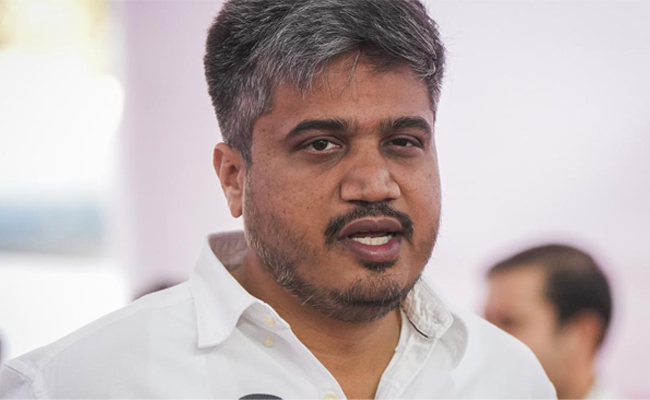
Pune (PTI): NCP (SP) MLA Rohit Pawar has questioned if VSR Ventures owner V K Singh was trying to hold the pilot of the Learjet aircraft responsible for the crash that killed Maharashtra Deputy CM Ajit Pawar and four others in January.

The Crime Investigation Department questioned Singh and recorded his statement last week, a CID officer had said, without disclosing details.

The CID has not issued any statement about the details regarding Singh's questioning.

ALSO READ:  CEC threatened Bengal govt officers at meeting, ‘false bravado’ unacceptable: Mamata

A Learjet 45 aircraft, operated by VSR Ventures, crashed near the Baramati air strip in Pune district on January 28, killing Ajit Pawar and four others.

Citing reports in a section of media about a submission purportedly made by Singh to CID, Rohit Pawar in a post on X on Monday said, "What exactly was recorded in the black box has still not been revealed. If that is the case, how did VSR company owner V K Singh come to know within a short time of the crash that it was the pilot's fault?"

"If this gentleman is declaring that the pilot was at fault and washing his hands of the matter, it appears as though he is trying to shift the blame onto someone else while keeping himself out of it," he added.

Until authorities release concrete and credible information about the plane crash, people should not believe any discussions or baseless claims, the NCP (SP) MLA said.

"The CID has said that the investigation into Ajit Dada's plane crash is still underway. It is even difficult to talk about the credibility of the recent preliminary report by the Aircraft Accident Investigation Bureau (AAIB)," he stated.

At times, reports say the black box of the plane was burnt, while at other times it is claimed that the data has been recovered, the legislator pointed out.

"Meanwhile, the investigating agencies are maintaining complete silence on the matter," he added.

Let the Truth be known. If you read VB and like VB, please be a VB Supporter and Help us deliver the Truth to one and all.


A war happening thousands of kilometres away can quietly reach our kitchens. The ongoing conflict in West Asia, particularly involving Iran, Israel and the United States, has begun disturbing global energy supply routes. One important fuel affected by this disruption is LPG — the cooking gas used in millions of Indian homes. When supply chains shake in that region, countries like India immediately feel the pressure.

India is the world’s second-largest importer of LPG. Last year, the country used about 33.15 million metric tonnes of cooking gas. But India does not produce enough LPG domestically to meet all its needs. Local production stands at around 12.8 million metric tonnes, which means less than half of the country’s demand is produced within India. The remaining requirement is filled through imports.

This heavy dependence on imports makes India sensitive to global disruptions. More than 50% of India’s LPG requirement comes from other countries, and about 80% of these imports arrive from Gulf nations such as Saudi Arabia, Qatar and the United Arab Emirates. Most of these ships travel through the Strait of Hormuz, a narrow sea route that acts like a busy highway for global energy supplies. Because of the ongoing conflict in West Asia, ship movements in this region have slowed sharply, affecting LPG shipments to India.

To understand the scale of LPG usage, consider the daily consumption numbers. India uses roughly 6.4 million LPG cylinders every day, based on annual consumption figures. Cities with large populations naturally consume large amounts. Bengaluru, for example, with an estimated 13 million residents, likely needs around 55,000 to 60,000 domestic LPG cylinders daily for households and small businesses.

The shortage has already begun affecting the market. According to officials, weekly LPG inflows into the country have dropped by nearly 30%. To manage the situation and prevent misuse, oil companies have tightened refill rules. Consumers can now book a new domestic cylinder only after 25 days from the previous delivery, compared to the earlier waiting period of 21 days. Delivery agents have also started using OTP or biometric verification to stop hoarding and illegal diversion of cylinders.

Restaurants and small eateries are facing an even tougher situation. Bengaluru alone has around 40,000 hotels and restaurants, while Karnataka has nearly one lakh such establishments. Many of the city’s popular darshinis — small eateries that are a vital part of Bengaluru’s food culture — operate in compact spaces. Because of limited storage capacity, these establishments usually keep only one or two days’ LPG reserve. They also consume three to four commercial cylinders every day, making them particularly vulnerable when supply slows.

Commercial cylinders are different from the domestic ones used in homes. Commercial LPG cylinders are usually blue and weigh between 19 and 47.5 kilograms, designed for continuous use in businesses like hotels and restaurants. Domestic cylinders are red and contain 14.2 kilograms of gas, meant for household cooking. Commercial cylinders are more expensive and do not receive government subsidies.

Prices have also moved upward. Last week, domestic LPG cylinder prices increased by ₹60, while commercial cylinders became costlier by ₹115. Rising global energy prices and supply disruptions caused by the conflict are the main reasons behind this increase.

To protect household supply, the Union Petroleum Ministry directed Oil Marketing Companies (OMCs) to prioritise LPG cylinders for domestic consumers instead of commercial users. The ministry also ordered oil refineries and petrochemical plants to divert propane and butane gases primarily for LPG production rather than using them to manufacture other petrochemical products such as plastics and industrial chemicals.

India still maintains a safety buffer. The country currently holds LPG stocks sufficient for about 25 to 30 days of national consumption, which helps manage temporary disruptions. Officials say the current supply position remains comfortable for the next two to three weeks, though careful management is required.

At the same time, India is actively searching for new suppliers. With shipments from the Gulf affected, the government has begun talks with countries such as Australia, Norway and Algeria to secure additional LPG supplies. Diversifying imports helps reduce dependence on a single region during times of geopolitical tension.

India has also signed new long-term agreements to strengthen supply security. New Delhi recently finalised contracts to import around 2.2 million tonnes of LPG every year from the United States, which accounts for nearly 10% of India’s annual LPG imports. Deliveries under these agreements started in January 2026, providing an additional cushion for the country’s energy needs.

The current situation is a reminder of how closely India’s daily life is connected to global events. A conflict far away can influence shipping routes, energy markets and fuel supplies. When those changes ripple through supply chains, they eventually reach the place where they matter most — the flame under a household kitchen vessel.

(Girish Linganna is an award-winning science communicator and a Defence, Aerospace & Geopolitical Analyst. He is the Managing Director of ADD Engineering Components India Pvt. Ltd., a subsidiary of ADD Engineering GmbH, Germany.)

Disclaimer: The views and opinions expressed in this article are solely those of the author. They do not necessarily reflect the views, policies, or position of the publication, its editors, or its management. The publication is not responsible for the accuracy of any information, statements, or opinions presented in this piece.