ISRO commences revised countdown for Proba-3 mission launch
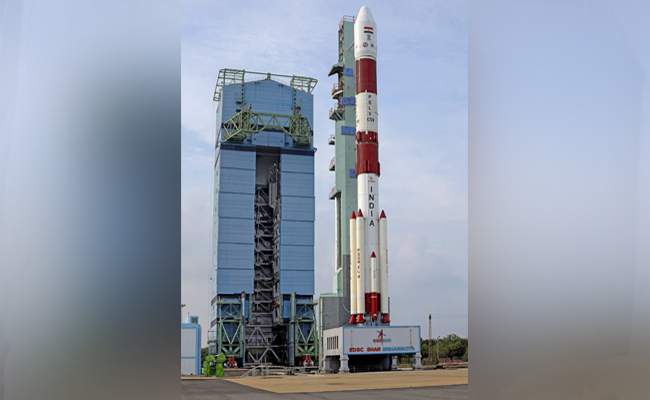
Sriharikota (Andhra Pradesh) (PTI): ISRO on Thursday commenced a revised 8.5 hour countdown for the launch of the European Space Agency's Proba-3 mission.
The Bengaluru-headquartered space agency had originally planned to launch European Space Agency's (ESA) Proba-3 at 4.08 pm on Wednesday from the spaceport here. However, minutes before the lift-off, following the request from the European Space Agency, ISRO rescheduled the launch of PSLV-C59/PROBA-3 to December 5, 4.04 pm.
It was rescheduled following an anomaly detected in the satellite propulsion system.
In an update on Thursday, ISRO said, "PSLV-C59/PROBA-3 Mission. Countdown commenced. Lift-off time 16.04 pm IST, 5th December 2024. Stay tuned as PSLV-C59 prepares to deploy ESA's Proba-3 satellites into orbit."
NewSpace India Ltd, the commercial arm of ISRO has bagged the order from the ESA.
The Proba-3 (Project for Onboard Anatomy) consists of two satellites -- Coronagraph (310kgs) and Occulter (240kgs) -- in which two spacecraft would fly together as one, maintaining precise formation down to a single millimetre to study the Corona, the Sun's outer atmosphere.
The ESA said the Corona is much hotter than the Sun itself and it is where space weather originates. It is also a topic of widespread scientific and practical interest.
For ISRO, besides providing its trusted workhorse PSLV vehicle for the launch, this mission would provide key insights on taking up scientific experiments on the Sun after its maiden mission--Aditya-L1 which was successfully launched in September 2023.
Proba-3 is a technology demonstration mission funded via the General Support Technology Programme. The instruments onboard the satellites would travel closer to the solar rim for up to six hours at a time and each spacecraft would take up approximately a 19-hour orbit around the Earth.
'Probas' is a Latin word, meaning 'Let's try'.
The mission objective is to demonstrate precise formation flying and the two spacecraft inside the satellites would be launched together in a stacked configuration after the desired orbit level is reached.
PSLV-C59 is a 44.5 metre tall rocket and is on its 61st flight and the 26th with the PSLV-XL variant which is normally used to place heavy satellites.
After the lift-off (4.04 pm) the two satellites (Coronagraph and Occulter) would undertake an 18-minute journey to reach the desired orbit.
The two spacecraft after reaching the preparatory conditions, would fly 150 metres apart (as one large satellite structure) in tandem so that the 'Occulter' spacecraft would block out the solar disk of the Sun enabling 'Coronagraph' to study the corona of the Sun or the surrounding atmosphere, for scientific observation.
Let the Truth be known. If you read VB and like VB, please be a VB Supporter and Help us deliver the Truth to one and all.
Trump says EU has until July 4 to approve last year's trade deal or it will face higher tariffs
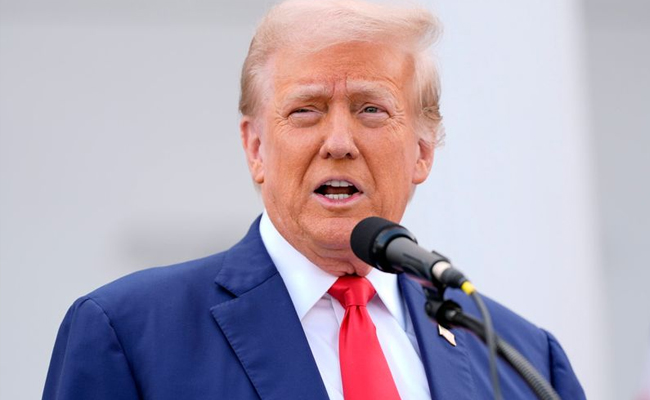
Washington (AP): President Donald Trump has said in a social media post that goods from the European Union would face higher tariff rates if the 27-member bloc fails to approve last year's trade framework by July 4.
The announcement on Thursday appeared to be a deadline extension after the president said last Friday that EU autos would face a higher 25 per cent tariff starting this week. Trump made the updated announcement after what he described as a "great call" with European Commission President Ursula von der Leyen.
Still, the US president was displeased that the European Parliament had yet to finalize the trade arrangement reached last year, which was further complicated in February by the US Supreme Court ruling that Trump lacked the legal authority to declare an economic emergency to impose the initial tariffs used to pressure the EU into talks.
"A promise was made that the EU would deliver their side of the Deal and, as per Agreement, cut their Tariffs to ZERO!" Trump posted. "I agreed to give her until our Country's 250th Birthday or, unfortunately, their Tariffs would immediately jump to much higher levels."
It was unclear from the post whether Trump was implying that the tariff rates would jump on all EU goods or the increase would only apply to autos.
His latest statement indicates he might be backing away from his earlier threat on EU autos by giving the European Parliament several more weeks to approve the agreement.
Under the original terms of the framework, the US would charge a 15 per cent tax on most goods imported from the EU.
But since the Supreme Court ruling, the administration has levied a 10 per cent tariff while investigating trade imbalances and national security issues, aiming to put in new tariffs to make up for lost revenues.