ISRO develops light-weight, innovative nozzle for rocket engines, terms it 'breakthrough'
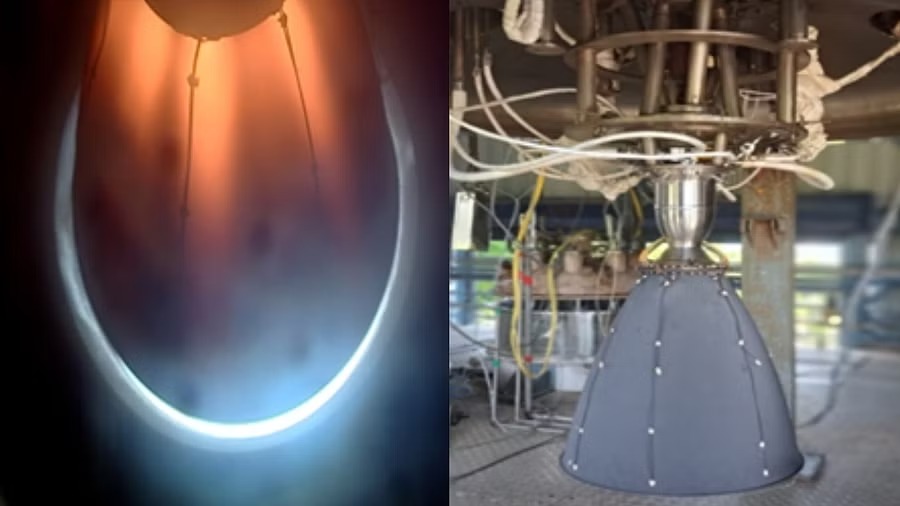
Bengaluru (PTI): ISRO said it has achieved a breakthrough in rocket engine technology with the development of a lightweight Carbon-Carbon (C-C) nozzle for rocket engines, enhancing payload capacity.
This innovation accomplished by the space agency's Vikram Sarabhai Space Centre (VSSC) promises to enhance the vital parameters of rocket engines, including thrust levels, specific impulse, and thrust-to-weight ratios, thereby boosting the payload capacity of launch vehicles, it said.
Thiruvananthapuram-based VSSC leveraged advanced materials like Carbon-Carbon (C-C) composites to create a nozzle divergent that offers exceptional properties, an ISRO statement said.
By utilising processes such as carbonisation of green composites, chemical vapor Infiltration, and high-temperature treatment, it has produced a nozzle with low density, high specific strength, and excellent stiffness, capable of retaining mechanical properties even at elevated temperatures, it said.
A key feature of the C-C nozzle is its special anti-oxidation coating of silicon carbide, which extends its operational limits in oxidising environments. This innovation not only reduces thermally induced stresses but also enhances corrosion resistance, allowing for extended operational temperature limits in hostile environments, according to ISRO.
The potential impact of this development is significant, particularly for the ISRO's workhorse launcher, the Polar Satellite Launch Vehicle (PSLV).
The PS4, the fourth stage of the PSLV, currently employs twin engines with nozzles made from columbium alloy. However, by replacing these metallic divergent nozzles with C-C counterparts, a mass reduction of approximately 67 per cent can be achieved, the space agency said.
This substitution is projected to increase the payload capability of the PSLV by 15 kg, a notable enhancement for space missions.
The successful testing of the C-C nozzle divergent marked a major milestone for ISRO. On March 19, 2024, a 60-second hot test was conducted at the High-Altitude Test (HAT) facility in ISRO Propulsion Complex (IPRC), Mahendragiri in Tamil Nadu, confirming the system's performance and hardware integrity.
"Subsequent tests, including a 200-second hot test on April 2, 2024, further validated the nozzle's capabilities, with temperatures reaching 1216 K, matching predictions," the release said.
The collaborative effort involved the Liquid Propulsion Systems Centre (LPSC) at Valiamala near Thiruvananthapuram which designed and configured the test, and IPRC, which conducted the instrumentation and execution of the tests at its HAT facility, it was noted.
Let the Truth be known. If you read VB and like VB, please be a VB Supporter and Help us deliver the Truth to one and all.
Uttarakhand Assembly passes censure motion against opposition over women's reservation bill
Dehradun (PTI): The Uttarakhand Assembly passed a censure motion against the Congress and other opposition parties on Tuesday for allegedly blocking the passage of the Constitution (131st Amendment) Bill, 2026, in Parliament.
The motion, which expressed the House's formal disapproval of the opposition's conduct, triggered a massive uproar by Congress members, leading to the adjournment of the House sine die.
Parliamentary Affairs Minister Subodh Uniyal moved the censure motion, citing the "uncooperative attitude" of opposition parties toward the bill seeking 33 per cent reservation for women in legislative bodies.
Addressing a special daylong session convened specifically to discuss "Nari Samman -- Rights in Democracy", Chief Minister Pushkar Singh Dhami said the bill's passage would have benefitted every political party.
Dhami noted that after delimitation, the number of Assembly seats in the hill state would have gone up to 105, with 35 reserved for women. He added that the number of Lok Sabha seats from Uttarakhand would have risen from five to seven or eight.
"The opposition fears that if women from ordinary households enter politics, the shops of dynastic politics run by certain parties will shut down," the chief minister claimed.
He compared the opposition's conduct in Parliament to the assembly in Mahabharat where Draupadi was insulted. Dhami further likened the opposition's behaviour to the "arrogance of Ravan".
The chief minister highlighted his government's initiatives, asserting that Uttarakhand was the first state to implement a Uniform Civil Code (UCC) to protect women's rights. He said the UCC freed Muslim women from practices like "halala", "iddat", polygamy and child marriage.
Leader of Opposition Yashpal Arya questioned the technical feasibility of the bill, calling the ruling Bharatiya Janata Party's (BJP) claims of providing reservation by 2029 "misleading".
He argued that the bill is linked to census and delimitation processes. The Congress leader said the 2026 census would conclude by 2027 and the final data publication would take two more years.
"The delimitation process will take another six years. The actual implementation of this bill is not possible before 2034," Arya said, describing the move as a strategy to protect the BJP's "political ground".
The session also saw high drama outside the Assembly gates, where Congress MLA Virendra Jati staged a protest, demanding the payment of "outstanding" dues to farmers by sugar mills.
Jati arrived at the Assembly's main gate with a tractor-trolley loaded with sugarcane and dumped it on the road. The move brought the traffic to a halt, prompting traffic and security personnel to intervene and clear the area.
Women Congress workers also staged a demonstration against the "anti-people policies" of the state government.