ISRO hits ton in style with successful navigation sat mission
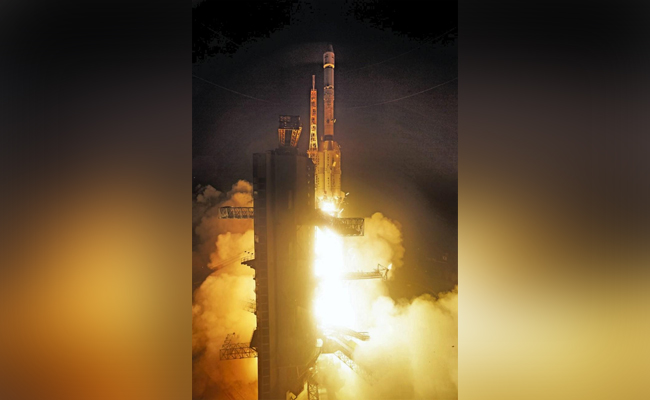
Sriharikota (PTI): ISRO on Wednesday celebrated its 100th mission with the textbook launch of a navigation satellite that would aid in terrestrial, aerial and maritime navigation and precision agriculture, among others, with a GSLV rocket injecting the payload in the desired orbit.
The early morning launch was the first under ISRO Chairman V Narayanan's leadership--he assumed office on January 16--and also the space agency's maiden venture in 2025.
A beaming Narayanan was hugged and greeted by fellow scientists post the launch.
"I am extremely happy to announce from the spaceport of ISRO, that the first launch of this year, 2025, has been successfully accomplished, with GSLV- F15 launch vehicle precisely injecting the navigation satellite NVS-02 in the intended required (GTO) orbit," he said from the Mission Control Center.
"This mission is the 100th launch from our launchpads, which is a very significant milestone of India," the ISRO chief added.
Further, all the vehicles systems have performed as expected in today's mission.
Earlier, as the 27.30-hour countdown concluded, the 50.9 metre tall Geosynchronous Satellite Launch Vehicle (GSLV) rocket with an indigenous cryogenic upper stage, emanating thick fumes on its tail lifted off majestically from the second launch pad at a prefixed time of 6.23 am on Wednesday.
After travelling for about 19 minutes in dark and cloudy skies, the rocket successfully separated its payload into the desired Geosynchronous Transfer Orbit (GTO).
The satellite is the second in the series of the Navigation with Indian Constellation (NavIC) aimed to provide accurate position, velocity and timing to users in the Indian sub-continent as well as to regions about 1,500 km beyond the Indian land mass. Its predecessor, NVS-01, the first of the second generation navigation satellites was launched on May 29, 2023.
The key applications of the NVs-02 satellite are terrestrial, aerial and maritime navigation, precision agriculture, fleet management, location based services in mobile devices, orbit determination for satellites, Internet-of-Things (IoT) based applications and emergency and timing services, ISRO said.
NavIC comprises five second generation satellites--NVS-01/02/03/04/05 envisaged to augment NavIC base layer constellation with enhanced features for ensuring continuity of services.
The NVS-02 satellite designed and developed by Bengaluru-based U R Rao Satellite Centre weighs about 2,250 kg. It has navigation payload in L1, L5 and S bands and employs a Tri-band antenna.
The heart of the navigation payload is the Rubidium Atomic Frequency Standard (RAFS), an atomic clock which acts as a stable frequency reference for the navigation payload.
In his address, Narayanan detailed ISRO's journey.
"Our space programme was conceived and started by the visionary leader Prof Vikram Sarabhai and taken forward by generations of leaders--couple of senior leaders are right now available in the VIP gallery," he said, pointing out to former ISRO chiefs, including S Somanath and AS Kiran Kumar.
So far, ISRO has developed six generations of launch vehicles, with the first one taking shape under the guidance of Prof Satish Dhawan and with former President APJ Abdul Kalam as the project director, in 1979. It was SLV-3 E1/Rohini Technology payload.
"From that, till today, including today, we have accomplished 100 launches from these launchpads. Over these 100 launches, we have lifted 548 satellites to orbits...we have lifted totally 120 tonnes of payload including 23 tonnes of 433 foreign satellites," Narayanan informed.
The launch site here has witnessed several significant milestones of the Indian space programme, including three Chandryaan missions, Aditya L1 mission, a single rocket placing 104 satellites in the orbit and a host of communication, earth observation and navigation satellites.
"On behalf of the present generation of ISRO leaders, I salute all the previous generation of leaders, the past and present employees and our family members, industrial and academia partners for their since efforts, hardwork and dedication that enabled us to accomplish this mission," he said.
He thanked the political leadership for the encouragement and support provided throughout the space programme.
The NavIC system was evolving as the backbone of indigenous satellite navigation ecosystem of the Indian region.
"The NVS-02 satellite incorporates the second indigenous Atomic clock, which is a shining example of Make in India in the critical technology development".
"Today, many applications based on NavIC, spanning from strategic uses, tracking of shipping vessels, time syncronisation, train tracking and safety of life alert dissemination are accomplished," he said.
The future launches include NISAR with NASA.
"Concurrently you all know, we are progressing extremely well for the preparation of the uncrewed G1 mission as part of the Gaganyaan programme and some more experiments are targeted this year," he said
"I think we are accelerating the activities this year. Let me thank our Prime Minister Narendra Modiji for his visionary leadership in rolling out the space sector reforms and what he has given for the next 20 years for ISRO and DoS (Department of Space) to make this country as a developed country." he said.
Let the Truth be known. If you read VB and like VB, please be a VB Supporter and Help us deliver the Truth to one and all.
IPL: BCCI bans "unauthorised" entries in players' rooms; warns of honey traps, security risk
New Delhi (PTI): Warning of potential "honey traps, legal liability and security risks", the BCCI has banned unauthorised visitors from the hotel rooms of players, support staff and team officials in the IPL after incidents of "misconduct and protocol violations" were flagged by the Board's Anti-Corruption Unit.
In an elaborate advisory for the 10 IPL franchises, the BCCI has said that written authorisation from the team managers would be a must for guests to have access to the players' and officials' rooms.
"The advisory has been issued in light of certain incidents observed during ongoing season and is intended to reinforce the standards of professionalism, discipline, security awareness and protocol compliance expected from all stakeholders associated with IPL," BCCI secretary Devajit Saikia said in a communication to the CEOs of the franchises, a copy of which is in possession of PTI.
"It has come to the attention of the BCCI that certain incidents of misconduct and protocol violation have occurred involving players, support staff and team officials during the course of the current IPL season.
"These incidents if left unaddressed, carry the potential to cause significant reputational harm to the tournament, the franchise concerned and the BCCI as the Governing Body. They may further expose individuals and franchises to legal liability and security risks of serious nature," he went on to warn in the preamble of the document.
The Board noted that certain players and support staff members have permitted unauthorised persons to access their hotel rooms without the knowledge or approval of the concerned Team Manager.
"In a number of instances, Team Manager was entirely unaware of the presence of such visitors. The practice is strictly prohibited with immediate effect," the notification ordered.
All players and support staff have now been given a Standard Operating Procedure (SOP) that needs to be followed for the duration of the tournament.
"No guest shall be escorted to private hotel rooms unless Team Manager has specifically authorised the same in writing. The BCCI draws attention to all franchises to the well documented risks of targeted compromise and honey trapping that pervade high profile sporting environments.
"The possibility of incidents giving rise to serious legal allegations, including those under applicable Indian laws on sexual misconduct cannot be discounted. IPL franchises must remain vigilant and proactive in mitigating such risks at all times," the Board stated.
It also banned players and support staff from leaving team hotels at "irregular hours" without informing their designated Security Liaison Officer (SLO) and Team Integrity Officer (TIO).
Saikia said periodic checks might be conducted by the BCCI or the IPL Operations Team to ensure compliance with the guidelines and breaches would invite sanctions ranging from financial penalties to suspension or disqualification of the concerned player, support staff and team official.
Owners barred from player interaction during games
================================
The document also highlighted breaches by unspecified team owners, alleging that they have not maintained the sanctity of Players' And Match Officials Access (PMOA).
"Specifically instances have been observed of IPL franchises owners attempting to communicate with, approach, hug, or otherwise physically interact with players during live match situations.
"Such conduct however well-intentioned, directly contravenes established protocol and may constitute interference with team dynamics and match proceedings," the Board asserted.
The BCCI has therefore banned owners from interacting with the players while a match is on.
"IPL franchise owners and their representatives are strictly prohibited from communicating with or physically accessing players or team officials in the dugout, dressing room or playing area during course of the match, except through designated and approved channels.
"All franchise owner level access to restricted zones must strictly conform to the PMOA Protocol as communicated by the IPL operations divisions. Any deviation shall be treated as serious violation."
Prohibition of Vaping
==============
Rajasthan Royals skipper Riyan Parag was seen vaping in the dressing room balcony during a match, causing a uproar. Without naming Riyan, Saikia said indulging in a banned activity as per Indian law will not be tolerated by the Board.
"It is pertinent to note that vapes and electronic cigarettes is prohibited under applicable Indian Law.
"Any individual found engaging in such conduct within tournament premises is not only violating BCCI and IPL regulations but may also be committing a cognisable offence under applicable statutory framework," he said.
"Accordingly the use of vapes, e-cigarettes, and all prohibited substances is strictly banned within all IPL tournament venues, including dressing rooms, dugouts, team hotels and practice facilities."