ISRO plans mission to Venus, eyes Dec 2024 launch window

New Delhi, May 5: After sending missions to the Moon and Mars, ISRO is now readying a spacecraft to orbit Venus to study what lies below the surface of the hottest planet in the solar system and also unravel the mysteries under the sulfuric acid clouds enveloping it.
Addressing a day-long meeting on Venusian science, ISRO Chairman S Somnath said the Venus mission has been conceived, project report has been made and money has been identified, and urged scientists to focus on high impact outcomes.
"Building and putting a mission on Venus is possible for India in a very short space of time, as the capability today exists with India," Somnath said in his inaugural address.
The space agency is eyeing the December 2024 window for launch with orbital maneuvers planned for the following year when earth and Venus would be so aligned that the spacecraft could be put in the neighbouring planet's orbit using a minimum amount of propellant. The next similar window would be available in 2031.
Indian Space Research Organisation (ISRO) Chairman Somnath cautioned against repeating experiments conducted by previous missions to Venus and focus on unique high impact outcomes as were achieved by the Chandrayaan-I and the Mars Orbiter Mission.
"Goal is to review that unique additional knowledge observation can be done and see that we are not repeating what all has already been done. Repeating some of them is not a crime but if we bring uniqueness, it will have an impact globally, he said.
Among the experiments planned include investigation of the surface processes and shallow sub-surface stratigraphy, including active volcanic hotspots and lava flows, studying the structure, composition and dynamics of the atmosphere and investigation of solar wind interaction with Venusian Ionosphere.
A key instrument on the spacecraft will be the high resolution synthetic aperture radar to examine the Venusian surface, which is covered by dense clouds that make it impossible to view the planet's surface.
"No prior observation of the sub-surface of Venus has been done. So, we will be flying the sub-surface radar for the first time. It will penetrate the sub-surface of Venus upto a few hundred meters," T Maria Antonita, Space Science Programme Officer, ISRO, said in her presentation at the virtual meet.
The mission will also bring an instrument to Venus to examine the planet's atmosphere in infrared, ultraviolet and submillimeter wavelengths, she said.
Let the Truth be known. If you read VB and like VB, please be a VB Supporter and Help us deliver the Truth to one and all.
Congress using hijab issue to pacify minority anger, alleges Karnataka LoP R Ashoka
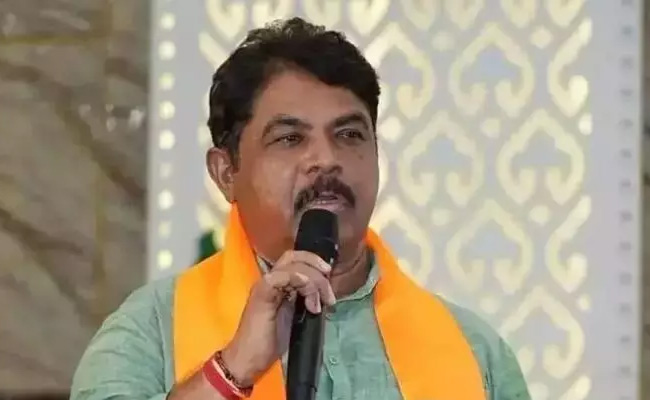
Bengaluru: Leader of Opposition in the Assembly R. Ashoka has accused the Congress government of using the hijab issue to placate what he described as discontent among minority voters after the Davanagere by-election.
In a post on X on Wednesday, Ashoka alleged that the state government, instead of addressing issues such as price rise, corruption, farmers’ distress and law and order, was attempting to retain its minority vote base by reviving the hijab issue.
Referring to the 2022 dress code introduced by the BJP government, which prohibited hijab in schools and colleges, Ashoka said the Karnataka High Court had upheld the policy and emphasised the importance of discipline in educational institutions.
He questioned the Congress government’s move to revisit the issue and asked whether setting aside the court-backed policy to benefit one community could be described as secularism.
Ashoka further alleged that while the government was willing to permit hijab, it continued to prohibit saffron shawls.
He accused the government of dividing students on religious lines rather than treating schools and colleges as spaces of equality.
Drawing a comparison with Mamata Banerjee’s government in West Bengal, Ashoka claimed that excessive appeasement politics had harmed the state and warned that the Congress in Karnataka could face a similar political response.
He said voters in Karnataka would teach the Congress a lesson for what he termed “vote-bank politics” and for compromising constitutional and judicial principles.