ISRO to launch CMS-03 satellite in November, says Chairman Narayanan
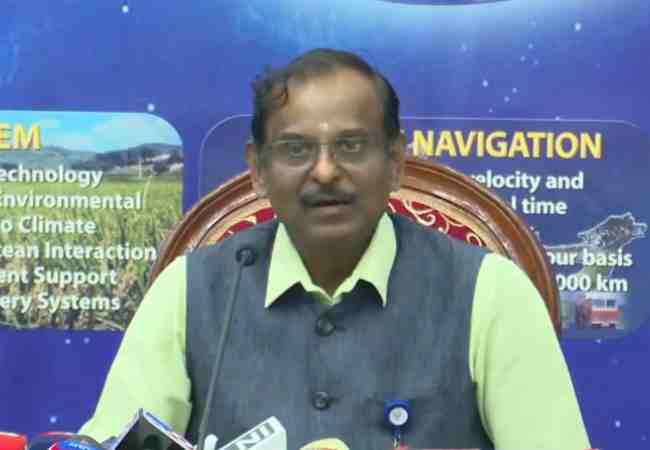
Bengaluru (PTI): ISRO has scheduled two launches of its heavy-lift rocket LVM-3 to place in orbit two satellites -- CMS-03 and private US communications satellite BlueBird--before this year-end, chairman V Narayanan said on Thursday.
Narayanan said the NASA-ISRO Synthetic Aperture Radar (NISAR) satellite, launched on July 30, was currently in the calibration stage and will become operational within 10-15 days.
"The satellite is healthy and both the payloads are working well," he added.
At a press conference to announce the Emerging Science, Technology and Innovation Conclave 2025, the ISRO chief listed out future missions of the space agency and asserted that 90 per cent work on the Gaganyaan project was complete.
The Gaganyaan mission is India’s first human spaceflight mission under development.
"Next month beginning, we are going to have the LVM3-M5 lift off to place a CMS-03 satellite," Narayanan said.
According to ISRO officials, the CMS-03 also known as GSAT7-R is likely to be launched on November 2.
BlueBird-6, a 6.5 tonne satellite of a US firm, is expected to be launched by the year-end, Narayanan said.
"We have received the satellite and are working for the launch, and the launch vehicle build-up is going on," the ISRO Chairman told reporters here.
One of the heaviest commercial satellites, BlueBird-6, arrived in India from the United States on October 19.
Asked about the progress of Chandrayaan-4, the ISRO Chairman said the project is in its design phase.
"Right now, we are working on the design phase and its approved projects. Also establishing the infrastructure that is the basic standard," he said.
The Chandrayaan-4 mission includes bringing back moon rocks and soil to earth after a soft landing on the lunar surface, launching a spacecraft from the moon, demonstrating a space docking experiment in lunar orbit and getting the samples back to earth.
Speaking about NavIC, India's indigenous navigation satellite system, Narayanan said, "We have four satellites and are building three more satellites. Yes, there were setbacks, but we're working on it."
"The NavIC navigation constellation, too, will be completed within 18 months with three new satellites," he added.
Responding to a question on the NVS-02 satellite which had a technical glitch, he said, "The satellite has gone to the elliptical orbit and we could not take it to circular orbit because of a valve malfunction."
The failure analysis committee formed to look into it has completed the investigation and zeroed down on the fault, he said.
"The recommendation of the committee will be placed before the government," he added.
Stating that Prime Minister Narendra Modi has clearly outlined the space mission 2047, the ISRO chief said today, India has around 56 satellites in the orbit serving the common man of this country.
"In another three to four years timeframe, the number of satellites are going to be increased to something around three times and by 2027, we are going to accomplish the Gaganyaan programme," he said.
"We are going to build our own space station called Bharatiya Antariksh Station by 2035 and first module, we have got the project approval and right now the work is going on and it is going to be placed in the orbit by 2028," Narayanan said.
Speaking on the next generation launcher, he said that the capability of the first launch was only 35 kg which was successfully accomplished in the year 1980.
"Today, we are talking about something around 30,000 kg to low earth orbit through the next generation launcher. Also, PM Modi has given a guideline for building a launcher for enabling the crewed lunar mission," the ISRO chief said.
"We are in the conceiving phase. We have not completed the design but it has to lift off something about 75,000 to 80,000 kg type of mass it has to lift off. That is the type of work that is going on," he added.
According to him, till today, around 433 satellites from 34 countries have been accomplished. Out of that, almost 95 satellites were accomplished during the last ten years.
"That means when the entire launch programme started from 1980, in 45 years, the last 10 years is 95 per cent of the foreign satellite launch. That shows the exponential growth of the space sector," he said.
"Initially, we were going through the experimental phase, gradually we moved to operational phase. Today we have exponential growth," Narayanan said.
Let the Truth be known. If you read VB and like VB, please be a VB Supporter and Help us deliver the Truth to one and all.
NCW chief condemns rape-murder of 4-year-old girl in Pune, calls for swift action
New Delhi (PTI): National Commission for Women (NCW) Chairperson Vijaya Rahatkar has condemned the alleged rape and murder of a four-year-old girl in Maharashtra's Pune, calling it "deeply distressing" and a "blot on humanity".
The girl was allegedly raped and killed by a 65-year-old labourer, who has a criminal record, in Bhor tehsil of Pune on Friday. The accused allegedly lured the child to a cattle enclosure on the pretext of giving her food. After raping her, he killed her by hitting her with a stone, according to police.
The accused has been arrested.
In a post on X on Saturday, Rahatkar said the incident in the Nasrapur area in Pune was heartbreaking and has shaken society.
"The brutal torture and murder of a four-year-old innocent girl in Nasrapur (Bhor, Pune) is deeply painful, heartbreaking, and shocking. It is a blot on humanity," she said.
She said Pune Rural police has arrested the accused and noted that Maharashtra Chief Minister Devendra Fadnavis and Deputy Chief Minister Sunetra Pawar have assured strict action in the case.
Rahatkar said the NCW has taken cognisance of the matter and written to the National Commission for Protection of Child Rights (NCPCR), requesting the body to ensure necessary and prompt action.
It has also been recommended that the case be pursued under stringent provisions of the Protection of Children from Sexual Offences (POCSO) Act and be closely monitored from the filing of the chargesheet to proceedings in a fast-track special court to ensure time-bound justice, she added.
Ensuring justice for the victim and stringent punishment for the accused is a collective responsibility, the NCW chairperson underlined.
In a post on X, the NCW said it has taken suo motu cognisance of the extremely "heinous" incident.
"This heinous crime causes profound pain and outrage, and it highlights serious concerns regarding the safety of young girls," it said.
Strongly condemning this grave "inhuman act", the NCW said such crimes constitute a serious violation of children's rights and raise questions about society's security system.