ISRO 'very busy' with various exploration missions in pipeline: Chairman
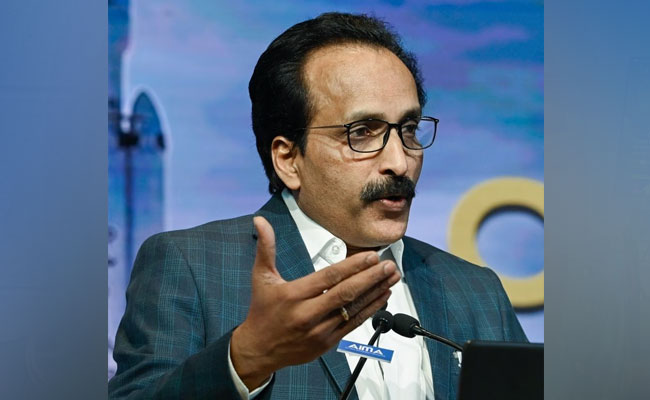
Chennai (PTI): ISRO has lined up a series of exploration missions including to Mars, Venus and to the Moon again, apart from the maiden human spaceflight programme, Chairman S Somanath said.
The space agency also has drawn up plans to launch missions for studying climate and weather conditions of the Earth, the space agency chief said, speaking to reporters on Sunday.
Besides, ISRO is also working on regular scientific missions including communication, remote sensing satellites, Somanath, who is also the Secretary of the Department of Space, said here.
Speaking about the Gaganyaan programme, he said the maiden TV-D1 test flight is scheduled for October 21.
Elaborating about the upcoming missions undertaken by the Bengaluru-headquartered space agency, he said, "We have exploration missions. We have plans to go to Mars, Venus, again sometime to the Moon. We also have programmes to look at the climate and weather of Earth.".
Stressing that the scientists at ISRO would be focused on taking up regular missions like launching satellites for communications and remote sensing, he said scientific missions are also in the pipeline to look at issues like aeronomy, thermal imaging, and climate change impact assessment.
"So many things are there and we are very busy doing all of this," he said.
To a query about whether scientists were able to receive any kind of response from the Vikram lander of the Chandrayaan-3 spacecraft, which successfully made a soft-landing on the surface of the Moon on August 23, he said Vikram had done its job very well during the lunar day (equivalent of 14 Earth days) at which time it was programmed to perform its functions.
"It is happily sleeping on the Moon. It has done its job very well. Maybe if it wishes to wake up, let it wake up. Until then, we will wait," he said. ISRO made efforts to re-establish communication with rover Pragyan and lander Vikram after they were put into sleep mode in September following the onset of night on the Moon.
"No signals have been received from them. Efforts to establish contact will continue," ISRO had said.
After the historic landing on August 23, lander Vikram and rover Pragyan performed different tasks on the lunar surface, including detecting the presence of sulphur and recording relative temperature.
About ISRO's maiden mission to study the Sun, Somanath said the spacecraft is ‘very healthy’ and is on a 110-day long journey to the Lagrange point L1 and is expected to reach the intended destination by “middle of January.”.
"It is a long journey. It is almost 110 days of journey and it has covered some distance now. We corrected a little bit of its trajectory, because early correction is important to reach the L1 point. After tracking, we find it is going in the right direction towards the L1 point," he said.
Observing that the rocket is on a ‘complex travel’, Somanath said, "It takes almost another 70-75 days further to reach. By the middle of January, it will reach there. After that, we will make some corrections to make it enter into the Halo orbit at the L1 point.".
"After that instruments will be switched on and it will start doing the scientific data streaming. Currently, everything is very healthy on Aditya L1," he said.
Aditya-L1 was launched on September 2, and it is the first Indian space-based observatory that will study the Sun from a halo orbit around the first Sun-Earth Lagrangian point (L1), which is located roughly 1.5 million km from the Earth.
Earlier, Somanath visited the residence of renowned agricultural scientist M S Swaminathan, who passed away on September 28. He met the family members of the eminent plant geneticist known as the driving force behind India’s ‘Green Revolution’, here in the city.
"I am here today just to pay my tributes and my affection to his (M S Swaminathan’s) contribution… Whoever works in whichever field whether it is space, agriculture or sustainability and many other domains, we all find a place to work together," he said.
"Thank you so much for the opportunity. His (M S Swaminathan’s) legacy will continue to inspire more young people in the country to work in science and technology." Somanath said.
Let the Truth be known. If you read VB and like VB, please be a VB Supporter and Help us deliver the Truth to one and all.
AIITA welcomes Karnataka’s ban on obscene songs in school events
Bhatkal: The Karnataka unit of the All India Ideal Teachers Association (AIITA) has welcomed the Karnataka government’s decision to strictly ban school children from dancing to obscene songs during educational and cultural programmes in government, aided, and private schools across the state.
AIITA Karnataka State President M. R. Manvi congratulated the government for taking what he termed an important step to preserve the sanctity of education.
“Such decisions to safeguard the dignity of school children and uphold the values of education are the need of the hour. This rule should not be limited to government schools alone but must be strictly implemented in all private educational institutions as well,” he said.
He further urged the government to address other concerns within school programmes.
“The government should not only prohibit obscene dances in the name of school anniversaries, but also ensure that plays and dialogues that incite religious hatred are avoided. Schools should be centres of harmony, not platforms for spreading hatred,” he added.
According to a recent circular issued by the Department of School Education and Literacy, obscene dances are adversely affecting the mental health and moral values of students.
In this regard, schools have been advised to use songs that promote nationalism, positive thinking, the greatness of Kannada culture, and value-based traditions instead of inappropriate content during programmes.
The circular also emphasises that students should be dressed in decent attire.
AIITA also backed the department’s warning that disciplinary action would be taken against head teachers if such guidelines are violated. The association has further demanded that district Deputy Directors of Public Instruction strictly monitor the implementation of these rules.